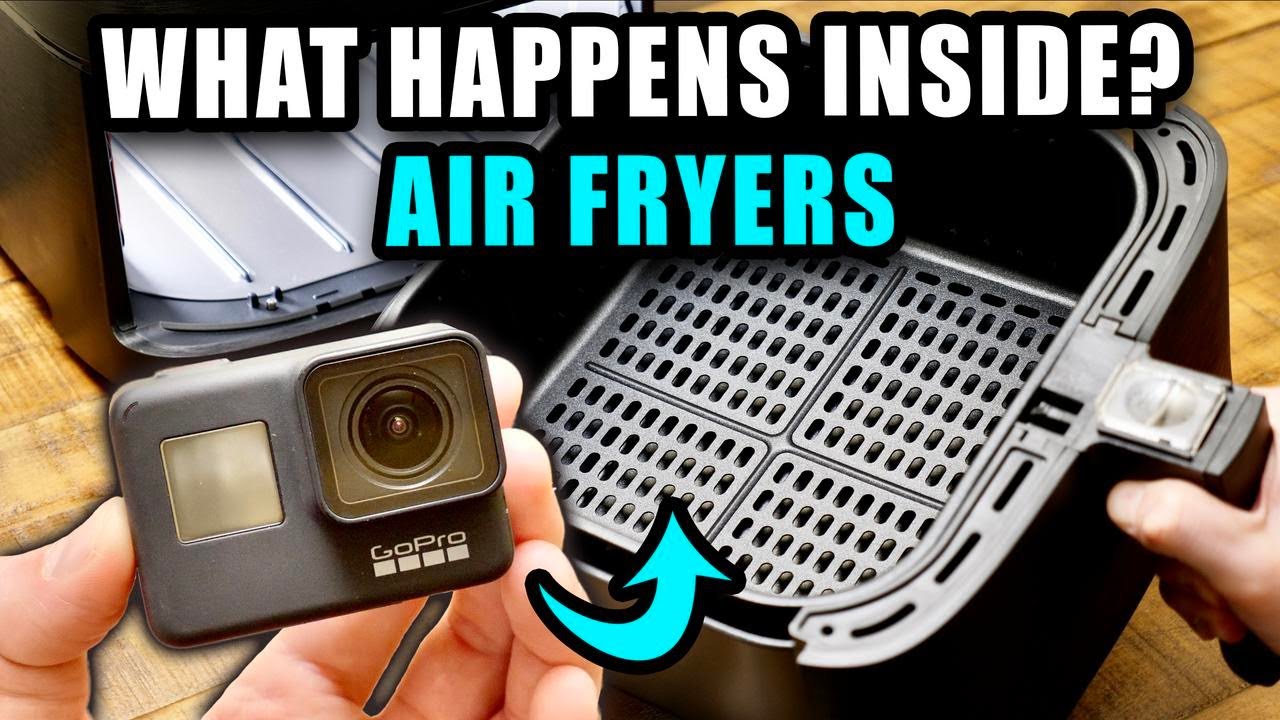
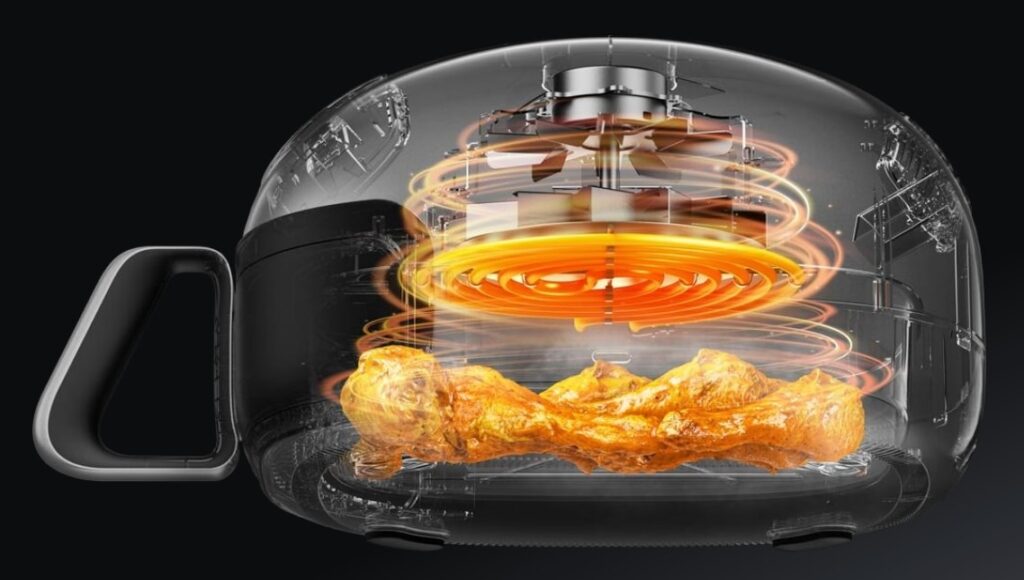
The inside of a typical basket-style air fryer contains a perforated food basket or crisper plate, a cooking chamber, a heating element near the top, and a fan that rapidly circulates hot air around the food.
If you open a common countertop air fryer in a U.S. kitchen and pull out its drawer, you will not find a hidden vat of oil or a complicated miniature oven. The visible cooking area is usually a compact chamber designed around one simple process: an electric heating element produces heat while a fan moves that hot air rapidly around a perforated basket.
The exact appearance varies by model. Basket-style air fryers generally place the heating system above the food, while air-fryer toaster ovens can use rear or top heating elements, racks, trays, and a larger oven-like cavity. Some models also use different airflow channels, shields, temperature sensors, or specialized basket designs. The manufacturer’s manual is therefore the best source for the exact internal layout of a particular appliance.
A conventional basket-style air fryer is essentially a compact forced-convection cooking appliance. Its internal design centers on moving heated air through a relatively small cooking space. The main components you can see or identify are the cooking chamber, food basket or crisper plate, heating element, fan, airflow openings, and lower pan or drawer.
Behind the visible components are additional parts that vary by model, including temperature sensors, thermostats or electronic temperature controls, thermal protection devices, wiring, a control board, and the motor that drives the fan. These parts are generally enclosed and are not intended to be accessed during normal cleaning or use.
The important distinction is between the cooking area and the appliance’s mechanical or electrical compartment. The cooking area is where food and hot air interact. The enclosed area above, behind, or around it contains components that should normally remain protected inside the appliance housing.
Source: Bing
Heating element
An electric resistance heating element produces the heat used to raise the temperature of the circulating air and cook the food.
Fan
A powered fan moves air rapidly through the cooking chamber, helping transfer heat around the food.
Food basket or crisper plate
The perforated basket or tray holds the food while allowing hot air to pass around and beneath it.
Cooking chamber
This is the enclosed space in which the hot air circulates around the food.
Lower pan or drawer
In many basket-style designs, the lower section supports the basket and catches drippings, crumbs, and other cooking residue.
Does an Air Fryer Have a Heating Coil Inside?
Most conventional basket-style air fryers use an electric heating element positioned near the cooking chamber, commonly above the food. It may look like a metal coil, tubular element, or another enclosed heating structure depending on the appliance. The element is controlled by the air fryer’s temperature-control system and cycles as needed to maintain the selected cooking conditions.
The element is not normally something you should touch, remove, bend, scrape, or attempt to repair yourself. Its position also explains why grease and food particles can sometimes accumulate in the upper interior of an air fryer, especially when food is cooked frequently or when the basket is overfilled.
Typical appearance
It may resemble a compact metal coil or tubular heater located near the top of a basket-style cooking chamber.
Purpose
It converts electrical energy into heat that warms the air moving through the appliance.
Safety boundary
Do not handle the heating element while the appliance is hot, powered, or otherwise outside the cleaning procedure specified by the manufacturer.
Where Is the Fan in an Air Fryer?
In many basket-style air fryers, the fan is located above or close to the heating element. It is usually protected by a cover or grille rather than being exposed like the fan in an ordinary room appliance. Its job is to drive heated air around the food at relatively high speed.
The fan is one of the most important reasons an air fryer can produce a crisp surface. Instead of relying mainly on relatively still hot air, the appliance forces moving hot air across the food. This promotes rapid heat transfer and helps remove moisture from the food surface.
Fan location
The exact position varies, but many basket-style designs place the fan near the upper cooking area.
Fan protection
A cover or guard normally separates the moving fan from the food compartment.
Air movement
The fan helps circulate heated air through and around the basket rather than leaving hot air relatively stagnant.
What Does the Cooking Chamber Look Like?
The cooking chamber is the open interior that becomes visible when you remove the basket or drawer. In a typical basket-style air fryer, it looks like a compact metal or coated cavity shaped to guide airflow around the basket. Its exact shape can be rounded, rectangular, or specially contoured depending on the manufacturer.
At the top of the chamber, you may be able to see the heating element or a protective structure around it. At the bottom, there is usually a support surface, pan, or airflow channel beneath the removable basket. The walls can contain openings or contours designed to direct air through the cooking space.
The chamber is intentionally much smaller than a conventional oven cavity. A smaller cooking volume means the appliance has less air to heat and can concentrate the circulating airflow around the food. This compact arrangement is a major part of how basket-style air fryers work.
Source: Bing
Top area
Often contains or protects the heating element and is associated with the fan and hot-air circulation system.
Side walls
Help contain and guide circulating air around the food basket.
Bottom area
Supports the basket or crisper plate and provides space for airflow and collection of drippings.
Rear or upper vents
Many appliances have designed air inlet and exhaust pathways, although their positions differ between models.
What Does the Bottom of an Air Fryer Look Like Inside?
When the removable basket or crisper plate is taken out, the bottom usually looks more like a collection area and airflow space than a traditional frying pan. Depending on the design, you may see a solid lower pan, raised supports, channels, grooves, or openings associated with airflow.
The removable basket generally sits above this lower area so that food is separated from accumulated drippings. This arrangement also gives heated air access to the underside of food through openings in the basket or crisper plate.
Under the basket
The lower space commonly provides room for drippings and helps support the basket.
Airflow openings
Perforations or gaps can allow hot air to move beneath the food.
Residue
Grease, crumbs, moisture, and food particles can collect in the lower pan during cooking.
What Does a Basket Look Like Inside an Air Fryer?
The basket is usually the most recognizable internal component. It is a removable container with a perforated bottom, mesh surface, or specially designed crisper plate. The openings are there for airflow, not simply to make the basket lighter.
Food rests above the lower collection area, allowing hot air to contact more of its surface. This is why covering the entire basket with a solid layer of food or using an improperly sized accessory can change cooking performance: the air has fewer pathways through the food.
Perforations
Small openings allow heated air to move around and beneath the food.
Raised cooking surface
Some baskets use a raised or removable crisper plate to create space below the food.
Handle and drawer
Basket-style models commonly allow the user to remove the food compartment without reaching into the hot cooking chamber.
How Does Air Move Around Inside an Air Fryer?
The airflow pattern is the key to understanding what you are seeing inside an air fryer. In a typical basket-style design, the fan moves air across or around the heating element and then drives the heated air into the cooking chamber. The air travels around the food, passes through openings in the basket, and returns through the appliance’s airflow pathway to be reheated and circulated again.
The precise path is model-dependent. Some appliances use specially shaped cooking chambers, curved surfaces, star-shaped bases, rear channels, or other features intended to distribute air. It is therefore more accurate to think of the appliance as having a designed circulation loop rather than assuming every air fryer sends air in exactly the same direction.
As hot air moves over food, moisture at the surface evaporates. The moving air also continually replaces the humid air immediately surrounding the food with hotter, relatively drier air. This combination of heat and airflow helps create the browned and crisp exterior associated with air frying.
Source: Bing
Step 1: Air enters the system
Room air is drawn into the appliance through its designed intake pathway.
Step 2: Air encounters the heating system
The heating element adds thermal energy to the air and surrounding cooking environment.
Step 3: The fan drives circulation
The fan pushes or draws air through the cooking chamber according to the model’s airflow design.
Step 4: Hot air contacts the food
Moving heated air transfers energy to the food and helps remove surface moisture.
Step 5: Air recirculates and exhausts
Much of the air can be circulated again, while designed vents allow heat, moisture, and some air to leave the appliance.
Why Does the Food Basket Have Holes?
The holes are essential to the air fryer’s cooking method. They give moving hot air access to the underside and sides of the food rather than allowing the food to sit on a completely solid surface. This increases exposure to circulating air and helps moisture escape.
However, more airflow does not mean that food should always be spread into a single microscopic layer. The correct arrangement depends on the food and the model. Small foods such as fries can often benefit from being shaken or turned during cooking, while larger pieces may need space around them for air to circulate effectively.
Better airflow
Openings provide pathways for hot air to reach surfaces that would otherwise be blocked by a solid tray.
Crisping
Moving hot air helps dry the food surface and supports browning.
Even cooking
Adequate space between food pieces generally gives the airflow more opportunity to contact the food.
What Other Parts Are Hidden Inside the Air Fryer?
What you see in the cooking chamber is only part of the appliance. An air fryer also contains electrical and control components that are normally enclosed by the exterior housing. These components allow the appliance to regulate temperature, operate the fan, control cooking time, and provide protection against abnormal conditions.
A temperature sensor is particularly important because the appliance needs feedback about its thermal environment. Depending on the design, the sensor and control system can regulate the heating element by switching it on and off or otherwise adjusting how the appliance operates.
There can also be thermal protection components, electrical connections, a fan motor, control electronics, and user-interface components. These parts are not universal in exact design or location, so the owner’s manual and service documentation should be used for model-specific information.
Source: Bing
Temperature sensor
Measures temperature for the appliance’s control system so heating can be regulated.
Fan motor
Provides the mechanical power needed to rotate the circulation fan.
Control electronics
Process settings such as time and temperature and coordinate the appliance’s operating functions.
Thermal protection
Many appliances include protective components intended to reduce risk from excessive temperatures or abnormal operation.
Electrical wiring and connections
Carry electrical power between the control system, heating system, motor, sensors, and other components.
Is the Inside of an Air Fryer Supposed to Be Completely Empty Above the Basket?
No. The space above the basket is where important operating components are commonly located. In a typical basket-style design, the heating element and fan system occupy the upper portion of the appliance. You may see the heating element directly, or you may see a protective cover or shield instead.
Because this area is part of the heating and airflow system, it should not be treated like an ordinary storage space. Do not put utensils, paper, plastic, loose accessories, or other objects into the upper cavity unless the manufacturer specifically designed the appliance for that use.
Normal
Seeing a heater, protective shield, airflow opening, or fan guard above the basket can be normal.
Not normal use
Using the upper cavity to store objects or placing materials near the heating element can create a safety problem.
When unsure
Check the exact owner’s manual rather than assuming that a visible part is safe to touch, remove, or reposition.
How Is an Air Fryer Different From a Regular Oven Inside?
An air fryer and a convection oven use related cooking principles, but the internal layouts are not identical. A basket-style air fryer is much smaller and is designed to push heated air aggressively around food in a compact chamber. A full-size oven has a larger cavity and can accommodate racks, baking sheets, roasting pans, and much larger foods.
The phrase air fryer can also describe more than one physical design. Basket-style models usually have a pull-out drawer and perforated basket. Air-fryer toaster ovens look more like compact ovens and may have a front door, multiple racks, baking trays, a crumb tray, and heating elements in more than one location.
That distinction matters when someone asks what the inside of an air fryer looks like. There is no single universal internal shape. The basket-style configuration is the most familiar, but an oven-style air fryer can look substantially different.
Source: Bing
Basket-style air fryer
Usually has a pull-out basket or drawer, a compact cooking chamber, and a heating and fan assembly positioned near the upper cooking area.
Air-fryer toaster oven
Typically has a front-opening door, racks or trays, and an oven-like cavity with a different airflow and heating arrangement.
Dual-basket air fryer
Uses two cooking compartments or drawers and may have separate airflow paths or independently controlled zones.
Model-specific designs
Manufacturers can use specialized chambers, heating systems, fans, shields, and airflow channels that change the appearance of the interior.
Can You See the Heating Element When the Basket Is Removed?
Often, yes, but not always. In many basket-style models, removing the drawer exposes the upper cooking chamber and makes the heating element or its protective cover visible. Other designs may conceal much of the heating system behind a guard or use a different arrangement.
If the visible component looks dirty, do not automatically assume that scraping it is the correct solution. Grease and residue should be removed according to the appliance’s cleaning instructions. The heating element, fan guard, sensors, and electrical areas can be damaged by aggressive tools, excessive water, or improper disassembly.
Visible heater
A metal heating element or coil may be visible above the basket in some models.
Protected heater
A metal shield or guard may cover the element in other models.
Different architecture
Oven-style and specialized air fryers can position heating elements differently.
What Should a Clean Air Fryer Interior Look Like?
A clean air fryer interior should be free of significant food debris, excessive grease buildup, and residue that could interfere with normal use. It does not necessarily need to look factory-new after every cooking session. Small amounts of discoloration or staining can develop with use, especially on surfaces exposed to heat and food vapors.
The removable basket, crisper plate, and lower pan generally receive the most direct food contact and should be cleaned according to the manufacturer’s instructions. The upper interior deserves attention too because grease and cooking residue can accumulate near the heating element and fan guard.
The most important rule is to avoid turning routine cleaning into appliance disassembly. Users should generally clean only the parts and areas that the manufacturer identifies as user-serviceable. If grease has entered an enclosed motor, electrical compartment, or inaccessible area, professional service may be more appropriate than attempting to open the housing.
Source: Bing
Remove loose crumbs
Clear visible food debris from the basket, lower pan, and accessible cooking surfaces after the appliance has cooled.
Clean removable components
Wash the basket, crisper plate, or pan using the method allowed by the manufacturer’s instructions.
Inspect the upper area
Look for grease or food residue around the heating element or protective guard without touching hot components.
Keep electrical areas dry
Do not pour or spray water into areas containing electrical or mechanical components unless the manufacturer specifically permits that cleaning method.
Follow the model manual
Cleaning procedures, dishwasher compatibility, detergents, and permitted tools vary between air fryers.
Can You Wash the Inside of an Air Fryer With Water?
Do not assume that the entire interior can be washed with running water. Removable cooking components may be washable, but the fixed cooking chamber and areas containing electrical or mechanical parts require the manufacturer’s specific cleaning method.
A safer general approach is to switch off the appliance, disconnect power when the manufacturer’s procedure calls for it, allow it to cool completely, remove the washable components, and clean only the surfaces and parts identified in the instructions. Never immerse the main appliance housing unless the manufacturer explicitly states that it is designed for immersion.
Safe starting point
Turn the appliance off and let hot components cool before cleaning.
Use the manual
The manufacturer’s cleaning instructions determine which components can be washed, soaked, or placed in a dishwasher.
Avoid flooding
Keep water away from electrical, motor, control, and other non-washable components.
Why Does My Air Fryer Have Grease Near the Heating Element?
Grease near the upper cooking area can result from normal cooking, particularly when fatty foods release oil and vapors into the circulating air. The fan can move these vapors around the cooking chamber, allowing some residue to settle on nearby surfaces.
Heavy buildup, smoke, persistent burning smells, or repeated flare-ups should not simply be dismissed as normal. Stop using the appliance if you see a potentially dangerous condition, allow it to cool safely, and consult the manufacturer’s instructions or customer service before using it again.
Normal residue
Some grease accumulation can occur during ordinary cooking, especially with fatty foods.
Heavy buildup
A thick layer of grease or food residue should be cleaned according to the manufacturer’s instructions before continued use.
Persistent smoke
Unusual or excessive smoke, burning odors, sparks, or other abnormal behavior warrants stopping use and investigating the cause safely.
What Should You Never Touch or Put Inside an Air Fryer?
The cooking chamber is accessible for normal loading and cleaning, but that does not mean every internal component is user-serviceable. The heating element, fan assembly, sensors, wiring, motor, and electrical controls should not be treated as ordinary removable parts.
You should also avoid placing loose materials where they can contact the heating element or interfere with airflow. Paper, plastic, lightweight packaging, and other materials not approved for the appliance can move during operation or become exposed to high heat.
If an air fryer has a problem such as sparking, exposed wiring, damaged insulation, a damaged heating element, unusual electrical smells, or repeated overheating, stop using it. Do not continue operating the appliance simply because it still turns on.
Source: Bing
Do not touch hot components
The heating element, metal surfaces, basket, and surrounding areas can remain very hot after a cooking cycle.
Do not reach into a running appliance
The fan and heating system can create a burn or mechanical hazard.
Do not obstruct airflow
Overfilling the basket or blocking designed openings can interfere with cooking performance and appliance operation.
Do not disassemble casually
Opening the appliance can expose electrical components and may create additional safety risks or affect warranty coverage.
Do not use damaged components
Replace damaged baskets, cords, plugs, or other parts with manufacturer-approved components when available rather than improvising repairs.
Why Is Overcrowding the Basket a Problem?
Overcrowding can restrict the movement of hot air around the food. That can lead to less consistent browning and may contribute to uneven cooking. USDA guidance specifically recommends avoiding overfilling an air fryer because limited space can interfere with adequate air circulation and cooking.
The practical solution is often to cook in batches when the food needs substantial airflow. A smaller amount of food with space between pieces can give the circulating air better access to the surfaces that need to brown.
Uneven browning
Pieces packed tightly together can shield one another from moving hot air.
Uneven cooking
Restricted airflow can make cooking less consistent, particularly when pieces vary in size.
Better approach
Use batches when necessary and follow the food quantity limits or recommendations in the appliance manual.
How the Inside of an Air Fryer Affects Cooking Results
The internal arrangement directly affects how food cooks. The heating element provides the thermal energy, the fan supplies moving air, and the perforated basket exposes food to that airflow. The size and shape of the chamber determine how effectively the appliance can circulate air around the amount of food inside.
This is why two air fryers set to the same displayed temperature can produce somewhat different results. Wattage, chamber geometry, fan design, basket shape, food quantity, food temperature, moisture content, and the exact cooking program can all affect the result.
For practical cooking, the internal design also explains why recipes often recommend shaking, turning, or leaving space between food pieces. Those actions help more surfaces encounter the moving hot air.
Source: Bing
Heat
The heating element supplies the thermal energy required for cooking.
Airflow
The fan distributes heated air and influences how quickly heat reaches the food surface.
Surface exposure
Basket perforations and spacing determine how much of the food is exposed to circulating air.
Food quantity
Adding too much food can reduce airflow around individual pieces.
Food geometry
Thick, thin, flat, irregular, wet, and dry foods respond differently to the same airflow and temperature.
Why Does an Air Fryer Make Food Crispy?
An air fryer does not create crispness by submerging food in hot oil. Instead, its heating element and fan create a hot, moving-air environment that transfers heat to the food while helping moisture leave the surface. As the surface dries and becomes hot enough, browning reactions can occur and produce the characteristic crisp, browned exterior.
The result depends on the food itself. A wet batter, a crowded basket, or a food with a naturally high moisture content may not crisp in exactly the same way as a thin, dry surface. The air fryer can encourage browning and surface drying, but it cannot make every food behave like a deep-fried product.
Moving hot air
Rapid circulation increases contact between heated air and the food surface.
Moisture loss
Surface water evaporates as the food heats, helping the exterior become drier.
Browning
High surface temperatures and reduced surface moisture support browning reactions that contribute to color and texture.
How to Inspect the Inside of an Air Fryer Safely
If you want to see what is inside your air fryer for routine cleaning or inspection, you generally do not need to take the appliance apart. A simple visual inspection of the accessible cooking chamber is enough to identify most food residue, grease buildup, damaged basket surfaces, or obvious debris.
Start with the appliance switched off and cooled. Remove the basket or drawer according to the normal operating procedure. Look at the upper heating area, cooking chamber walls, lower pan, and basket. Check for excessive residue, foreign objects, damaged coatings, or anything that looks different from the manufacturer’s documented design.
If you notice an internal component that appears loose, broken, burned, melted, or electrically damaged, do not attempt to bend it back into place or continue using the appliance as though nothing happened. Consult the manual or manufacturer for the appropriate service procedure.
Source: Bing
1. Turn it off
Stop the cooking cycle and follow the manufacturer’s instructions for disconnecting power.
2. Let it cool
Wait until the appliance and removable components are cool enough to handle safely.
3. Remove the basket
Take out the drawer, basket, rack, or tray using the normal removal procedure.
4. Inspect without disassembly
Look at accessible areas around the basket and upper cooking chamber without opening the appliance housing.
5. Clean according to instructions
Use only the cleaning methods and products permitted by the manufacturer.
6. Stop if damage is found
Do not operate the appliance if you find serious damage, exposed electrical parts, or another potentially unsafe condition.
What Are Signs Something Inside the Air Fryer Is Wrong?
A small amount of cooking odor or smoke can occur with certain foods, especially when grease or residue is heated. However, persistent heavy smoke, sparks, electrical burning smells, visible arcing, melted components, damaged wiring, or repeated abnormal shutdowns are not conditions to ignore.
If a problem occurs, stop the appliance and follow the manufacturer’s safety instructions. Do not open the electrical housing to diagnose a fault unless you are qualified and the manufacturer specifically provides a service procedure intended for that work.
Potentially concerning
Sparks, exposed wires, melted plastic, electrical burning odors, or repeated overheating should be treated as reasons to stop using the appliance.
Potentially routine
A temporary cooking smell or small amount of vapor can occur depending on the food and cooking conditions.
Best next step
When the behavior is unusual or persistent, consult the model-specific manual or manufacturer support rather than experimenting with internal repairs.
Food Safety Still Matters Inside an Air Fryer
Seeing a browned exterior does not prove that meat or poultry has reached a safe internal temperature. The USDA recommends using a food thermometer rather than relying only on color or appearance. For example, poultry should reach 165°F, ground meats should reach 160°F, and fish should reach 145°F.
Air circulation is important for cooking performance, but it does not replace temperature measurement when food safety depends on reaching a specific internal temperature. The same principle applies whether the food is cooked in an air fryer, conventional oven, skillet, or another appliance.
Avoid cross-contamination by keeping raw meat and poultry separate from ready-to-eat foods and by cleaning food-contact surfaces appropriately. If cooked perishable food is left at room temperature for too long, the air fryer’s cooking chamber cannot make that storage condition safe retroactively.
Source: Bing
Poultry
Cook poultry to a minimum internal temperature of 165°F as measured with a food thermometer.
Ground meat
Cook ground beef, pork, lamb, and veal to at least 160°F.
Beef, pork, lamb, and veal steaks, chops, and roasts should reach 145°F and rest for at least 3 minutes.
Fish and shellfish
Cook to a minimum internal temperature of 145°F.
Leftovers
When reheating leftovers, USDA guidance recommends reheating them to 165°F.
Does the Inside of an Air Fryer Get Hot Enough to Kill Bacteria?
The cooking environment can become hot enough to cook food safely, but the relevant question is whether the food itself reaches the required internal temperature for the specific food. Air temperature in the chamber is not a substitute for measuring the center of a thick piece of meat or poultry.
For that reason, use the cooking temperature and time specified by the food manufacturer or air fryer instructions as a starting point, then verify doneness with a food thermometer when food safety requires it.
Air temperature is not food temperature
The chamber setting tells you about the cooking environment, not necessarily the temperature at the center of the food.
Use a thermometer
Measure the thickest appropriate portion of the food and follow USDA safe minimum temperatures.
Frequently Asked Questions
Q
What is the round thing at the top inside an air fryer?
It may be the fan assembly, heating element, or a protective cover over those components, depending on the model. In many basket-style air fryers, the heating and airflow system is positioned above the food basket. Check the owner’s manual for the exact component identification.
Q
Is there a fan inside an air fryer?
Yes, most conventional air fryers use a powered fan to circulate heated air through the cooking chamber. The fan works with the heating element to create the rapid convection environment associated with air frying.
Q
Is the heating element supposed to be exposed inside an air fryer?
Some models make the heating element visible when the basket is removed, while others protect it behind a shield or grille. Visibility alone does not indicate a problem. Do not touch or manipulate the element, and use the manufacturer’s cleaning instructions for the model.
Q
Can I put aluminum foil inside an air fryer?
Whether foil is appropriate depends on the particular air fryer and the way it is used. Follow the manufacturer’s instructions before using foil or other liners. Never use a liner in a way that blocks required airflow, contacts the heating element, or can be lifted into the heating area by circulating air.
Q
Why does my air fryer smoke from the inside?
Smoke can result from grease or food residue being heated, particularly when cooking fatty foods. Excessive or persistent smoke, sparks, electrical odors, or visible damage should not be ignored. Stop using the appliance if the behavior appears abnormal, allow it to cool safely, and consult the manufacturer’s instructions or support.
Q
Can I take apart an air fryer to see how it works?
Routine users generally should not disassemble the appliance simply to inspect its internal electrical or mechanical components. Opening the housing can expose live electrical parts and create additional hazards. For service or repair, follow the manufacturer’s instructions and use qualified service when required.
✦ Wrapping Up
Conclusion
The inside of a typical basket-style air fryer is a compact cooking chamber built around three core functions: generating heat, moving that heat with a fan, and exposing food to the circulating air through a perforated basket or crisper plate. Above the food, you will commonly find the heating and fan assembly; beneath it, the lower pan or drawer collects drippings and supports the cooking basket.
The exact appearance varies considerably between models, especially when comparing basket-style air fryers with air-fryer toaster ovens and other multi-function designs. What matters most is understanding the role of each component and recognizing which parts are user-serviceable and which should remain untouched.
For everyday use, keep the basket from being unnecessarily overcrowded, clean accessible components according to the manufacturer’s instructions, keep water away from electrical areas, and do not attempt to repair damaged internal components yourself. When cooking meat or poultry, use a food thermometer because a browned exterior does not guarantee a safe internal temperature.
💡 Key Takeaway
If you want to inspect your own air fryer, switch it off, let it cool completely, remove the basket or drawer, and visually inspect the accessible cooking chamber without disassembling the appliance. Identify the heating element, fan guard, basket, and lower collection area using your model’s manual, then clean only the components and surfaces the manufacturer identifies as safe to clean.