Stop pillow covers from slipping by choosing the right insert size, securing loose openings, and adding suitable non-slip grips or fabric ties.
Throw pillows are common in American homes. They add comfort and color to living rooms, family rooms, bedrooms, and covered patios. But a loose pillow cover can spoil the look of a neat sofa. The cover may slide down, bunch up, twist to one side, or pull away from the insert each time someone sits down.
The good news is that you usually do not need to buy new pillows. The problem often comes from a poor fit, a weak closure, or smooth fabrics that move against each other. A few simple changes can help the cover stay in place and make the pillow look full again.
Start by checking the size of your cover and insert. Then look at the opening and the fabric. These three details can help you find the right fix without wasting money on products that may not solve the real problem.
Pillow covers slip because the insert and the outer fabric do not stay in the same position. This can happen when the cover is too large, the insert has lost its shape, or the opening does not hold the filling in place. Smooth fabrics and frequent use can make the problem worse.
Before choosing a fix, watch how the pillow moves. If the insert stays in place but the fabric gathers around it, the cover may be too loose. If the whole insert comes out, the opening may be weak or too wide. If the pillow turns inside the cover, the two parts may need a simple anchor.
Finding the cause matters because each problem needs a different solution. Adding more stuffing will not fix a broken zipper, and sewing the opening shut will not correct a cover that is much too large.
Source: sleep-cycles.com
The cover is too large
Extra fabric gives the insert room to move. The result may be loose corners, wrinkles, and fabric that gathers on one side.
The insert is too small
A small insert cannot fill the cover. It may shift inside the fabric and leave empty areas near the corners.
The insert has flattened
Old polyester or other soft filling can lose volume. A cover that once fit well may become loose as the insert loses its shape.
The fabric is too slippery
Smooth satin, silk-like fabric, and some tightly woven materials may move easily over a smooth insert.
The opening does not hold well
A loose envelope flap, damaged zipper, or missing fastener can let the insert move toward the opening.
How to Tell Which Part Is Moving
Hold the pillow by its sides and gently move it from side to side. Watch the cover and insert as you do this. If the insert moves freely inside the fabric, the fit is likely too loose.
Next, check the corners. If the cover has empty corners but the center feels full, the insert may not have enough volume or may be poorly positioned. If the fabric pulls tightly across the face, the insert may be too large.
Loose fabric around the center
Check the insert size and fill level.
One corner keeps folding inward
Check whether the insert has reached the corner and whether its shape matches the cover.
The insert comes out
Inspect the zipper, envelope flap, buttons, or other closure.
Choose the Right Insert Size for Your Pillow Cover
Choosing the right insert is one of the best ways to stop a loose pillow cover from moving. The insert should fill the cover without stretching the fabric too much. A well-fitted insert supports the corners and helps the pillow keep its shape.
Measure the cover and insert before buying a replacement. Lay the empty cover flat and measure from seam to seam. Measure the insert along its seams rather than across its fullest, rounded part. This gives you a better idea of the actual fit.
A slightly larger insert can create a fuller appearance in many square throw pillows. For example, a 20-by-20-inch cover may work well with a soft 21-by-21-inch or 22-by-22-inch insert. However, these are starting points, not fixed rules. The fabric, filling, construction, and zipper all affect the best size.
Some covers need a same-size insert. This is often true for firm synthetic inserts, stiff fabrics, small decorative pillows, and covers with limited stretch. A larger insert is not always better. If the zipper becomes hard to close or the seams pull, the insert may be too large.
Source: housedigest.com
Measure the empty cover
Remove the insert, lay the cover flat, and measure its width and height from seam to seam.
Measure the insert
Use a flexible tape along the seams. Do not judge its size only by how wide it looks when fully puffed.
Check the filling
Down and feather inserts compress more easily than many firm polyester inserts. This can affect how much extra size the cover can accept.
Test the finished fit
The corners should be filled, the face should look smooth, and the closure should work without force.
A Simple Pillow Insert Size Guide
Use the following chart as a starting point when choosing an insert. It focuses on common square throw pillows found on sofas, chairs, and beds. Always check the cover maker’s sizing advice before buying.
16-by-16-inch cover
Try a 16-by-16-inch insert for a snug fit. A soft 17-by-17-inch insert may work if the fabric and seams allow it.
18-by-18-inch cover
A same-size insert gives a softer shape. A 19-by-19-inch or 20-by-20-inch insert may provide more fullness when the filling is compressible.
20-by-20-inch cover
Try a 20-by-20-inch insert for a relaxed fit or a slightly larger insert for a fuller look.
22-by-22-inch cover
A 22-by-22-inch insert may fit well, while a soft 23-by-23-inch or 24-by-24-inch insert can add volume if the cover permits it.
12-by-20-inch lumbar cover
Match the insert to the long shape. Avoid adding too much height or width, as this can distort the pillow.
Do Not Overstuff the Cover
An overfilled pillow can look round and stiff rather than soft and inviting. Too much pressure may also strain the zipper, seams, and fabric. If you need to pull hard to close the cover, stop and check the size.
A good fit should let you shape the pillow with your hands. You should be able to move the filling into the corners without forcing the fabric. The insert should stay in place when you lift the pillow.
Good fit
Full corners, smooth fabric, and a closure that works easily.
Too loose
Wrinkled fabric, empty corners, and a shifting insert.
Too tight
Stretched seams, a strained zipper, and a hard or misshapen pillow.
Secure the Pillow Cover Opening
A loose opening can let the insert move out of position even when the cover fits well. Check the opening before adding extra stuffing or changing the insert. A small repair may be all you need.
Most decorative pillow covers use a zipper, an envelope flap, buttons, or ties. Each style needs a slightly different fix. The goal is to keep the insert inside while still allowing you to remove the cover for cleaning.
Source: cdnimg.co
Fix a Loose Zipper
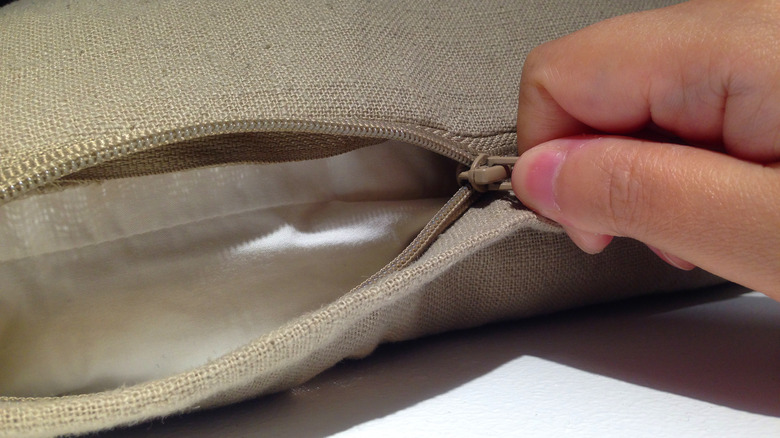
A working zipper should close the full opening and keep the insert inside. First, remove the insert and check the zipper teeth, slider, and nearby fabric. Look for trapped threads, loose stitching, or a slider that no longer joins the teeth.
If the zipper is simply stuck, remove any trapped fabric and gently move the slider back and forth. Do not pull hard. For a damaged zipper, a tailor or sewing repair shop may be able to replace the slider or zipper tape.
If the zipper works but the insert pushes against it, check the insert size. A cover that is too tight can put extra pressure on the closure.
Clean the zipper area
Remove lint and loose threads without pulling on the stitching.
Check the zipper ends
Look for split seams or damaged stops that may allow the slider to move off track.
Use a repair service when needed
Replace damaged parts rather than forcing a broken zipper closed.
Keep Envelope Pillow Covers Closed
Envelope covers use overlapping fabric panels at the back. They are easy to remove, but the opening may spread when the insert is too large or the panels do not overlap enough.
Place the insert fully inside the cover and smooth the back panels over one another. If the opening still gaps, you can add a few hand stitches along the edge to create a stronger overlap. Use stitches that you can remove later if you want to wash the cover.
Another option is to sew small fabric ties inside the opening. Tie them together after inserting the pillow. This helps keep the panels in place without permanently closing the cover.
Increase the overlap
Make sure the back panels extend over one another rather than meeting edge to edge.
Add removable stitches
Use a few loose hand stitches that can be removed before washing.
Add fabric ties
Attach matching fabric strips inside the opening and tie them together.
Check Buttons and Other Fasteners
Button closures can loosen over time. Check that each button is secure and that its loop or buttonhole is not stretched. Replace loose buttons before they fall off.
If the cover has a decorative flap, make sure it sits flat over the opening. A small hidden snap or fabric tie may help when the original closure no longer holds the cover in place.
Loose buttons
Reattach them with strong thread and secure stitching.
Stretched loops
Repair or replace the loop so it holds the button firmly.
Use Fabric Grips and Other Non-Slip Solutions
If the insert and cover are the right size but still move, a non-slip layer may help. This works best when smooth surfaces slide against each other. The added grip creates more friction and makes it harder for the cover to shift.
Choose a method that suits the pillow fabric. A removable solution is often best for decorative covers that need regular washing. Avoid strong glue, rough tape, or household products that may stain or damage delicate fabric.
Source: i.redd.it
Non-slip fabric
A small piece of suitable non-slip textile can add grip between the insert and cover. Test it first to make sure it does not leave marks or damage the fabric.
Sew-in grip patches
Small pieces of textured fabric can be sewn inside the cover at points where the insert tends to move.
Fabric ties
Ties can connect the inside of the cover to suitable attachment points on the insert, helping keep both parts aligned.
Lightweight cotton lining
A cotton layer may reduce movement between some smooth surfaces, although it is not a guaranteed non-slip solution.
How to Add a Non-Slip Fabric Patch
You can make a simple grip patch with a small piece of suitable textured fabric. Choose a material that is soft enough for the pillow and safe for the cover. Avoid rough edges that may wear through delicate fabric.
Turn the cover inside out and mark the areas where the insert moves most. These are often near the lower corners or along the sides. Place the patch on the inside of the cover and secure it with small stitches.
Keep the patch flat. Large or bulky patches can create lumps that show through the pillow. Once the stitching is complete, turn the cover right side out and test it with the insert.
Prepare the materials
Use a needle, matching thread, fabric scissors, and a small piece of compatible textured fabric.
Mark the problem area
Check where the insert moves before deciding where to place the patch.
Sew the patch in place
Use small, even stitches around the edges.
Test the cover
Insert the pillow and move it gently to check whether the patch reduces shifting.
Can You Use Rubber Shelf Liner?
Some people use rubber shelf liner to stop household items from sliding. A small piece may seem useful inside a pillow cover, but ordinary shelf liner is not always made for direct contact with upholstery fabric.
It may leave marks, shed particles, transfer color, or become uncomfortable as the pillow bends. It may also make cleaning harder. If you want to try a liner, check its material and care instructions first, then test a small hidden area.
A washable textile grip designed for fabric is generally a better option than an unknown rubber material. Do not use adhesive-backed shelf liner directly on a pillow insert or cover.
Check the material
Make sure it is compatible with the cover and will not transfer color or leave residue.
Avoid permanent adhesive
Glue can damage the cover and make future cleaning difficult.
Test before regular use
Check for marks, odors, rough edges, and changes in the fabric.
Sew Pillow Inserts to Covers for a More Secure Fit
A few small stitches can keep an insert from turning or shifting inside a cover. This method is useful for pillows that stay in one place and do not need frequent cover changes. It is also helpful when a pillow has no zipper or has a loose inner layer.
You do not need to sew the entire cover shut. Small anchor points can hold the insert in place while allowing the pillow to keep its normal shape. Use strong thread and a needle that suits the fabric.
Before sewing, check whether the cover and insert are both suitable for this method. Avoid stitching through delicate decorative details, foam that may tear, or areas that need to remain removable for cleaning.
Source: i.pinimg.com
How to Sew Small Anchor Points
Turn the cover inside out and place the insert in its correct position. Find the corners where the insert tends to pull away from the fabric. Mark each point with a removable fabric marker or a pin placed safely away from the seam.
Use a few small stitches to connect a suitable point on the inside of the cover to the insert’s outer fabric. Do not pierce through a delicate insert or pull the thread so tight that it creates a dent. The goal is to limit movement, not compress the pillow.
Repeat at the other corners if needed. Turn the cover right side out and check the shape. If you see puckering, remove the stitches and try again with less tension.
Use matching thread
Choose thread that is strong enough for the fabric and close in color to the cover.
Keep stitches small
Small anchor points are less likely to create visible marks or lumps.
Avoid tight knots
Tight knots can pull the fabric inward and change the pillow’s shape.
Check both sides
Make sure the pillow looks smooth from the front and back.
Use Fabric Ties for Removable Covers
Fabric ties are a good choice when you want a secure fit but still need to remove the cover. Sew one tie inside the cover and another at a suitable point on the insert’s outer fabric. Tie them together with a simple bow or knot.
Place the ties where they will not create lumps. For a square pillow, two or four attachment points may be enough, depending on the size and construction. Do not pull the ties too tightly, as the insert should retain its natural shape.
If you use this method on a frequently washed cover, make sure the ties can be untied easily. This will make future cleaning and replacement much simpler.
Use soft fabric strips
Cotton or another compatible fabric is less likely to scratch or damage the insert.
Place ties near the corners
This can help keep the insert aligned and prevent twisting.
Leave enough room
Allow the pillow to move naturally without making the ties loose enough to lose their purpose.
Improve the Fit Without Sewing
Not everyone wants to sew a pillow cover. If you rent your home, change your decor often, or simply want a quick fix, several no-sew options may help. Start with the simplest method and check whether it solves the problem before adding anything else.
The easiest approach is often to reshape the insert and position it properly. A pillow that has shifted toward one side may only need to be moved back into the corners. If the insert is flat, fluffing it may restore enough volume to reduce the loose fabric.
Source: housedigest.com
Fluff the insert
Gently shake and reshape the filling so it spreads across the cover. Follow the care instructions for the insert material.
Use a compatible inner liner
A properly sized inner pillow protector or liner may help create a more stable fit, provided it does not make the pillow too bulky.
Fold excess fabric inward
For a temporary display fix, smooth extra fabric toward the back. This will not correct a badly sized cover, but it can improve the appearance.
Replace worn filling
If the insert has lost most of its volume, a replacement may be more effective than repeated adjustments.
Try a Pillow Protector or Inner Cover
A pillow protector is usually designed to shield the insert from dirt, moisture, and wear. It is not automatically a non-slip device, but a well-fitted protector can create a more consistent outer surface and make handling easier.
Choose one that fits the insert without adding too much bulk. If it is loose, it may simply create another layer that can move. Check that the zipper or closure does not create a hard lump inside the decorative cover.
Wash the protector according to its care label. Make sure it is fully dry before placing it back inside the decorative cover.
Choose the correct size
A protector should fit the insert closely without squeezing it.
Check the fabric
Choose a soft material that works with the insert and outer cover.
Keep the layers smooth
Remove wrinkles and trapped folds before closing the decorative cover.
Avoid Tape and Household Glue
Strong tape and household glue may seem like quick ways to hold a cover in place. However, they can leave sticky residue, damage fibers, and make washing or future repairs harder.
Double-sided tape can also lose its grip when the fabric bends or becomes dusty. Hot glue may stiffen the fabric and create rough spots that can be felt through the pillow.
Use removable fabric ties, suitable grip patches, or a better-fitting insert instead. These options are easier to inspect and maintain.
Do not glue the insert to the cover
This can make the cover difficult to remove and may damage both pieces.
Avoid pins and sharp clips
They may poke through the cover or injure someone handling the pillow.
Match the Fix to the Pillow Fabric and Style
Different pillow fabrics behave in different ways. A thick cotton cover may grip an insert more easily than a smooth satin cover. Velvet, linen, canvas, and outdoor fabric also have different levels of weight, texture, and stretch.
The best fix should protect the material while keeping the pillow comfortable. A method that works for a strong cotton cover may not be suitable for delicate silk or an embroidered decorative pillow.
Use materials made for outdoor conditions. Check that any added grip or ties will not trap moisture or interfere with cleaning.
Stretch covers
Check the care label and choose an insert that does not stretch the fabric beyond its intended shape.
How to Keep Velvet Pillow Covers in Place
Velvet can be smooth in some directions and more resistant in others. This can affect how the cover moves over an insert. Use a properly sized insert and avoid rough materials that could flatten or damage the velvet pile.
If the cover still shifts, add soft fabric ties inside the cover. Sew them carefully into the lining or a suitable seam area. Do not place bulky knots where they can press against the visible surface.
Use gentle handling
Avoid pulling hard on the fabric when inserting or removing the pillow.
Choose soft anchor materials
Use smooth fabric ties rather than rough rubber or abrasive patches.
How to Keep Outdoor Pillow Covers Secure
Outdoor pillows face extra movement from wind, frequent use, and changing weather. A cover that fits loosely may shift more often on patio chairs and outdoor sofas.
Use an insert designed for the outdoor cover and its intended conditions. Fabric ties can help hold the insert in place, while a secure zipper or flap helps prevent the insert from escaping. Allow the pillow to dry as directed before storing it.
Check the closure
Make sure the zipper or flap is secure after every cover change.
Use compatible materials
Choose outdoor-suitable fabrics and components that can handle the expected moisture and exposure.
Store pillows properly
Keep them dry and protected when they are not in use.
Common Mistakes That Make Pillow Covers Slip More
Some quick fixes can make the problem worse. Before adding more filling or buying special accessories, avoid these common mistakes. A simple adjustment is often better than adding extra layers or making permanent changes.
The most important rule is to avoid forcing the insert into a cover that cannot hold it properly. A tight cover may look full at first, but constant pressure can damage the seams and closure.
Source: miro.medium.com
Buying an insert that is much too large
An oversized insert can stretch the fabric, distort the corners, and put pressure on the zipper.
Adding loose stuffing without checking the fit
Extra filling can create lumps and uneven pressure. It may not stop the insert from moving.
Sewing the opening completely shut
This can make cleaning difficult and may prevent you from replacing the insert later.
Using strong glue or tape
These materials can leave residue and damage the cover.
Ignoring a worn insert
A flat insert may keep slipping because it no longer fills the cover.
Washing without checking the care label
Heat and unsuitable cleaning methods can shrink the cover or damage its shape.
Do Not Force a Stuck Zipper
A zipper that will not close may be under too much pressure or may have fabric trapped in its teeth. Pulling harder can damage the slider or split the stitching. Remove the insert and check the zipper before trying again.
If the zipper is damaged, repair it before using the cover. If the insert is simply too large, choose a better-fitting size rather than forcing the closure.
Remove the insert
This reduces pressure and gives you room to inspect the zipper.
Check for trapped fabric
Gently free any fabric or thread caught in the zipper.
Repair damaged parts
Replace a faulty zipper or seek help from a sewing repair shop.
How to Maintain a Secure Pillow Cover Fit
Regular care can help your pillow cover keep its shape. Dirt, body oils, repeated washing, and worn filling can all affect how the cover fits over time. A quick check every few weeks can help you spot small problems before they become harder to fix.
Follow the washing instructions on the cover and insert. Some decorative fabrics need gentle washing or dry cleaning, while other covers can be machine washed. Never assume that the cover and insert have the same care needs.
Source: sleepshacks.com
Fluff pillows regularly
Gently shake and reshape the insert to spread the filling evenly.
Check the seams
Look for loose threads, small holes, and stretched areas before they become larger problems.
Inspect closures
Make sure zippers, buttons, and envelope flaps still work properly.
Wash with care
Use the correct washing method and temperature listed on the care label.
Replace worn inserts
If the filling no longer holds its shape, consider replacing the insert.
Check the Pillow After Washing
A pillow cover may fit differently after washing. Some fabrics can shrink, while others may stretch or become more relaxed. Check the care label before washing and avoid high heat unless the maker allows it.
Let the cover dry fully before putting the insert back inside. A damp cover may feel different and can hold moisture against the insert. Once dry, smooth the seams and check the opening before use.
Check for shrinkage
Compare the cover measurements with the insert if the fit changes after washing.
Avoid excess heat
Use only the drying method allowed by the fabric care instructions.
Reshape before use
Smooth the cover and position the insert in each corner.
Know When to Replace the Insert
A pillow insert does not need to be replaced just because the cover moves. First, check whether the filling can be reshaped. However, an insert that stays flat, forms hard lumps, or no longer fills the corners may be past its useful life.
Choose a replacement based on the cover size, the type of filling, and the feel you want. A soft down or feather insert may suit a cover that needs a fuller shape, while a firmer synthetic insert may work better for a neat, structured pillow.
Replace when it stays flat
If fluffing does not restore the volume, new filling may be needed.
Replace damaged inserts
Torn inner fabric or leaking filling can make it difficult to keep the pillow neat.
Match the new insert carefully
Measure the cover again instead of assuming the old insert size was correct.
Frequently Asked Questions
Q
Why does my pillow cover keep sliding off the insert?
Your pillow cover may be too large, or the insert may have lost its volume. A loose zipper or envelope opening can also let the insert move toward the edge. Check the measurements, filling, and closure before choosing a repair.
If the size and closure are correct, try fabric ties or a small non-slip patch inside the cover.
Q
Should a pillow insert be bigger than its cover?
A slightly larger insert can help many decorative pillows look fuller. Some people use an insert about 1 to 2 inches larger than a square cover, but this is not a universal rule. Firm inserts, small covers, and stiff fabrics may need a same-size insert.
Choose a size that fills the corners without stretching the seams or making the zipper difficult to close.
Q
How can I stop an envelope pillow cover from opening?
Make sure the back panels overlap enough to cover the opening. If they keep spreading apart, add a few removable hand stitches or sew small fabric ties inside the opening.
Also check the insert size. An insert that is too large may push the envelope panels apart.
Q
Can I use Velcro to keep a pillow cover in place?
You can use suitable sew-on hook-and-loop fasteners on some sturdy pillow covers. Place the soft side where it will not rub against delicate fabric or skin. Avoid putting rough hook material against the insert or visible cover surface.
Sew-on fasteners are generally easier to control than strong adhesive versions. Check the fabric care instructions before using them.
Q
How do I stop a pillow insert from bunching inside its cover?
Remove the pillow and reshape the filling before putting it back. Push each corner of the insert into the matching cover corner, then smooth the fabric from the center toward the edges.
If bunching returns quickly, the insert may be too small or may have uneven filling. A better-sized replacement or a few small anchor points may help.
Q
Can I use safety pins to hold a pillow cover closed?
Safety pins are not a good long-term solution. They can open, poke through the fabric, damage the insert, or injure someone handling the pillow.
Use a working zipper, sewn fabric ties, buttons, or removable hand stitches instead.
Q
How do I keep decorative pillows from moving on a sofa?
If the entire pillow slides across the sofa, the issue is different from a cover slipping off its insert. You may need a suitable non-slip cushion grip between the pillow and the sofa, depending on the upholstery material.
If only the outer fabric moves around the filling, focus on the insert size, closure, and internal anchor points.
✦ Wrapping Up
Conclusion
Pillow covers that slip off their inserts can make even a well-arranged sofa look untidy. The best fix is to find out why the movement happens. A loose cover needs a better fit, a weak opening needs a secure closure, and a slippery inner surface may need a suitable grip layer.
Start with the measurements and check the insert’s condition. Then try simple fixes such as reshaping the filling, improving the closure, or adding fabric ties. If the problem continues, consider small sewn anchor points or a compatible non-slip patch.
You do not need a complicated repair to keep decorative pillows neat. A properly fitted insert, a secure opening, and a little routine care can make a noticeable difference.
💡 Key Takeaway
Remove one slipping pillow cover today, measure the cover and insert, check the closure, and test the simplest suitable fix before buying new materials.