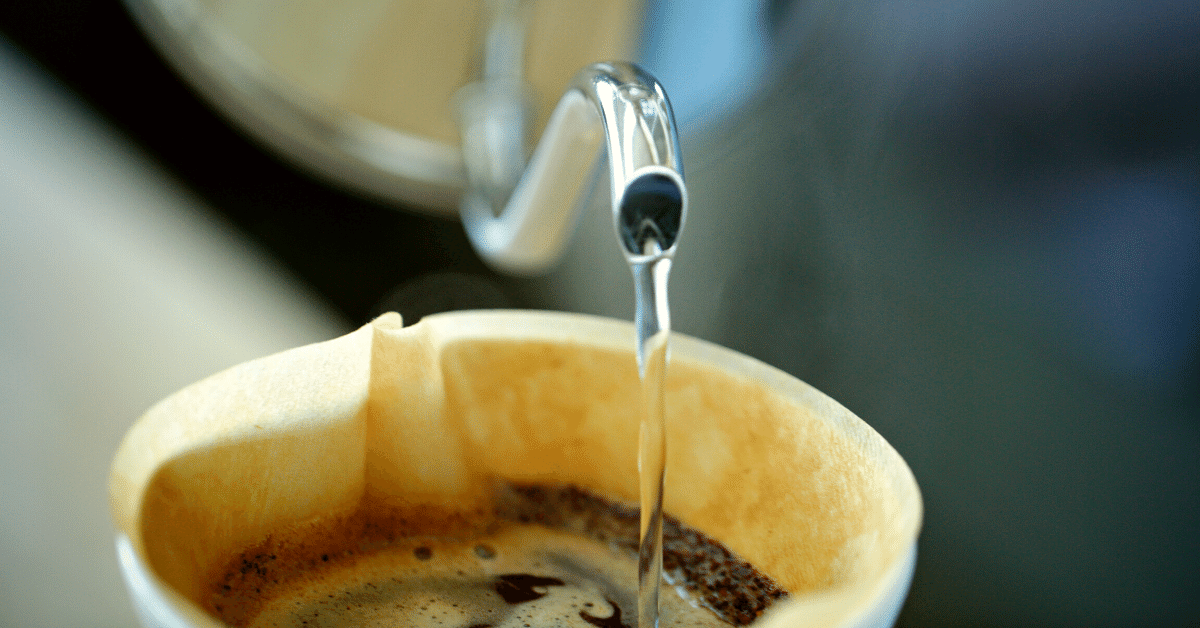
Yes, you can use distilled water to make coffee, but it is usually not the best choice for flavor because it contains almost no dissolved minerals.
If you are making coffee at home in the United States, distilled water is easy to find in grocery stores, pharmacies, and many big-box retailers. It is very pure water, but that purity can work against you when you brew coffee. Coffee is mostly water, so the water itself plays a major role in how the finished cup tastes.
Distilled water can extract compounds from coffee grounds, but its lack of minerals changes how that extraction happens. Coffee-water research and specialty coffee guidance both show that minerals and alkalinity affect extraction, acidity, flavor, and balance. For most home brewing, a clean drinking water with a moderate mineral content is a more practical choice than completely distilled water.
That does not mean distilled water is useless. It can make sense when your local tap water has an unpleasant taste or unusually high mineral content, but using it straight from the bottle may produce a thin, flat, sharp, or otherwise unbalanced cup. The better approach is to use water that is clean and suitable for drinking while still providing an appropriate mineral balance.
Distilled water is water that has been purified through distillation. The water is heated until it becomes steam, and the steam is then condensed back into liquid. Many dissolved minerals and other nonvolatile substances are left behind during this process.
The result is water with very low dissolved mineral content compared with ordinary drinking water. That makes distilled water useful for some household and equipment applications, but coffee brewing is a special case because the mineral content of water affects extraction and flavor.
Pure distilled water is also different from filtered tap water. A typical carbon filter can reduce chlorine, odors, and some contaminants while leaving many naturally occurring minerals in the water. Distillation removes much more of the dissolved mineral content.
Source: drinkstype.com
Very low mineral content
Distilled water contains very little of the calcium, magnesium, sodium, and other dissolved minerals found in ordinary drinking water.
Clean taste
Because many dissolved substances are removed, distilled water can have a very neutral or flat taste on its own.
Different brewing behavior
The lack of minerals changes the way water interacts with coffee compounds during brewing.
Why Minerals Matter When Brewing Coffee
Coffee grounds contain many compounds that dissolve into hot water. Water is the medium that pulls those compounds from the grounds and carries them into your cup. Minerals in the brewing water influence this process and can also affect the way acidity and other flavors are perceived.
Calcium and magnesium are among the minerals commonly discussed in coffee-water chemistry. Alkalinity also matters because it can buffer acids in brewed coffee. The goal is not simply to use water with as many minerals as possible. Too much mineral content can also create problems with flavor and scale.
Can You Use Distilled Water to Make Coffee?
Yes, you can. A coffee maker can heat distilled water and pass it through coffee grounds just as it does with other water. The bigger question is whether the resulting coffee tastes the way you want.
Distilled water has almost no dissolved minerals to contribute to the brewing process. Specialty coffee guidance explains that water without minerals extracts different substances from coffee grounds than water containing minerals. This can change the balance of the finished drink.
For a single cup, using distilled water is unlikely to ruin your coffee maker simply because the water is distilled. However, regular use should be considered separately from occasional use, especially if your machine manufacturer gives specific water-quality requirements.
Source: tophomeapps.com
For occasional brewing
Distilled water can be used when it is the only suitable water available, although the coffee may taste different from your usual brew.
For everyday brewing
A clean drinking water with an appropriate mineral balance is generally a better starting point for consistent coffee.
For specialty coffee
Water chemistry becomes more noticeable when you are trying to reproduce a specific flavor profile or extraction recipe.
Will Distilled Water Make Coffee Taste Bad?
Not necessarily, but it can make the cup taste different. Some people describe coffee brewed with very low-mineral water as flat, thin, sharp, or lacking body. The exact result depends on the coffee, brewing method, recipe, and the water used before and after brewing.
If your usual tap water is very hard or has a strong chlorine taste, switching to distilled water may remove some unwanted flavors. The improvement may come from removing problematic substances, even though the distilled water itself is not ideal for extraction.
How Distilled Water Affects Coffee Extraction
Extraction is the process in which water dissolves compounds from ground coffee. Temperature, grind size, contact time, coffee-to-water ratio, and water chemistry all influence what ends up in the cup.
Distilled water has very little mineral content, so it behaves differently from ordinary drinking water. Water chemistry does not determine every part of extraction, but it is one of the variables that can change the balance of flavors.
This is why two cups made with the same beans, grinder, temperature, and brew time can taste noticeably different when the water changes. The coffee has not changed, but the brewing medium has.
Source: flashycoffee.com
Acidity
Very low-mineral water may allow a coffee’s acids to stand out differently because there is little alkalinity available to buffer them.
Body
Changes in extraction can affect how full or thin the coffee feels on the palate.
Flavor clarity
The balance of extracted compounds can change, so familiar notes may seem weaker, sharper, or less rounded.
Consistency
Using the same water source each time can make your brewing results easier to repeat.
Why pH Alone Does Not Tell You Enough
It is tempting to judge coffee water only by pH, but pH does not describe the whole water chemistry. Alkalinity helps describe how strongly water can resist changes caused by acids, which is especially relevant to coffee flavor.
For home brewing, this means a water bottle labeled neutral is not automatically the best coffee water. Mineral content, alkalinity, taste, and the condition of your coffee equipment all matter.
Distilled Water vs. Tap Water for Coffee
The better choice between distilled and tap water depends on the quality of your local water. In many U.S. homes, tap water that tastes good and is safe to drink can be perfectly reasonable for coffee.
Tap water contains dissolved minerals and other substances. Those minerals can help coffee extraction, while chlorine or other off-flavors can carry into the finished drink. Distilled water removes much of that mineral content, but it also removes substances that may contribute to a more balanced extraction.
If your tap water tastes unpleasant, try a suitable water filter before switching completely to distilled water. A filter can reduce unwanted tastes while retaining some mineral content, depending on the filtration system.
Source: cafeish.co
Distilled water
Very low in dissolved minerals; useful when you need highly purified water, but often not the first choice for flavorful everyday coffee.
Tap water
Contains naturally occurring minerals that can support coffee extraction, but its taste and hardness vary greatly by location.
Filtered water
Can reduce chlorine, odors, and some unwanted substances while retaining some minerals, depending on the filter.
Coffee-specific water
Designed or prepared with coffee brewing in mind, allowing mineral content and alkalinity to be controlled more deliberately.
Which Water Should You Try First?
Start with the water that is safe to drink, tastes clean, and does not create excessive scale in your coffee equipment. If your tap water already meets those basic needs, there is no strong reason to replace it with distilled water simply because distilled water is purer.
If your coffee tastes like chlorine, seems unusually harsh, or your equipment develops heavy mineral deposits, test a filtered or otherwise treated water. Change one variable at a time so you can tell whether the water actually improved the cup.
Can Distilled Water Damage a Coffee Maker?
Distilled water does not automatically mean that a coffee maker will be damaged. However, coffee machines differ, and the manufacturer’s instructions should take priority over general advice about water chemistry.
There is also a difference between mineral buildup and corrosion. Hard water can leave scale inside heating systems and other components. Very low-mineral water avoids much of that mineral scale, but water chemistry is more complicated than simply saying that less mineral content is always better for equipment.
If your coffee maker, espresso machine, or kettle has a specific water-quality requirement, follow that requirement. This is especially important for machines with boilers, sensors, water-level systems, or warranty conditions tied to water quality.
Source: storage.googleapis.com
Check the manual
Look for the manufacturer’s instructions about distilled, demineralized, softened, filtered, or bottled water.
Watch for scale
White mineral deposits and slower water flow can indicate scale from hard water.
Do not assume pure means ideal
Water with very low mineral content can solve some problems while creating different brewing or equipment considerations.
What About Espresso Machines?
Espresso machines can be more sensitive to water chemistry because water is heated inside equipment and repeatedly contacts internal components. Water that is too hard can contribute to scale, while water chemistry also affects espresso extraction.
For an espresso machine, follow the machine manufacturer’s water guidance rather than choosing distilled water solely because it reduces mineral deposits. A properly treated water can provide a better balance between coffee extraction and equipment care.
How to Make Better Coffee If You Only Have Distilled Water
If distilled water is the only water you have, you can still make coffee. The simplest approach is to brew a normal batch and treat the result as a starting point rather than assuming the coffee will taste exactly like it does with your usual water.
For better control, use water specifically prepared for coffee rather than adding random amounts of minerals or salts. Coffee-water recipes can be precise, and improvised mineral additions can produce unpredictable results.
If you are not interested in water chemistry, a practical home approach is to use good-tasting filtered drinking water instead. This avoids turning a simple morning cup into a chemistry project.
Source: fluentincoffee.com
Keep the coffee recipe consistent
Use the same coffee dose, grind size, water temperature, and brew time when comparing distilled water with another water source.
Taste the difference
Compare the cups side by side instead of relying only on general claims about distilled water.
Change one variable
If you change the water, coffee, grind, and brewing method at the same time, you will not know which change caused the flavor difference.
A Simple Home Comparison Test
To compare water fairly, brew the same coffee twice using the same grinder setting, coffee dose, water temperature, and brew method. Use distilled water for one batch and your usual drinking water for the other.
Taste both after they have cooled enough to evaluate comfortably. Look for differences in acidity, sweetness, bitterness, body, aroma, and aftertaste. This simple test tells you more about your own coffee setup than a general statement that one water is always better.
Keep everything else fixed
Use the same beans, dose, grind, brewer, temperature, and brew ratio.
Taste at the same temperature
Allow both cups to cool similarly so temperature does not become an extra variable.
Common Mistakes When Using Distilled Water for Coffee
The biggest mistake is assuming that water purity and coffee quality are the same thing. Distillation removes many dissolved substances, but coffee brewing needs water that can interact with the grounds in a useful way.
Another common mistake is blaming the beans when the water has changed. If a coffee suddenly tastes flat or unusually sharp after switching water, the water may be part of the reason.
Finally, avoid making large changes to water chemistry without knowing what you are adding. Coffee-water minerals are not interchangeable, and more minerals do not automatically produce better coffee.
Source: tophomeapps.com
Mistake: choosing water only by purity
Very pure water is not automatically ideal for coffee extraction.
Mistake: ignoring local tap water
Your tap water may already be suitable for brewing, especially if it tastes clean and does not cause excessive scale.
Mistake: changing several brewing variables
Change the water first and keep the rest of your recipe stable so you can identify its effect.
Mistake: assuming all bottled water is the same
Bottled waters can have very different mineral profiles, so the label and water source can matter.
When Distilled Water Can Be Useful
Distilled water can be useful when you need very low-mineral water for a particular purpose, when your normal water has an unwanted taste, or when you are following a tested coffee-water recipe that starts with purified water and adds controlled minerals.
The key is to use distilled water intentionally rather than assuming that removing every mineral will automatically improve coffee.
Frequently Asked Questions
Q
Can you use distilled water in a regular coffee maker?
Yes, distilled water can be used in many regular coffee makers, but check the owner’s manual first. Because distilled water lacks minerals, it may also produce different-tasting coffee.
Q
Is distilled water good for making coffee?
Distilled water can make coffee, but it is not usually the first choice for flavor. Its very low mineral content can change extraction and may leave the coffee less balanced than coffee brewed with suitable drinking water.
Q
Does distilled water make coffee taste different?
Yes, it can. Water minerals and alkalinity affect how coffee compounds are extracted and perceived, so changing from mineral-containing water to distilled water can change acidity, body, and overall flavor.
Q
Can distilled water prevent scale in a coffee maker?
Because distilled water contains very little mineral content, it can reduce the minerals available to form typical hard-water scale. However, follow your coffee maker’s water instructions instead of choosing distilled water for this reason alone.
Q
What water is better than distilled water for coffee?
For many home brewers, clean drinking water with a moderate mineral content is a practical choice. Filtered water can also work well when it improves taste without removing all useful minerals.
✦ Wrapping Up
Conclusion
So, can you use distilled water to make coffee? Yes. It will brew a cup, but its lack of dissolved minerals can change extraction and flavor, so distilled water is not automatically the best water for everyday coffee.
For most people in the United States, the easiest starting point is clean, good-tasting drinking water that works with the coffee maker manufacturer’s instructions. If your tap water tastes good and does not create excessive scale, you may already have a suitable option. If it tastes strongly of chlorine or has other issues, filtered or properly treated water may be a better next step.
If you want to experiment, compare distilled water with your normal drinking water while keeping every other brewing variable the same. That gives you a practical answer based on your beans, brewer, and local water rather than relying on a one-size-fits-all rule.
💡 Key Takeaway
Use distilled water when you have a specific reason to do so, but for everyday coffee, start with clean drinking water that has a suitable mineral balance and follow your coffee maker’s water requirements.