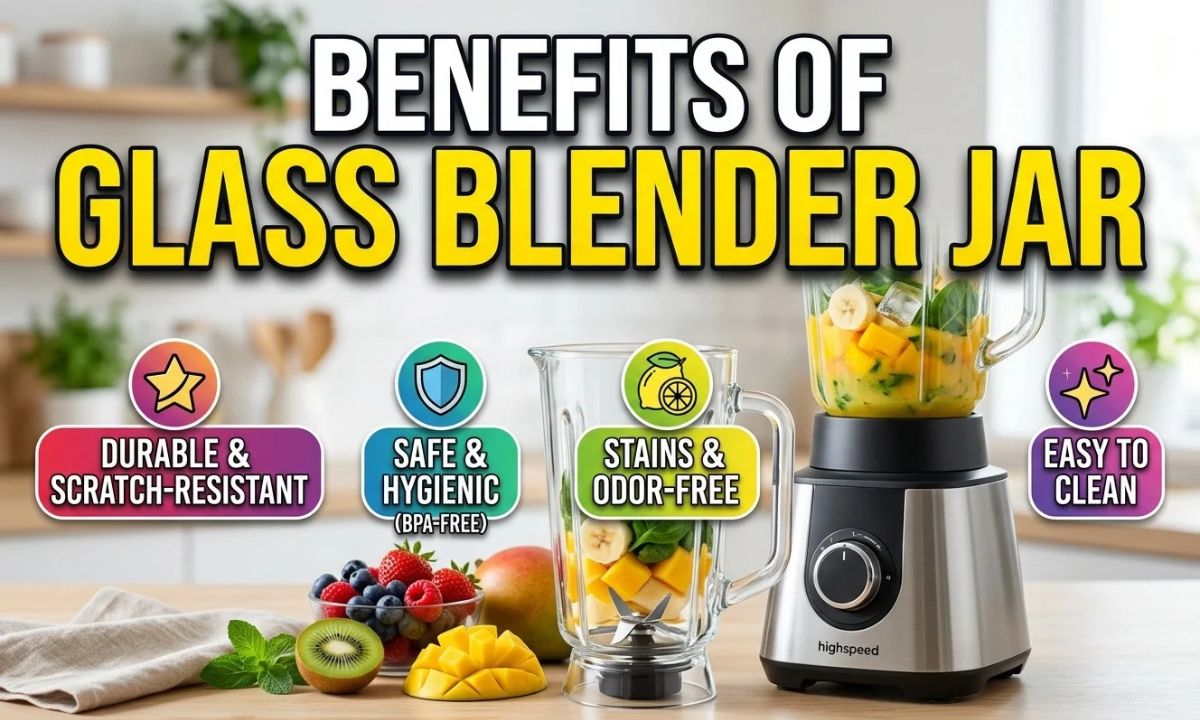
A glass blender jar resists lingering odors and stains, offers clear visibility, and provides a sturdy blending container, although it is heavier and can break if dropped.
In American kitchens, blenders help prepare breakfast smoothies, homemade salad dressings, soups, sauces, and frozen drinks. Choosing the right blender jar can make these everyday tasks easier. Glass is a popular option for households that value a clear view of ingredients, a nonporous surface, and a container that is easy to maintain.
The benefits of a glass blender jar depend on its design, glass type, and intended use. Glass generally resists odors and stains better than many plastics, but it weighs more and can shatter if mishandled. It also does not automatically make a blender more powerful, safer, or better at producing smooth results. Understanding these differences helps you choose a jar that fits your cooking habits and cleaning routine.
A glass blender jar is the container attached to a blender’s motor base. It holds ingredients while the blades chop, mix, crush, or puree them. Depending on the model, the jar may include a handle, pouring spout, removable or fixed blade assembly, lid, and measurement markings.
Blender jars are not all made from the same type of glass. Some use conventional glass, while others use specially formulated heat-resistant glass. The material and construction affect how the jar handles temperature changes, everyday use, and accidental impacts.
Glass is one of several common jar materials. Plastic jars are often lighter and less likely to shatter, while stainless steel containers are opaque and can be useful for certain commercial or specialty applications. Each material has different practical advantages.
Source: i.pinimg.com
Glass
A clear, relatively rigid material that generally resists stains and odors but can break when dropped or struck.
Plastic
Usually lightweight and convenient to handle. Its resistance to scratches, odors, stains, and heat varies with the specific plastic and construction.
Stainless steel
Durable and opaque, with no direct view of the ingredients during blending. Features and intended uses depend on the model.
Why the Type of Glass Matters
Ordinary glass and heat-resistant glass do not have identical properties. Some blender jars are designed for a wider range of temperatures than others, but the word glass alone does not establish that a container is suitable for hot soup or rapid temperature changes.
Before pouring hot ingredients into a blender, check the manual for explicit hot-liquid instructions. A jar rated for heat may still have limits related to sudden temperature changes, steam pressure, fill level, or the lid design.
Check the manual
Confirm whether the jar supports hot ingredients, dishwasher cleaning, and the temperature range required for your recipes.
Inspect the glass
Do not use a jar with cracks, chips, or damaged areas, particularly near the handle, rim, or blade assembly.
7 Main Benefits of a Glass Blender Jar
The biggest advantages of a glass blender jar relate to cleanliness, visibility, and its feel during everyday food preparation. These features can make glass appealing for people who regularly prepare different types of food and want a container that is straightforward to inspect and maintain.
The following benefits describe general material characteristics, not guaranteed performance for every blender. Jar design, glass quality, cleaning methods, and manufacturer instructions still matter.
Source: kitchenwaresets.com
1. Better resistance to lingering odors
Glass is nonporous under normal kitchen use, so it generally absorbs fewer food odors than many plastics. This is useful when switching between strongly flavored ingredients such as garlic, onions, herbs, fruit, and protein shakes. Seals and lids can still retain smells.
2. Resistance to food stains
Glass generally resists discoloration from ingredients such as berries, tomatoes, and turmeric better than many plastic containers. Prompt cleaning remains helpful because residue can collect around seals, blades, and other components.
3. Clear visibility while blending
A transparent jar lets you watch ingredients move, check liquid levels, and judge when a mixture looks sufficiently blended. You can often identify large pieces or ingredients stuck above the blade without opening the lid.
4. A sturdy, substantial feel
Glass is rigid and has a solid feel during handling. It can tolerate ordinary food preparation when used as directed, although its weight and impact sensitivity mean it is not necessarily more durable than plastic in every situation.
5. Easy routine cleaning
Glass does not generally absorb food residue into its surface, which helps with washing after everyday recipes. Some jars are dishwasher-safe, but the blade assembly, lid, seals, and jar itself may have different cleaning requirements.
6. No direct contact with plastic from the jar body
For people who prefer to reduce contact between food and plastic, a glass jar provides a glass container body. However, the complete blender may still contain plastic in its lid, seals, blade housing, or other components, so the exact construction matters.
7. A reusable container for many recipes
A well-maintained glass jar can serve for years of routine blending if it remains undamaged and replacement parts are available. Its useful lifespan depends on handling, maintenance, and the condition of the lid and blade assembly rather than material alone.
Which Benefits Matter Most for Everyday Cooking?
For people who prepare smoothies, sauces, and flavored drinks throughout the week, odor resistance, stain resistance, and clear visibility may be the most noticeable benefits. These characteristics reduce some of the small annoyances associated with using one container for many recipes.
For households that frequently lift a full blender jar or have limited storage space, weight may matter more than the surface benefits. A lighter plastic jar may be more practical, particularly when handling a large batch or cleaning the container by hand.
Best for varied recipes
Glass can be convenient when you move between fruit smoothies, savory sauces, and other strongly flavored foods.
Best for visual control
Transparency makes it easier to monitor texture and ingredient movement during blending.
Best for careful handlers
Glass is a reasonable option for people who can lift it comfortably and have a safe place to store and wash it.
Glass Blender Jar vs. Plastic Blender Jar
Glass and plastic can both work well for home blending, but they suit different priorities. Glass usually has an advantage in resisting odors and stains, while plastic is often lighter and more forgiving if accidentally dropped. Neither material automatically produces smoother drinks or lasts longer under every condition.
Use the comparison below to match the jar material to your kitchen routine. These are general material characteristics; a particular model may differ because of its design, plastic formulation, glass type, and care instructions.
Source: i.pinimg.com
Odor resistance
Glass generally resists absorbing food odors. Plastic performance varies, and scratches or retained residue can contribute to lingering smells.
Stain resistance
Glass typically resists staining well. Some plastics can discolor after repeated contact with richly colored foods.
Weight
Plastic jars are usually lighter, making them easier to lift and pour. Glass jars generally feel heavier, especially at larger capacities.
Impact resistance
Plastic often withstands accidental drops better than glass. Glass can chip or shatter, so careful handling is essential.
Visibility
Clear glass and clear plastic both allow you to see ingredients. Opaque or scratched containers can make visual inspection more difficult.
Cleaning
Glass usually cleans without absorbing many food odors or pigments. Dishwasher suitability depends on the complete jar assembly and the manufacturer’s instructions.
Cost and replacement
Price varies by blender model. Compare replacement jar availability and cost rather than assuming glass is always more expensive or economical.
Is Glass Better Than Plastic for Blending?
Glass is often better for people who prioritize resistance to stains and lingering odors, prefer a rigid container, and want a clear view of their ingredients. Plastic is often better for people who prioritize low weight, easier handling, and greater tolerance of accidental drops.
Blending performance depends more directly on the motor, blade geometry, jar shape, ingredient quantity, and operating speed. A glass jar alone does not prove that a blender can crush ice effectively, process thick mixtures, or make smoother smoothies.
Choose glass when
You want a container that generally resists odors and stains and you are comfortable handling the extra weight.
Choose plastic when
You need a lightweight jar for frequent lifting, easier pouring, or a household where accidental drops are a concern.
Compare complete models
Check motor performance, capacity, blade design, cleaning requirements, replacement parts, and warranty terms before deciding.
Does a Glass Jar Prevent Microplastics?
A glass jar body avoids direct food contact with plastic along the jar’s glass surfaces, but that fact alone does not establish the total amount of plastic particles a blender may release. Lids, seals, blade assemblies, and other components can contain different materials.
If reducing plastic contact is a priority, review the manufacturer’s material information for every part that touches food. Avoid assuming that a glass jar makes the entire appliance plastic-free or guarantees zero particle exposure.
Inspect food-contact parts
Check the jar, lid, seal, blade housing, and any removable components.
Avoid unsupported health claims
The jar material by itself cannot establish a specific health benefit or quantify exposure to particles.
Does a Glass Blender Jar Make Blending Easier?
A glass jar can make certain parts of blending easier, particularly checking ingredients and cleaning up after use. It does not necessarily reduce blending time or improve texture. Those outcomes depend on the appliance’s design and the ingredients being processed.
For example, a clear jar helps you see whether frozen fruit is moving freely or whether ingredients remain near the top. You can stop the motor before adjusting the mixture, following the manufacturer’s directions. Never insert a utensil into a running blender or reach into the jar while the blades are moving.
Source: kitchenwink.com
Monitor consistency
Use the transparent walls to judge whether a smoothie, dressing, or puree has reached the desired texture.
Check ingredient movement
Look for ingredients that remain above the blade or fail to circulate. Stop the blender before adjusting the contents.
Measure ingredients
Use the measurement marks if the jar includes them, and confirm their accuracy if precise measurements matter to a recipe.
How to Get Better Results From Any Blender Jar
Good blending habits can improve consistency regardless of whether the jar is made of glass or plastic. Follow the manufacturer’s recommended fill limits, use the correct setting, and add ingredients in the order recommended by the recipe or appliance instructions.
When a thick mixture stops circulating, turn off and unplug the blender before checking for trapped ingredients. Use a tamper only if the manufacturer supplies or approves one for that model, and never force the lid open while the blades are moving.
Avoid overfilling
Leave the required headspace, especially when blending ingredients that expand, foam, or generate steam.
Add liquid when appropriate
For recipes that permit it, enough liquid can help ingredients circulate more easily.
Use suitable settings
Follow the recommended speed and pulse settings for the food and the blender model.
Potential Drawbacks of a Glass Blender Jar
The main disadvantages of a glass blender jar are its weight and risk of breakage. These drawbacks may be minor in a kitchen where the blender stays on the counter, but they become more important if you regularly carry a full jar, have limited storage, or need a container that can tolerate accidental drops.
Glass is rigid, but it is not indestructible. An impact against a hard countertop, sink, or tile floor can chip or crack the jar. A damaged jar should not be used because cracks can worsen under vibration, pressure, or handling.
Source: oliviascookingtips.com
Heavier handling
A full glass jar may be harder to lift, pour from, and wash than a comparable plastic jar.
Breakage risk
Dropping or striking the jar can cause chips, cracks, or shattering.
Temperature limitations
Not every glass jar is designed for hot liquids or rapid temperature changes. Follow the model’s stated limits.
Replacement costs
A replacement jar may be expensive or unavailable for older blender models. Confirm part compatibility before buying.
Care requirements
The jar may be dishwasher-safe while the lid, seal, or blade assembly requires separate cleaning. Check the instructions for each component.
How to Reduce the Risk of Damage
Handle a glass jar with both hands when it is heavy, and avoid placing it where it can slide off the counter. Set it down gently on a stable surface instead of striking it against the sink or countertop.
Avoid sudden temperature changes unless the manufacturer explicitly permits them. For example, do not assume a cold jar can safely receive boiling liquid. Thermal shock can damage glass, even when the container appears intact.
Inspect before use
Check for cracks, chips, and damage around the base, rim, handle, and blade connection.
Handle hot contents carefully
Use only jars and blending procedures approved for hot ingredients, accounting for steam and pressure.
Replace damaged parts
Stop using a chipped or cracked jar and obtain a compatible replacement approved by the manufacturer.
How to Clean and Maintain a Glass Blender Jar
Regular cleaning helps a glass blender jar stay clear and reduces the buildup of food residue around the blade assembly, lid, and seals. Clean the jar soon after use rather than allowing smoothies, sauces, or other ingredients to dry on the surface.
Always follow the manufacturer’s cleaning instructions. Some jars are dishwasher-safe, while others require handwashing or have removable components that must be cleaned separately. Never submerge a motor base or electrical assembly in water.
Source: kitchenwink.com
1. Disconnect the blender
Turn off the appliance and unplug it before removing the jar or handling the blade assembly.
2. Empty and rinse
Remove the remaining food and rinse the jar with water that is appropriate for its temperature limits.
3. Wash with dish soap
Use warm water and ordinary dish soap with a suitable sponge or brush. Avoid abrasive tools that could damage other components or leave residue.
4. Clean the lid and seals
Remove only the parts that the manual identifies as removable, and clean crevices where food can collect.
5. Rinse and dry
Rinse thoroughly and allow the components to dry as directed before reassembly or storage.
6. Inspect the jar
Look for chips, cracks, cloudy residue, or damage around the handle and blade connection before using the blender again.
Can You Clean a Glass Blender Jar in the Dishwasher?
You can put a glass blender jar in the dishwasher only if the manufacturer identifies that jar as dishwasher-safe. The glass body, lid, seals, and blade assembly may have different care requirements, so do not assume the entire assembly can go into the dishwasher together.
If handwashing is recommended, use a nonabrasive sponge and mild dish soap. For dried-on residue, let the jar soak if the manual permits it, then wash the surface and rinse thoroughly.
Verify dishwasher compatibility
Check the exact blender model’s instructions rather than relying on the fact that the jar is made of glass.
Protect removable components
Follow the specified method for cleaning blades, seals, and lids, and avoid handling sharp blades carelessly.
How to Remove Lingering Food Odors
Glass itself generally resists odor absorption, but smells can remain in food residue around the blade assembly, lid, or seals. Start with a thorough wash using warm water and dish soap rather than assuming the glass has absorbed the odor.
If the smell remains, inspect the removable parts and clean them according to the manual. Replace worn or damaged seals when recommended. Do not mix cleaning chemicals or use a treatment that the manufacturer does not approve.
Clean hidden areas
Check the lid, gasket, blade base, and other food-contact crevices for residue.
Dry completely
Allow washed components to dry properly before storing them to reduce trapped moisture and stale odors.
What to Check Before Buying a Glass Blender Jar
Before buying a blender with a glass jar, compare more than the container material. Capacity, weight, replacement-part availability, cleaning instructions, and the blender’s intended uses can have a bigger effect on daily convenience than glass alone.
If you already own a blender and need a replacement jar, match the exact model and compatible part number. Similar-looking jars may not fit the motor base or blade assembly correctly.
Source: sarahscoopeats.com
Jar capacity
Choose a size that fits your usual batch. A larger container may be useful for family recipes but can be harder to lift when full.
Overall weight
Consider the empty jar’s weight as well as the weight of the ingredients you typically blend.
Glass construction
Look for clear information about the glass type and any limits for hot liquids or temperature changes.
Blade and motor design
Review the manufacturer’s supported tasks, recommended ingredients, and operating instructions.
Cleaning requirements
Check whether the jar, lid, and blade assembly are dishwasher-safe or need handwashing.
Replacement parts
Confirm that compatible jars, lids, seals, and blade assemblies are available and review their cost.
Warranty and support
Review the manufacturer’s warranty and the conditions that apply to damaged jars and replacement parts.
Is a Glass Blender Jar Worth It for Your Kitchen?
A glass blender jar may be worth choosing if you blend different foods regularly, want a container that generally resists staining and odors, and do not mind the extra weight. It can be especially convenient when the blender stays in one place and you can lift the jar safely.
A plastic jar may be more practical for people who carry a full container frequently, need a lighter appliance, or are concerned about accidental drops. The right choice depends on your priorities, not a universal claim that one material is always superior.
For smoothie drinkers
Compare capacity, blade performance, frozen-fruit guidance, and how easily the jar can be washed after thick mixtures.
For soup and sauce preparation
Confirm hot-liquid compatibility and the correct blending procedure before choosing glass for warm recipes.
For households with children
Consider the weight and breakage risk, along with how the appliance will be stored and handled.
For people reducing plastic contact
Review all food-contact materials rather than relying on the jar body alone.
Common Myths About Glass Blender Jars
Glass has several useful properties, but some claims about glass blender jars go beyond what the material alone can establish. Separating practical advantages from unsupported assumptions makes it easier to choose the right appliance.
Source: i.pinimg.com
Myth: Glass jars never stain or smell
Glass generally resists food stains and odors, but residue can still collect on seals, lids, and blade assemblies. Inadequate cleaning can leave smells even when the glass itself is not absorbing them.
Myth: Glass always lasts longer than plastic
Glass can resist scratches and staining, but it can break from impact. A plastic jar may survive a drop that would damage glass, so service life depends on handling and construction.
Myth: Glass makes smoothies smoother
Smoothness depends on motor performance, blade design, ingredients, liquid quantity, and blending time. The jar material alone does not determine the final texture.
Myth: Every glass jar can hold boiling liquids
Heat tolerance varies by glass type and jar design. Use hot ingredients only when the manufacturer explicitly permits them and follow its fill and lid instructions.
Myth: A glass jar makes the entire blender plastic-free
Other food-contact components may contain plastic. Check the product’s material specifications if this distinction matters to you.
Myth: Glass jars are always dishwasher-safe
Dishwasher compatibility is model-specific. Follow the care instructions for the jar and each removable component.
Frequently Asked Questions
Q
What are the main benefits of a glass blender jar?
The main benefits are resistance to lingering food odors and stains, clear visibility during blending, a rigid container, and straightforward routine cleaning. Glass also avoids direct food contact with plastic along the jar body. However, it is heavier than most plastic jars and can break if dropped.
Q
Is a glass blender jar healthier than a plastic jar?
The material alone does not establish that one jar is healthier in every situation. Glass provides a nonporous food-contact surface, while plastic formulations and their intended uses vary. If reducing direct contact between food and plastic is your priority, check the materials used throughout the blender, including the lid, seals, and blade assembly.
Q
Can a glass blender jar go in the microwave?
Do not assume a blender jar is microwave-safe just because it is made of glass. Blender jars may have handles, blade assemblies, seals, or other components that are unsuitable for microwave use. Use a separate microwave-safe container unless the manufacturer explicitly approves the exact jar and its configuration for microwave heating.
Q
Can I put hot soup in a glass blender jar?
Only if the manufacturer specifically permits hot-liquid blending in that jar. Some glass jars are designed for heat, while others may crack from thermal shock. Hot liquids also release steam and can create pressure inside a closed blender. Follow the manufacturer’s fill limits, lid instructions, and recommended method for blending hot ingredients.
Q
Does a glass blender jar break easily?
Glass can handle normal use when designed for the appliance and handled correctly, but it is vulnerable to impact. Dropping it on tile, striking it against a sink, or exposing it to an unsuitable temperature change can cause damage. Inspect the jar regularly and stop using it if you notice a crack or chip.
Q
Are glass blender jars easier to clean than plastic jars?
Glass often has an advantage because it generally resists absorbing food odors and pigments. Smooth glass surfaces are usually straightforward to wash, although food residue can still collect around blades, lids, and seals. Whether the jar can go in a dishwasher depends on the manufacturer’s instructions.
Q
Is a glass blender jar good for crushing ice?
It depends on the blender’s design and whether the manufacturer approves ice crushing. Motor power, blade construction, jar shape, and the amount of ice all affect performance. Do not assume a glass jar is suitable for crushing ice simply because it feels sturdy.
Q
How long does a glass blender jar last?
There is no universal lifespan for a glass blender jar. Its service life depends on the glass construction, frequency of use, cleaning routine, storage, and exposure to impacts or temperature changes. A jar may remain usable for years with proper care, but any chipped or cracked jar should be replaced.
✦ Wrapping Up
Conclusion
The benefits of a glass blender jar include resistance to food odors and stains, clear visibility, and a surface that is generally easy to clean. These qualities make glass appealing for households that prepare a variety of smoothies, sauces, and other blended foods.
Glass is not the best fit for every kitchen. It is heavier than most plastic alternatives and can chip or shatter after an impact. It also does not guarantee better blending performance, greater overall safety, or unlimited heat resistance. The most suitable choice depends on your recipes, handling needs, cleaning preferences, and the manufacturer’s specifications.
💡 Key Takeaway
Before choosing a glass blender jar, compare its weight, capacity, temperature limits, cleaning instructions, blade performance, and replacement-part availability. Choose glass if odor and stain resistance matter most to you; consider plastic if low weight and resistance to accidental drops are higher priorities.