
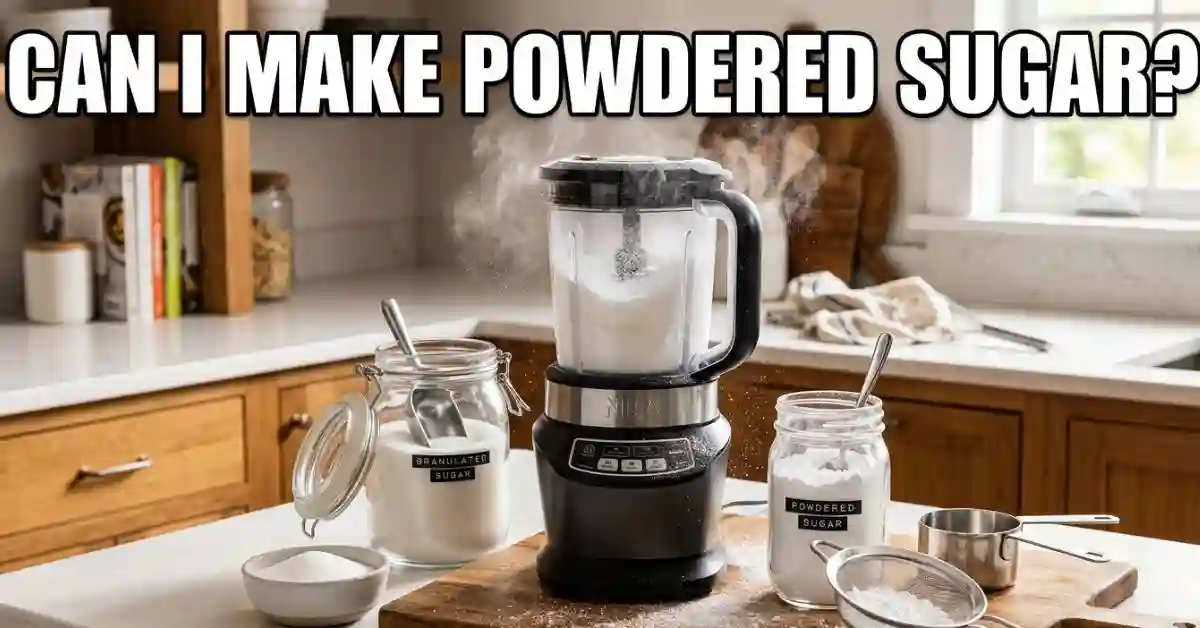
I’ve been there—halfway through frosting a cake, then I see the powdered sugar jar is empty. If you’ve ever asked, “Can I Make Powdered Sugar?”, the good news is yes—you can, and it’s fast. I’ve done this in busy home kitchens from humid Florida to dry Arizona, and with a simple blender or food processor, regular sugar turns into soft powder in minutes.
Yes—Can I Make Powdered Sugar at Home?
This happened to me on a wet Saturday afternoon while I was making cupcakes for family. The frosting was ready. The butter was soft. Then I reached for the powdered sugar—and the jar was empty.
Not ideal.
I stood in my kitchen for a second, staring at a full bag of regular sugar. Then I thought, Can I make powdered sugar from this?
Yes. You can.
And honestly, it saved dessert.
You can make powdered sugar at home with plain granulated sugar and one small kitchen tool. I used my blender, but a food processor or even a coffee grinder works too. It took less than a minute. By the time my oven beeped, I was done.
The short answer
Yes, you can make powdered sugar from regular sugar.
That’s all store-bought confectioners’ sugar really is—very fine sugar, often with a little cornstarch mixed in to stop clumps.
Here’s what you need:
- 1 cup granulated sugar
- A blender, food processor, or coffee grinder
- About 30 to 60 seconds
That’s it.
The first time I tried it, I kept opening the blender lid to check. Big mistake. A little sugar cloud floated out and landed on my counter. My kitchen looked lightly snowed on. Lesson learned—let the dust settle first.
Why people make homemade powdered sugar
I’ve made homemade powdered sugar for a few different reasons.
Sometimes it’s because I ran out in the middle of baking. That’s the most common one.
Other times, it’s because:
- I wanted a quick fix without going to the store
- I didn’t want to spend money on one more baking ingredient
- I needed a fast powdered sugar substitute
- I like knowing exactly what’s in my food
And honestly? Once you do it once, it feels easy.
Now I keep it in mind any time I bake cookies, whip frosting, or make a quick glaze. It’s one of those simple kitchen tricks that makes you feel oddly prepared. Like—you beat the cupcake crisis.
What Is Powdered Sugar, Exactly?
The first time I made homemade powdered sugar, I remember dipping my finger into the blender cup just to check it. It felt soft. Almost like flour. That surprised me.
Because really, powdered sugar sounds like some special baking ingredient—but it isn’t.
It’s just regular sugar that has been ground into a very fine powder.
That fine texture is what makes it so useful. It melts fast. It blends into frosting smoothly. It makes a silky glaze instead of a gritty one. That’s why bakers love it.
Powdered sugar vs granulated sugar
This is the easiest way I think about it:
- Granulated sugar = bigger sugar crystals
- Powdered sugar = tiny, finely ground sugar
Same ingredient. Different texture.
That texture changes everything.
If you stir granulated sugar into frosting, you may feel little grains on your tongue. Not great.
But powdered sugar blends in fast. It makes buttercream smooth and soft. No crunch. No grit.
Most store-bought powdered sugar also has a little cornstarch mixed in. Usually just a small amount.
Why?
It helps stop clumps.
I learned that the hard way one humid afternoon. I left homemade powdered sugar in a bowl on my counter for too long. It turned into tiny sweet lumps. Still usable—but not pretty.
Other names for powdered sugar
This confused me at first.
I was following a recipe that asked for confectioners’ sugar, and I thought I needed something different.
I didn’t.
These are all the same thing:
- Powdered sugar
- Confectioners’ sugar
- Icing sugar
- 10X sugar
“10X” just means the sugar was ground very fine.
So if your recipe uses any of those names, don’t stress. It’s the same sweet powder.
Once I understood that, baking got much easier—and much less dramatic. No more standing in the pantry, reading labels like it’s a quiz.
What You Need to Make Powdered Sugar
One thing I love about making powdered sugar at home is how simple it is. No special trip to the store. No fancy ingredients.
The first time I did it was on a Sunday morning in my home kitchen. I was still in slippers. Coffee was on the counter. I thought, Surely this can’t be that easy.
It was.
You probably already have everything you need.
That’s the nice part.
Main ingredient
The best choice is simple:
- White granulated sugar
That’s it.
It gives you the closest result to store-bought powdered sugar. The color stays bright white. The texture gets soft and fluffy. And it tastes exactly right for frosting, icing, or a quick glaze.
I’ve tested other sugars too. They can work—but white sugar is the easiest and most reliable.
Optional ingredient
You can also add:
- 1 tablespoon cornstarch per cup of sugar
Do you need it?
No.
I skip it when I plan to use the sugar right away, like for fresh buttercream.
But if I’m making extra to store later, I add it.
Why? It helps stop clumps.
That matters in humid weather. I learned that in summer, when my kitchen felt like a tiny sauna and my sugar started sticking together by lunch.
Best tools
You do need one machine to grind the sugar.
Here’s what I’ve used:
- High-speed blender — my favorite for smooth results
- Food processor — works well, but may take a little longer
- Spice grinder — great for small batches
- Coffee grinder — also works, but clean it first unless you want coffee-flavored frosting
Ask me how I know.
The first time I used my coffee grinder, I forgot it had just made espresso beans. My vanilla cupcake glaze had a surprise mocha note. Not terrible. Just… unexpected.
If your goal is homemade powdered sugar, don’t overthink the tool. Use what you have. If it can grind sugar crystals into fine powder, it can do the job.
How to Make Powdered Sugar (Step-by-Step)
This is the fun part.
And honestly? It’s faster than waiting for your oven to preheat.
The first time I tried to make powdered sugar, it was late on a Tuesday night. I was already tired. I expected a kitchen project.
Instead, it took less than a minute.
Once you do it once, you’ll wonder why you ever worried about running out.
Step 1: Measure your sugar
Start with:
- 1 cup white granulated sugar
That usually gives me enough homemade powdered sugar for a batch of frosting or a quick glaze.
You can make more if you want. Just don’t overfill the machine.
I learned that the messy way.
Too much sugar in the blender means sugar dust on your counter. And somehow on your shirt.
Step 2: Add cornstarch (optional)
If I plan to store the sugar, I add:
- 1 tablespoon cornstarch
It helps keep the powder loose and stops clumps.
If I’m using it right away? I usually skip it.
Both ways work.
That’s one reason I like this powdered sugar recipe—it’s flexible.
Step 3: Blend until fine
Now blend it.
Usually 30 to 60 seconds is enough.
Listen to the sound.
At first, it sounds sharp and grainy. Then it gets softer. That’s when you know the sugar crystals are breaking down.
When you open the lid, it should look light and fluffy.
Almost like fresh snow.
Just… sweeter.
Step 4: Test the texture
This is my favorite part.
Take a small pinch and rub it between your fingers.
It should feel:
- soft
- smooth
- silky
Not gritty.
If you still feel grains, blend it a little longer.
I usually check twice because I’m picky about frosting texture.
No shame in that.
Step 5: Sift if needed
Most days, I skip this.
But if I see tiny sugar bits, I run it through a sieve.
That removes any larger pieces and gives you smoother confectioners’ sugar.
It makes a difference in icing and buttercream.
Especially if you want that bakery-style finish.
And that’s it.
You just learned how to make powdered sugar in your own kitchen—with one ingredient and one machine.
Not bad for a Tuesday night rescue.
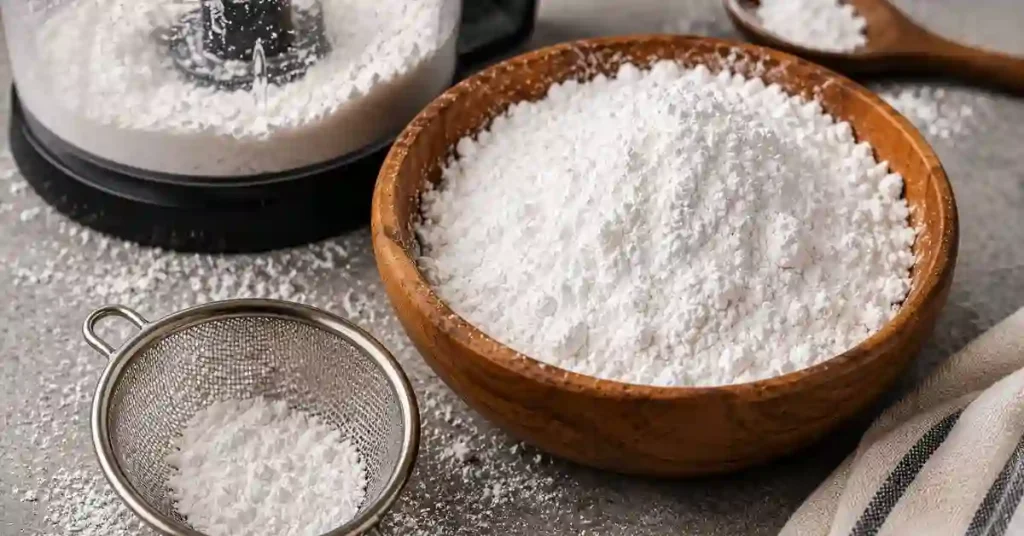
Can I Make Powdered Sugar From Regular Sugar?
Yes—you absolutely can.
In fact, that’s exactly what I did the first time.
It was a cold Wednesday evening. I was halfway through making cream cheese frosting. The butter was out. The mixer was on. Then I realized I had no powdered sugar left.
Classic.
I looked at the bag of regular sugar in my pantry and thought, Can I make powdered sugar from regular sugar?
Turns out, yes.
And that’s basically how store-bought powdered sugar starts too. It’s just regular sugar ground into a very fine powder.
So if you have regular sugar, you’re already halfway there.
Best sugar to use
After trying a few types, I always come back to this:
- White granulated sugar
It works best.
It blends quickly. It turns bright white. And it gives you that soft, fluffy texture you want in homemade powdered sugar.
Most important—it tastes exactly like the powdered sugar you buy at the store.
That’s what I use for frosting, cookie icing, and quick dessert glazes.
It has never let me down.
Can you use other sugars?
Yes—but each one behaves a little differently.
I’ve tested a few on lazy baking afternoons, mostly because I was curious… and once because I ran out of white sugar too.
Here’s what I found:
- Cane sugar — yes, works well. Very close to regular white sugar.
- Coconut sugar — yes, but it turns tan or light brown. Good for some recipes, not ideal for white frosting.
- Brown sugar — possible, but it changes the flavor. More caramel-like. Sometimes that’s great. Sometimes it’s weird.
- Raw sugar — harder to grind smooth. The larger sugar crystals take longer.
My oddest test was coconut sugar.
I made a quick glaze for banana bread on a rainy afternoon. It tasted amazing—warm and rich—but it looked beige.
Not bad.
Just not what I expected.
So yes, you can use other sugars.
But if your goal is classic powdered sugar, stick with white granulated sugar. It’s the easiest path—and usually the best one.
How Homemade Powdered Sugar Compares to Store-Bought
After I learned I could make powdered sugar at home, my next question was obvious.
Is it actually as good as the store-bought kind?
So I tested it.
One Saturday morning, I made two bowls of vanilla frosting. One with store-bought powdered sugar. One with my homemade powdered sugar.
Yes, my family thought I was being dramatic.
They were right.
But it taught me a lot.
The short answer?
They’re very close.
But they’re not exactly twins.
What’s the same
For most recipes, the results are almost identical.
Both give you:
- the same sweetness
- smooth frosting
- a nice finish for dusting cakes or cookies
I’ve used homemade powdered sugar in:
- buttercream
- cream cheese frosting
- cookie icing
- pancake dusting
- quick glaze for muffins
It works.
Most people won’t notice a difference.
In fact, I once used homemade sugar on cupcakes for a birthday party. Nobody knew. They just asked for seconds.
That felt like a win.
What’s different
That said, there are a few small differences.
First, homemade can feel a little less silky.
Not always—but sometimes.
That depends on how strong your blender or food processor is. A high-speed blender usually gives a finer powder.
Mine got much better after I stopped being impatient and blended for the full minute.
Second, homemade powdered sugar can clump faster.
Especially in humid weather.
I live where summer air can feel sticky, and I’ve watched fresh sugar clump by afternoon if I leave it uncovered.
Store-bought usually handles that better because it often has more cornstarch.
Third, the texture can vary.
Some batches come out perfect.
Some need a quick sift.
That’s just part of making it yourself.
Honestly, I don’t mind that.
It feels homemade because it is homemade.
And for everyday baking? I use it all the time. The slight difference is worth the convenience. Especially when the alternative is driving to the store in pajamas.
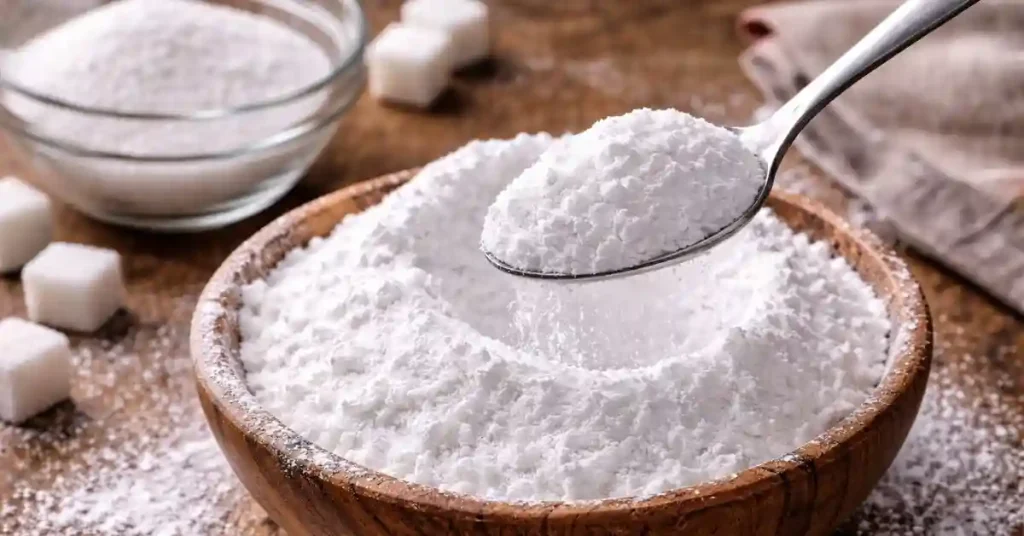
Best Ways to Use Homemade Powdered Sugar
The funny thing about homemade powdered sugar is this: once you learn how easy it is, you start using it on everything.
That happened to me fast.
The first batch I made was just to save a cupcake recipe on a rainy afternoon. But a few days later, I was dusting it over pancakes on a slow Sunday morning. Then I used it in frosting. Then in whipped cream.
Now I keep regular sugar in the pantry almost like backup powdered sugar.
And honestly? It works surprisingly well in most desserts.
Baking uses
This is where homemade powdered sugar shines the most.
I use it all the time for frosting and simple baking recipes because it blends quickly and gives desserts that soft, sweet finish people expect.
Here are the recipes where I use it most:
- Buttercream frosting
- Cream cheese frosting
- Cake glaze
- Cookie icing
One night, I used homemade powdered sugar for a batch of chocolate cupcakes because I was too tired to drive to the store. I expected the frosting texture to feel different.
It didn’t.
The buttercream came out smooth, fluffy, and easy to spread. My family scraped the bowl clean, which felt like solid proof.
I will say this, though.
If your blender does not grind the sugar very fine, frosting can feel a tiny bit grainy. I notice it most in vanilla icing because the flavor is simple and the texture stands out more.
That’s why I sometimes sift the sugar first when I want extra smooth frosting.
Quick finishing uses
This may be my favorite part.
Homemade powdered sugar makes simple food feel special in about five seconds.
I use it for:
- Dusting pancakes
- Topping brownies
- Sprinkling on French toast
- Sweetening whipped cream
One cold Saturday morning, I dusted homemade powdered sugar over warm French toast while coffee brewed in the background. The sugar melted slightly from the heat and smelled sweet and buttery.
It felt like something from a small breakfast café.
That’s the nice thing about powdered sugar. Even a tiny amount changes the texture and look of a dessert.
Just remember one thing.
Open the blender too fast, and your kitchen may look like it survived a snowstorm.
I learned that lesson the sugary way.
Common Mistakes to Avoid
I wish I could say I got this perfect the first time. I didn’t.
The first time I tried making powdered sugar at home, I made almost every mistake in the book. It was one of those late evenings when I just wanted to finish frosting cupcakes quickly. Instead, I ended up with sugar dust in the air, a slightly gritty texture, and a blender I probably overworked.
So here’s what I learned the hard way.
Blending too little
This was my first mistake.
I thought 20 seconds was enough. It wasn’t.
When I used that under-blended sugar in frosting, I could still feel tiny sugar crystals. The texture wasn’t smooth, and it didn’t melt nicely into the buttercream.
Now I always let it run a full 30–60 seconds, sometimes a bit longer if needed. It makes a big difference in that soft frosting texture we all want.
Overfilling the blender
I did this on a busy Saturday morning while trying to rush through baking.
I added too much granulated sugar at once, thinking I’d save time. Instead, the blender couldn’t break it evenly. Some parts turned into fine powder, and some stayed chunky.
The result? Uneven powdered sugar and a slightly grainy glaze.
Now I always work in small batches. It takes a little longer, but the result is much more consistent.
Using a wet machine
This one surprised me the most.
Even a tiny bit of moisture in the blender or grinder can ruin the whole batch. I once forgot to dry my blender properly after washing it, and the sugar immediately started clumping.
Instead of soft powder, I got little sticky lumps.
Now I always make sure everything is completely dry before I start. It sounds simple, but it saves a lot of frustration.
Forgetting to let dust settle
This is the mistake I still laugh about.
The first time I made homemade powdered sugar, I got impatient and opened the lid right away. A cloud of fine sugar puffed out into the air like a mini snowstorm.
My kitchen counters were covered. Even my sleeves had a light dusting of sugar.
Now I wait a few seconds before opening the blender. It gives the dust time to settle and keeps the mess under control.
Small habit, big difference.
Once I learned these few things, making homemade powdered sugar became much easier—and honestly, kind of satisfying.
How to Store Homemade Powdered Sugar
After I made my first batch of homemade powdered sugar, I learned something quickly—making it is easy, but storing it right matters just as much. Especially if you don’t want it turning into little hard lumps the next time you need it for frosting or a quick glaze.
One time, I left a small bowl of powdered sugar on my counter overnight. It was a humid evening. By morning, it wasn’t soft anymore. It had started to clump. That was my reminder: air and moisture are not friends with sugar crystals.
Since then, I’ve kept things simple and consistent.
Best storage tips
When I store homemade powdered sugar, I always treat it like any other sensitive baking ingredient that needs to stay dry and fine in texture.
Here’s what I actually do in my kitchen:
- I use an airtight container with a tight lid
- I keep it in a cool, dry cabinet away from the stove
- I avoid leaving it open, even for a few minutes
- I label it with the date so I don’t forget how long it’s been sitting there
I also make sure the container is completely dry before I add the sugar. Even a tiny bit of moisture can change that soft, powdery texture into small clumps. I learned that the hard way after one rushed cleanup after baking cookies.
How long it lasts
From my experience, homemade powdered sugar stays good for up to 6 months if it stays dry and sealed properly.
The key thing is texture. If it still feels light and smooth when you open it, it’s fine to use in frosting, glaze, or dusting desserts. If it starts forming hard pieces, I just break it up or blend it again for a few seconds.
Honestly, once I started storing it properly, I stopped worrying about running out mid-recipe. Now it just sits in my pantry like a small backup plan for any baking day surprise.
FAQs About Making Powdered Sugar
Can I make powdered sugar from regular sugar?
Yes, you can make powdered sugar from regular sugar. Just blend granulated sugar until it turns fine. It takes about 30–60 seconds.
Do I need cornstarch to make powdered sugar?
No, cornstarch is not required. It only helps stop clumps. Without it, powdered sugar still works fine for most baking uses.
What is the best sugar for homemade powdered sugar?
White granulated sugar works best. It blends fast and gives a soft, fine texture. Other sugars may change color or taste.
Can I use a blender to make powdered sugar?
Yes, a blender works very well. Just use small batches and blend until the sugar looks light, soft, and powdery.
Why is my homemade powdered sugar gritty?
It is usually not blended long enough. Blend again for a short time. A fine texture is key for smooth frosting and glaze.
To Get More About Home & Kitchen Product You Can Visit Our Site. If You Found our Posts Helpful Leave a Comment Below