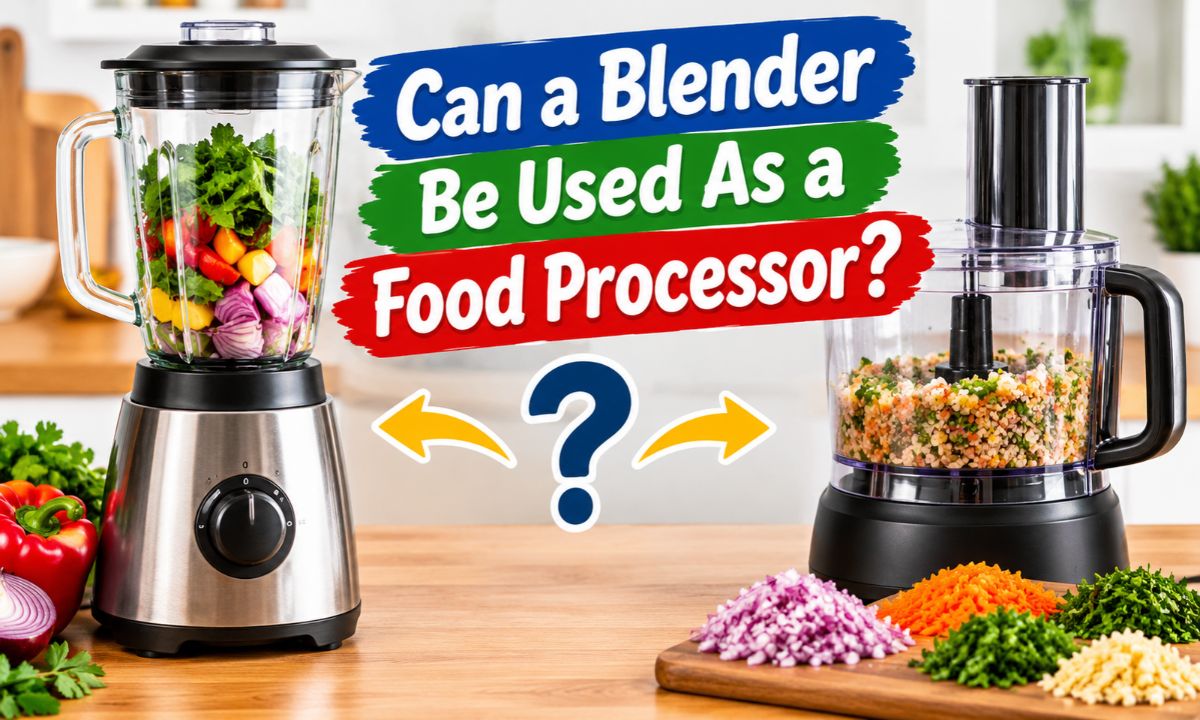
Yes, a blender can replace a food processor for some tasks, but it is not ideal for every type of food preparation.
In American kitchens, a blender is a common tool for smoothies, soups, sauces, and frozen drinks. If your food processor is missing, or you want to avoid buying another appliance, your blender may handle several everyday preparation jobs. The key is knowing which foods work well with its narrow container and fast-spinning blades.
A blender can chop small batches of vegetables, grind certain nuts, make breadcrumbs, and blend ingredients for dips. However, a food processor usually performs better when you need evenly chopped vegetables, shredded cheese, sliced produce, or pastry dough. Your results depend on the blender design, blade assembly, container shape, food texture, and amount you process at one time.
A blender and a food processor both use rotating blades, but their containers and blade designs serve different purposes. A blender usually has a tall, relatively narrow jar that helps liquid ingredients circulate toward the blades. A food processor typically has a wider bowl that gives solid ingredients more room to move and spread out.
These design differences affect the texture of your food. A blender tends to turn ingredients into a smooth mixture when enough liquid and blending time are involved. A food processor can often cut, chop, shred, and mix ingredients while keeping more of their original texture.
Neither appliance is automatically better for every job. Choose based on the result you need rather than the appliance name alone.
Blender
Best suited to smoothies, liquid batters, pureed soups, sauces, dressings, and other mixtures that benefit from a smooth consistency.
Food processor
Best suited to chopping vegetables, shredding cheese, slicing produce with compatible attachments, mixing certain doughs, and preparing solid ingredients in larger batches.
Important exception
Some high-powered blenders and personal blenders have specialized attachments or programs. Their capabilities vary, so consult the specific model’s manual.
Why a Blender Can Turn Chopped Food Into Puree
A blender’s narrow jar helps draw ingredients toward its blades, especially when liquid creates circulation. That is useful for breaking down fruit, cooked vegetables, and other ingredients into a consistent mixture. However, dry or chunky foods may not circulate evenly.
If you blend solid ingredients continuously for too long, the pieces near the blades may become very fine while larger pieces remain near the top. Adding too much liquid can also change chopped ingredients into a wet paste or puree.
For chunky results
Use short pulses and stop frequently to inspect the texture.
For smooth results
Use the manufacturer’s recommended liquid level and blending speed.
What Can You Do in a Blender Instead of a Food Processor?
A blender can take over several food processor tasks when you adjust the batch size, processing technique, and desired texture. It is most useful when the ingredients can move freely around the blades or when a smooth result is acceptable.
The following comparison shows which common kitchen jobs are practical substitutions and where a food processor remains the better choice.
Make breadcrumbs
Break bread into small pieces and process them in short pulses. Work in small batches so the crumbs do not become too fine.
Prepare sauces and dips
A blender works well for smooth salsa, dressings, hummus, pesto-style sauces, and other mixtures, although thick recipes may require scraping and stopping.
Chop small amounts of vegetables
Cut vegetables into manageable pieces, add a small batch, and pulse briefly. Expect less uniform pieces than you would typically get from a food processor.
Grind suitable nuts
Some blenders can break down nuts in small quantities. Follow the manufacturer’s instructions because hard ingredients can strain unsuitable motors or damage components.
Blend cooked vegetables
A blender can turn cooked vegetables into smooth soup or puree. Let hot ingredients cool as directed by the manual and use a model approved for hot liquids.
Mix liquid batters
Pancake batter, crepe batter, and similar mixtures can be prepared in a blender. Avoid prolonged blending when the recipe requires a light texture.
Can You Chop Onions in a Blender?
Yes, you can chop onions in some blenders, but a food processor usually makes the task easier. Peel the onion, cut it into chunks, and place a small amount in the jar. Use brief pulses rather than running the blender continuously.
Stop as soon as the pieces reach the size you want. Onions release moisture when cut, so excessive processing can quickly produce a wet, uneven mixture. If your blender cannot move the pieces without added liquid, use a knife or a food processor instead.
Best method
Use small onion chunks, short pulses, and frequent visual checks.
Common problem
Continuous blending can leave large pieces above the blades while turning the lower portion into onion puree.
Can You Make Breadcrumbs in a Blender?
Yes. A blender can make fresh breadcrumbs from bread that is suitable for your appliance. Tear the bread into small pieces and process a little at a time. Pulse until the crumbs reach your preferred size.
For dry breadcrumbs, use bread that has been dried according to your recipe. Avoid overfilling the jar, and check that the blender manual permits processing dry ingredients.
For coarse crumbs
Stop early and check the texture before processing again.
For fine crumbs
Use additional short pulses, taking care not to turn the bread into a dense powder.
Can You Make Nut Butter in a Blender?
Some powerful blenders can make nut butter, but the process places a sustained load on the motor and may require a model-specific tamper or scraping procedure. A regular blender is not guaranteed to handle thick nut mixtures safely or effectively.
Follow the recipe and manufacturer’s instructions for permitted ingredients, quantities, operating time, and cooling intervals. Stop the appliance if the motor smells overheated, the blades stop moving, or the mixture does not circulate as expected.
Check the manual
Confirm that your model supports thick nut mixtures before starting.
Avoid forcing the motor
Do not keep running a stalled blender or push ingredients toward moving blades.
What Should You Avoid Processing in a Blender?
A blender is not a universal replacement for a food processor. Certain ingredients are difficult to control in a tall jar, and some tasks require special blades or attachments. The main risks are poor texture, overloading, overheating, and damage to equipment that is not designed for the job.
Before processing any solid food, check the manual for approved ingredients and limits. A powerful motor does not mean that every blender can safely perform every food processor task.
Large batches of firm vegetables
A tall jar may produce uneven pieces because ingredients do not spread out as they do in a wide processing bowl.
Shredding and slicing
A standard blender generally cannot produce consistent cheese shreds, carrot strips, or cucumber slices. A food processor with the appropriate disc is more suitable.
Heavy pastry dough
Some blenders are not designed for thick dough. The mixture may fail to circulate or put excessive strain on the motor.
Only process these ingredients when the manual specifically permits them. Some jars, blades, and motors are not suitable for hard frozen foods.
Foods requiring precise cuts
If a recipe depends on evenly diced ingredients, such as vegetables for a uniform salad, hand-cutting or using a food processor is usually more reliable.
Can a Blender Replace a Food Processor for Dough?
Usually, a blender is not the best substitute for a food processor when making pastry dough, pie crust, or thick bread dough. Dough can become too dense to circulate, and prolonged operation may strain the motor.
Some appliances include specific dough programs or attachments, so check the manual before deciding. If your blender is not approved for dough, use a food processor designed for that task, a stand mixer where appropriate, or the traditional hand-mixing method.
For pie crust
Use a method that cuts fat into flour without developing excess gluten, such as a pastry cutter or an approved food processor.
For bread dough
Use a suitable stand mixer, a food processor rated for dough, or hand kneading according to the recipe.
Can You Shred Cheese in a Blender?
A standard blender is generally not a good tool for shredding cheese. The cheese may stick to the jar, form clumps, or break down into uneven fragments instead of producing consistent shreds.
For predictable results, use a box grater or a food processor fitted with a compatible shredding disc. If your appliance has a manufacturer-approved shredding attachment, follow its specific directions.
Best alternative
Use a box grater for small amounts or a food processor with the correct disc for larger quantities.
How to Use a Blender for Food Processor Tasks
The best way to use a blender for solid foods is to work in small batches, control the processing time, and inspect the texture often. These steps help you avoid turning chopped ingredients into an unwanted puree.
Start by checking the manual. If the appliance does not support the ingredient or task, choose another method rather than testing its limits.
Step 1: Prepare the ingredients
Wash and dry produce as appropriate, remove inedible parts, and cut large ingredients into pieces that fit comfortably in the jar.
Step 2: Add a small batch
Use a quantity that allows the ingredients to move. Overfilling can create uneven results and may strain the appliance.
Step 3: Select pulse mode
Use short pulses for chopping tasks when your blender provides this function. If there is no pulse setting, use brief bursts only if permitted by the manual.
Step 4: Stop and inspect
Turn the blender off and wait for the blades to stop before opening the lid or using a spatula. Check whether the pieces are the right size.
Step 5: Repeat if needed
Continue in short intervals until the food reaches the desired texture. Process the remaining ingredients in another small batch if necessary.
Step 6: Clean the appliance
Unplug the blender before handling the blade assembly or cleaning parts that could expose sharp edges. Follow the manufacturer’s cleaning instructions.
How to Tell Whether the Results Are Good
Successful processing depends on the recipe. Chopped vegetables should have pieces close to the size you intended, while breadcrumbs should remain crumb-like rather than becoming a compact paste. Sauces and purees should have the smoothness the recipe requires.
If the food is uneven, stop the blender, let the blades come to a complete stop, and redistribute the ingredients only after it is safe to open the jar. Reduce the batch size and use shorter pulses on the next attempt.
Food is too fine
Reduce the pulse length and inspect the texture more often.
Large pieces remain
Use smaller batches and cut the ingredients into smaller pieces before processing.
Ingredients will not move
Stop the appliance and check whether the mixture is too thick or the quantity is unsuitable. Add liquid only if the recipe allows it and a wetter result is acceptable.
What If Your Blender Cannot Handle the Task?
Do not force a blender to process ingredients that remain stuck or prevent the blades from turning. Stop the motor if it stalls, overheats, or produces an unusual smell, and consult the manufacturer’s troubleshooting guidance before using it again.
A chef’s knife, box grater, pastry cutter, hand chopper, or food processor may be a simpler solution. The right alternative depends on whether you need finely chopped ingredients, grated food, sliced produce, or a dough mixture.
For chopping
Use a knife or hand chopper when you need control over the size of solid pieces.
For shredding
Use a box grater or a suitable shredding attachment.
For thick mixtures
Use an appliance specifically rated for the task or prepare the mixture by hand.
Blender vs. Food Processor: Which Is Better for Each Task?
The best appliance depends on the texture, quantity, and preparation method required. This comparison summarizes common kitchen jobs so you can decide whether your blender is sufficient or whether another tool will save time and produce better results.
These recommendations describe typical appliance designs, not a guarantee for every model. A blender with specialized attachments may perform additional tasks, while some food processors have limited capacity or functionality.
Smoothies and milkshakes
A blender is usually the better option because its jar and blades are designed to blend liquid ingredients.
Pureed soups
A blender is generally suitable when the model permits hot liquids and the ingredients are handled according to its instructions.
Chopped onions and peppers
A food processor usually gives more consistent results, although a blender can handle small batches with careful pulsing.
Breadcrumbs
Either appliance can work, depending on batch size, bread texture, and the manufacturer’s instructions.
Shredded cheese
A food processor with a shredding disc or a box grater is usually preferable.
Pie crust and thick dough
Use a food processor or mixer specifically suited to the recipe, or prepare the mixture by hand.
Smooth sauces and dressings
A blender is a practical choice for emulsifying or pureeing ingredients into a smooth consistency.
Should You Buy a Food Processor if You Already Own a Blender?
You may not need a food processor if your regular cooking mainly involves smoothies, soups, sauces, protein drinks, and liquid batters. A blender can cover much of that work without adding another appliance to your counter or cabinets.
A food processor becomes more useful when you frequently prepare salads, chop onions and vegetables, shred cheese, slice produce, make certain doughs, or prepare large quantities of ingredients. Its wider bowl and interchangeable accessories can reduce manual preparation for those tasks.
Before purchasing another appliance, list the tasks you perform most often. If most of them involve liquids or purees, keep using your blender. If most involve uniform cuts or solid ingredients, a food processor may offer a more practical improvement.
Keep using your blender
Choose this approach if you mainly blend drinks, puree cooked foods, and prepare smooth sauces.
Consider a food processor
Consider one if you regularly chop, shred, slice, or prepare thick mixtures that your blender cannot handle.
Use basic kitchen tools
A knife, grater, and mixing bowl may be enough if you only occasionally need food processor functions.
Common Mistakes When Using a Blender as a Food Processor
Most unsuccessful attempts happen because the batch is too large, the blender runs too long, or the ingredients are unsuitable for the appliance. A few adjustments can improve the results without requiring a new machine.
Use the following checks before repeating a task that produces poor texture or puts unusual strain on the motor.
Running the blender continuously
Continuous blending can turn chopped food into puree. Use short pulses for solid ingredients and inspect the results frequently.
Filling the jar too high
Large quantities may prevent ingredients from reaching the blades evenly. Reduce the batch size and process the food in stages.
Adding unnecessary liquid
Liquid may help ingredients circulate, but it also changes the final texture. Add it only when appropriate for the recipe.
Using the wrong blade or attachment
Follow the model’s instructions and never assume that a standard blending blade can replace a slicing or shredding disc.
Ignoring signs of strain
Stop if the motor stalls, smells overheated, or behaves unusually. Let the appliance cool as directed and investigate the cause before continuing.
Reaching into the jar while the blades move
Switch off the blender and wait for the blades to stop before opening the jar or moving ingredients with a utensil. Unplug it before cleaning or handling exposed blades.
Is It Safe to Use a Blender for Solid Foods?
It can be safe to process solid foods when the blender is designed for the ingredient and you follow the manufacturer’s operating instructions. However, safety and performance depend on the appliance, the food, the batch size, and the processing method.
Never place your fingers, a spoon, or a spatula near moving blades. Do not operate the blender with the lid or required safety components removed. If the manual prohibits a particular ingredient or technique, use another tool instead.
Before processing
Check approved ingredients, maximum fill levels, pulse instructions, and any limits on hard or frozen foods.
During processing
Watch for unusual noise, stalled blades, or signs of overheating, and stop the appliance if these occur.
During cleaning
Unplug the appliance and follow the manual for safely cleaning sharp blades and removable components.
Frequently Asked Questions
Q
Can I use a blender instead of a food processor for vegetables?
Yes, for small amounts of vegetables that you want to chop roughly, a blender may work with short pulses. However, a food processor generally produces more even pieces because its wider bowl allows solid ingredients to move more freely. For uniform diced vegetables or large batches, use a knife or a suitable food processor.
Q
Can I use a blender to make hummus?
Yes. A blender can make smooth hummus from chickpeas, tahini, lemon juice, and other recipe ingredients. Thick hummus may need careful scraping and small batches. Turn off the appliance and wait for the blades to stop before opening the jar or redistributing the mixture. Follow the blender’s instructions for thick foods.
Q
Can a blender chop nuts without turning them into nut butter?
Often, yes, if the blender supports processing nuts. Use a small batch and short pulses, checking the texture frequently. Stop when the pieces reach the desired size. Continuous blending creates more heat and can turn chopped nuts into a paste. Follow the manual’s limits for hard or dry ingredients.
Q
Can I use a blender to shred carrots or cheese?
A standard blender is not ideal for shredding carrots or cheese into uniform pieces. It may produce uneven fragments, clumps, or puree. A box grater is a practical option for small amounts, while a food processor with the appropriate shredding disc is useful for larger batches.
Q
Can I use a blender instead of a food processor for pie crust?
A regular blender is generally not recommended for pie crust because the mixture is thick and needs controlled mixing to keep the pastry tender. Use a pastry cutter, a food processor approved for pastry preparation, or another method recommended by the recipe. Only use a blender for dough if its manufacturer explicitly supports that task.
✦ Wrapping Up
Conclusion
A blender can serve as a food processor for selected kitchen tasks, including making breadcrumbs, blending sauces, preparing smooth dips, and chopping small quantities of suitable ingredients. The best results come from small batches, short pulses, and careful attention to texture.
However, a blender does not fully replace a food processor. If you regularly shred cheese, slice vegetables, prepare uniform chopped ingredients, or mix thick dough, a food processor or a simple manual tool is usually more practical. Always check your appliance’s instructions before processing solid or hard foods.
💡 Key Takeaway
Before using your blender as a food processor, identify the texture you need, check the manufacturer’s instructions, and start with a small batch using short pulses. If the food will not move freely or the motor shows signs of strain, stop and choose a more suitable tool.