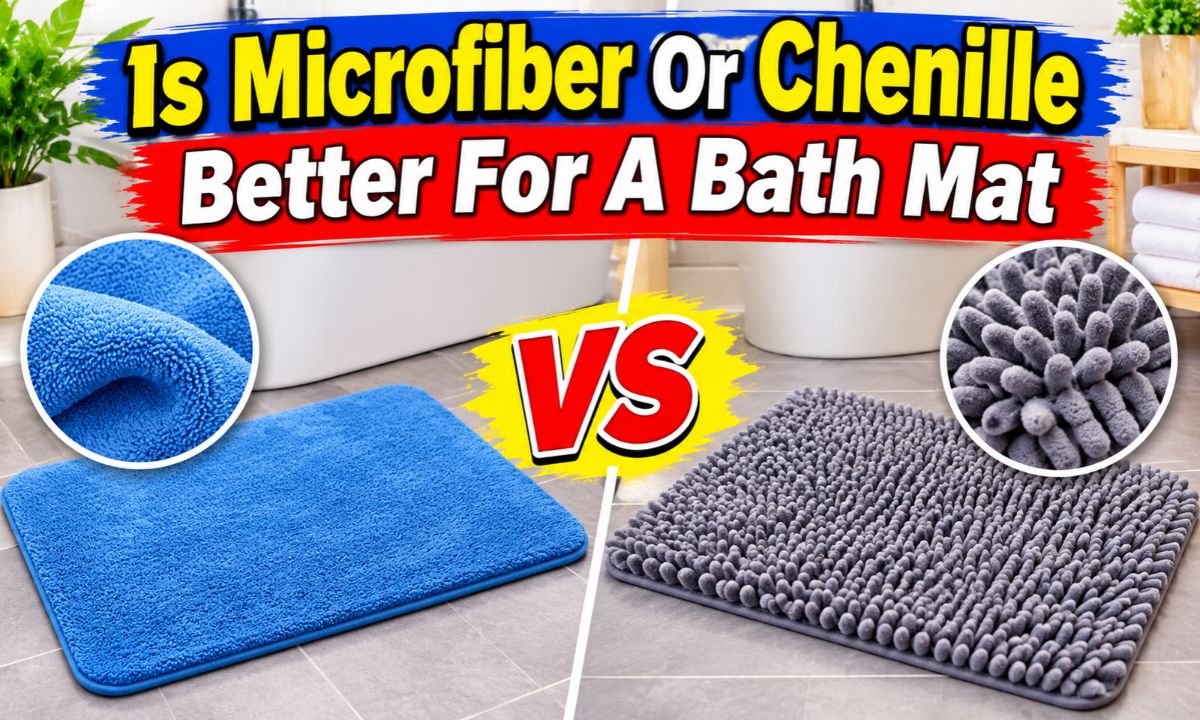
Chenille is usually better for plush comfort and soaking up water, while thin microfiber is often better for quick drying and easy care. The best choice depends on pile thickness, backing, and bathroom airflow.
In American homes, a bath mat often sits on tile, vinyl, or another hard floor just outside a bathtub or walk-in shower. It catches water from wet feet and gives you a softer place to stand while you dry off. Choosing the right fabric matters, especially in a shared family bathroom where several showers may happen each morning.
Microfiber and chenille are both popular choices, but comparing them is not as simple as comparing two different fabrics. Microfiber describes very fine synthetic fibers, while chenille describes a yarn or pile construction that creates a soft, fuzzy surface. Some chenille bath mats are made from microfiber polyester, so the two terms can describe parts of the same product.
This difference can change what you should buy. A thin, flat microfiber mat may dry faster than a thick chenille mat, but a chenille mat made with microfiber yarn can also absorb plenty of water. Rather than relying on the label alone, look at the surface, pile height, fabric, backing, and care instructions.
Microfiber and chenille describe different things. Microfiber refers to fibers that are much finer than many ordinary textile fibers. These fine strands can create a soft surface and, depending on their construction, can help draw water into the fabric.
Chenille refers to a fuzzy yarn or pile with fibers that extend around a central core. The finished surface often looks like short, dense tufts or soft caterpillar-like strands. This structure gives chenille bath mats their familiar fluffy feel.
Many bath mats combine both. A mat may have a microfiber polyester face made into a chenille pile. In that case, calling it either a microfiber mat or a chenille mat may be correct, but each label describes a different feature.
Microfiber
A fine synthetic fiber material, often polyester or a polyester blend, used in smooth, short-pile, or plush bath mats.
Chenille
A fuzzy yarn or pile construction that creates a soft, raised surface. It may use microfiber polyester as its fiber material.
Microfiber chenille
A combination that uses fine synthetic fibers in a chenille-style pile. It can offer both softness and good moisture absorption.
Why The Difference Matters
A product label does not tell the whole story. Two mats labeled microfiber may have very different pile heights and densities. One may be thin and smooth, while another may have long, fluffy strands.
The same is true of chenille. A low-pile chenille mat may dry more easily than a very thick one. For a fair comparison, think about the actual construction instead of treating the two labels as exact opposites.
Check the fiber content
Look for polyester, nylon, cotton, or a blend on the product label.
Check the pile
A short, open pile may dry more easily than a dense, deep pile.
Check the backing
The bottom layer affects floor grip, care needs, and how well the mat releases moisture.
Microfiber Vs. Chenille Bath Mats: A Quick Comparison
The main trade-off is between surface feel, water handling, and drying time. A thin microfiber mat is often easier to dry and store. A thick chenille mat usually feels softer and more cushioned, although it can hold more moisture within its pile.
These are general tendencies, not fixed performance rules. Fiber blend, pile density, thickness, backing, washing method, and room conditions can change the result. The table below compares common designs rather than every product sold under these labels.
Microfiber
Often a good fit for people who want a light, easy-care mat with a smooth or short-pile surface.
Chenille
Often a good fit for people who want a fluffy surface with a warm, soft feel underfoot.
Side-By-Side Material Comparison
Use this comparison as a buying guide, not a laboratory ranking. A thick microfiber mat can be slower to dry than a thin chenille design, and a dense chenille mat may absorb more water than a flat microfiber mat.
Softness
Chenille usually has the edge when you prefer a fluffy, textured surface. Microfiber can also feel soft, but flat designs may feel less plush.
Absorbency
Both can absorb water well. Dense chenille pile may hold more water, while fine microfiber fibers can draw moisture into the surface.
Drying
Thin microfiber often dries sooner. Thick chenille may need more time because its deep pile can hold moisture.
Cleaning
Both are available in machine-washable designs. Always follow the label because the backing may limit washing and drying methods.
Comfort
Chenille often feels warmer and more cushioned. Thin microfiber gives a lighter, less bulky feel.
Storage
A thin microfiber mat is often easier to fold and store. A thick chenille mat takes up more room.
Value
Neither material is automatically more durable or affordable. Construction, stitching, backing, and care requirements affect long-term value.
Which Bath Mat Absorbs More Water?
Chenille often has an advantage when the goal is to catch water from wet feet, especially when the mat has a dense, raised pile. Its many soft strands create a larger textured surface that can hold moisture between the fibers.
Microfiber can also absorb water very well. Its fine fibers can draw moisture into the fabric, and some microfiber mats are designed for high absorption. A thick microfiber chenille mat may therefore perform much like a product sold simply as a chenille bath mat.
The important point is that absorbency is not the same as drying speed. A mat can take in plenty of water but still remain damp for a long time. If the floor stays wet after every shower, you need to consider both how much water the mat catches and how quickly it releases that moisture.
For heavy water exposure
Consider a dense, absorbent pile that can catch water from several wet steps.
For light daily use
A thin microfiber mat may provide enough absorption without adding unnecessary bulk.
For shared bathrooms
Choose a mat that can dry fully between uses, or keep a second washable mat ready to rotate.
Does A Thicker Mat Always Absorb More?
No. Thickness alone does not prove that a mat can hold more water. Fiber type, pile density, surface area, and the backing all play a part. A thick mat with a dense pile may absorb plenty, but a thick foam layer may simply add weight and slow drying.
Look for clear product details about the face fabric and construction. If a listing only says super absorbent without explaining the material or care needs, treat that phrase as marketing rather than a measured result.
Look for a dense but open pile
It should feel substantial without appearing tightly packed into a solid layer.
Read the material label
Check whether the mat uses polyester microfiber, cotton, or a mixed fabric.
Which Material Dries Faster?
Thin microfiber usually has the advantage in drying speed because it contains less bulky pile and can release moisture more easily. This can be useful in a small bathroom, a humid home, or a room with limited ventilation.
Thick chenille can take longer to dry because water may remain between its many raised strands. However, a lightweight chenille mat with an open pile may dry faster than a dense microfiber mat with a thick backing. There is no reliable rule that every microfiber mat dries faster than every chenille mat.
The bathroom itself also affects drying. A mat on a damp floor, in a closed room, or beneath a vanity with poor airflow may stay wet much longer than one hung over a drying rack.
Choose a low-pile design
A shallow surface usually gives moisture less room to remain trapped.
Improve airflow
Use a bathroom fan where available and leave enough space for air to move around the mat.
Lift the mat after use
Hang it over a rack or towel bar if the care instructions allow this.
How To Tell If Your Mat Is Dry Enough
Check both the top and bottom before putting the mat back on the floor. The surface may feel dry while the backing or lower pile still feels damp. Pay attention to any musty smell, which can signal that moisture is lingering.
A mat should be fully dry before you place it on a clean, dry floor again. If it remains damp between showers, use a lighter mat, improve airflow, or rotate between two mats.
Touch the center
Check the thickest part rather than only the edges.
Check the underside
Feel the backing and the fabric close to it for trapped moisture.
Check the smell
A persistent musty odor means the mat needs cleaning and a more complete drying routine.
Which Bath Mat Feels Softer And More Comfortable?
Chenille is usually the better choice if softness is your main concern. Its fuzzy strands create a plush surface that feels gentle under bare feet. This can be welcome on cold tile floors during winter mornings.
Microfiber can feel soft too, especially in a brushed or thick-pile design. A smooth microfiber mat may feel more like a soft towel, while a chenille mat feels more like a fluffy rug. The difference is mainly in texture and pile construction.
Comfort is personal, so consider how you use the bathroom. Someone who wants a soft place to step after a shower may prefer chenille. Someone who wants a thin mat that does not feel bulky around a small sink may prefer microfiber.
For a fluffy feel
Choose chenille with a soft, dense pile.
For a smooth feel
Choose a short-pile or flat microfiber surface.
For a small bathroom
Consider a thinner mat that does not interfere with doors, drawers, or walking space.
Does Pile Height Affect Comfort?
Yes. A taller pile can feel more cushioned because your feet sink slightly into the fibers. It may also feel warmer than a thin surface. But a very deep pile can be harder to clean and may take longer to dry.
A medium or low pile can offer a useful balance. It gives your feet a soft surface without making the mat overly bulky.
Low pile
Useful for easy movement, simpler cleaning, and a less bulky feel.
Medium pile
A practical middle ground between softness and ease of care.
High pile
Best suited to people who value a fluffy feel and can manage the extra drying time.
Which One Is Easier To Wash And Maintain?
Both microfiber and chenille bath mats can be easy to maintain, but the product’s construction matters more than its name. A simple fabric mat may be machine washable, while another mat with a rubber-like backing may need gentle washing and low-heat or air drying.
Before buying, read the full care label. Check the washing temperature, cycle, detergent guidance, drying method, and any warning about bleach or fabric softener. Never assume that a machine-washable mat is also safe for a hot dryer.
Fabric softener can leave a coating on synthetic fibers and reduce how well they take in water. For many microfiber products, a mild detergent without softener is a sensible care choice, unless the manufacturer gives different instructions.
Wash when needed
Clean the mat when it becomes visibly dirty, smells unpleasant, or has collected hair and soap residue.
Avoid harsh heat
High heat can damage some synthetic fibers and backing materials.
Dry completely
Do not put a damp mat back on the bathroom floor after washing.
Keep the backing in good shape
Stop using a mat if the backing flakes, cracks, peels, or loses its grip.
How To Wash A Microfiber Or Chenille Bath Mat
Start by checking the care label. If the mat is machine washable, shake off loose hair and dust outdoors or over a trash can. Wash it separately or with similar soft items if the label permits.
Use the recommended cycle and a suitable detergent. Avoid bleach and fabric softener unless the manufacturer specifically allows them. After washing, inspect the backing and dry the mat as directed.
If the mat is not machine washable, use the cleaning method listed by its maker. Do not soak a mat with an unknown backing or foam layer, as water can become trapped inside.
Step 1: Read the label
Confirm whether the mat can go in the washer and dryer.
Step 2: Remove loose debris
Shake out hair, lint, and loose dirt before washing.
Step 3: Wash gently
Use the approved temperature and cycle with a mild detergent.
Step 4: Dry as directed
Use low heat only if allowed, or air-dry the mat until both sides are completely dry.
Step 5: Inspect before reuse
Check for loose tufts, damaged seams, peeling backing, or a lingering smell.
Are Microfiber Or Chenille Bath Mats Safer?
Neither material is automatically safer. A bath mat can help catch water, but it can also become a slipping or tripping hazard if it moves, curls, or sits unevenly on the floor. The backing, floor condition, mat size, and placement are important safety factors.
Look for a backing designed for your floor type. Some products use thermoplastic rubber, latex, PVC, or other coatings. Their grip and care limits vary, so check the maker’s instructions and confirm that the backing is suitable for your flooring.
Place the mat on a clean, dry, flat surface. Water, soap residue, dust, and floor cleaners can reduce grip. If the mat slides when you step on it, remove it until the problem is fixed rather than relying on the fabric pile to keep it in place.
Choose a stable backing
Check that the backing is suitable for the exact floor material in your bathroom.
Keep the floor dry
Do not place a backed textile mat over standing water or a wet floor.
Avoid curled edges
Replace a mat that no longer lies flat or creates a raised edge.
Check it often
Look for wear, cracks, peeling, and loss of grip.
What If You Have Older Adults Or Children At Home?
A thick, fluffy bath mat is not always the best choice for someone with balance or mobility concerns. Deep pile and raised edges may make foot placement less predictable. A low-profile mat that lies flat may be easier to step onto.
For an older adult or anyone at higher risk of falling, do not treat a textile bath mat as a replacement for properly installed grab bars or other suitable bathroom safety equipment. A qualified occupational therapist or home safety professional can help assess individual needs.
Prefer low-profile edges
Avoid thick borders that can catch a toe or mobility aid.
Check the floor grip
Make sure the mat stays in place during normal use.
Keep walking paths clear
Do not place several loose mats where someone must step over them.
Which Material Is Better For Different Bathrooms?
The best choice depends on how much water the mat receives, how often people use the bathroom, and whether you can dry it between uses. A mat that works well in a large, ventilated bathroom may stay damp in a small room with little airflow.
Think about your daily routine before choosing a material. If several people use the same shower, a mat that is easy to wash and rotate may be more useful than one chosen only for its plush feel.
Small bathroom
A thin microfiber mat can save space and may be easier to hang or store.
Busy family bathroom
A washable, absorbent chenille or microfiber chenille mat can handle repeated use if it dries fully.
Humid bathroom
Choose a low-pile, lightweight design and improve ventilation. Hang the mat after use.
Guest bathroom
A soft chenille mat can add comfort, provided you can wash and dry it between visits.
Bathroom with limited storage
A thin microfiber design may be easier to fold and put away.
Best Choice For A Bathroom That Stays Damp
If your bathroom stays humid, avoid choosing a mat based on thickness alone. A lightweight, low-pile microfiber design may be easier to dry than a thick chenille rug. Still, its backing must allow proper drying, and the mat should be lifted after use.
If a textile mat repeatedly stays wet or develops a musty smell, changing from chenille to microfiber may not solve the underlying problem. Better ventilation, a dry storage spot, and a second mat for rotation may make a bigger difference.
First choice
A washable, low-pile mat with a simple construction.
Helpful habit
Hang it so air can reach both sides.
When to replace it
Replace it if the backing breaks down, the pile remains damp, or odor persists after proper cleaning.
Best Choice For A Cozy Bathroom
If comfort is your main goal and the bathroom has good airflow, chenille is often the more satisfying option. Its raised pile gives a soft feel and adds texture beside a tub or shower.
Choose a mat with a manageable pile height and a washable construction. A plush mat still needs regular cleaning and complete drying.
Look for
A soft, even pile with secure tufts and a backing that suits your floor.
Avoid
Very deep pile if you cannot hang the mat or give it time to dry.
What To Check Before Buying A Bath Mat
The label gives you more useful information than a broad claim such as ultra absorbent or quick drying. Check the fiber content, pile, backing, size, and care instructions before making a choice.
A well-made mat should fit the space without blocking a door or creating a raised edge. It should also be easy to lift, wash, and dry as part of your normal bathroom routine.
Fiber content
Look for the actual material, such as polyester microfiber or a cotton blend.
Pile height
Choose a height that balances comfort with easy cleaning and drying.
Backing type
Check the backing material and any limits on floor type, washing, or heat.
Wash instructions
Confirm that you can clean the mat with the time and equipment you have.
Size and shape
Measure the area and leave enough space for doors and safe movement.
Construction
Look for secure seams, even pile, and no loose backing or tufts.
Do Not Rely On GSM Alone
GSM means grams per square meter. It describes the mass of the fabric per unit of area, but it does not prove how well a bath mat absorbs water or how quickly it dries. A heavier mat may simply contain more material.
Use GSM as one detail, not the deciding factor. A lighter mat with an open pile may dry more easily than a heavy, tightly packed mat. Construction and care instructions still matter.
Compare similar designs
GSM is more useful when the mats have similar fiber types and construction.
Check real care limits
A heavy mat that cannot be machine washed may be less practical for your routine.
Common Mistakes When Choosing Between Microfiber And Chenille
The biggest mistake is assuming that a material label tells you everything about a bath mat. Two products with the same label can differ in thickness, backing, absorbency, and care needs. A good buying decision comes from looking at the complete design.
Mistake 1: Assuming chenille and microfiber are unrelated
Many chenille mats use microfiber polyester. Check both the fiber content and the pile construction.
Mistake 2: Choosing the thickest mat
A deep pile may feel cozy but can take longer to dry and may be harder to clean.
Mistake 3: Ignoring the backing
A poor or damaged backing can cause sliding and may affect floor finishes.
Mistake 4: Using too much detergent or softener
Residue can build up and affect how well the fibers absorb water.
Mistake 5: Leaving the mat on a wet floor
Moisture trapped beneath the mat can cause odor and may affect some flooring.
Mistake 6: Assuming every mat is dryer-safe
Heat can damage some backings. Follow the care label rather than guessing.
When Should You Replace Your Bath Mat?
Replace a bath mat when it no longer performs its basic job. Warning signs include a backing that peels or cracks, edges that curl, loose fibers, worn patches, and an odor that remains after proper washing and drying.
There is no single replacement schedule that fits every home. A mat used by several people each day may wear out sooner than one in a guest bathroom. Inspect it often and judge its condition rather than relying on age alone.
Loss of grip
Stop using the mat if it slides or the backing has broken down.
Persistent odor
Replace it if a musty smell remains after proper cleaning and complete drying.
Visible damage
Replace mats with torn seams, loose pile, or curled edges that create a trip risk.
Research Notes And Next-Question Gap Map
The comparison above uses product construction and care details rather than claiming that one material wins every test. The key distinction is that microfiber names a fiber type, while chenille describes a yarn or pile structure. This helps explain why many products combine both.
A review of available comparison and buying guides found useful coverage of softness, absorption, drying, and care. Some pages discuss microfiber and chenille as if they were fully separate material types, while product listings show that chenille faces are often made from microfiber polyester. That distinction deserves a clear explanation before a buyer compares labels.
The research sample included general bath mat guides, material comparisons, and product care information available on November 12, 2026. The reviewed pages were not treated as independent laboratory tests. Manufacturer and retailer descriptions can identify listed materials and care directions, but marketing claims do not establish universal performance.
Competitor coverage
The reviewed pages covered material feel, absorbency, drying, and maintenance. The distinction between microfiber as a fiber and chenille as a pile construction was not explained consistently.
Important limitation
No standardized side-by-side test of all microfiber and chenille bath mats was established by the reviewed material. Exact performance rankings would need controlled testing.
Reader benefit
Buyers can compare the actual construction, backing, and care needs instead of relying on a broad product label.
Useful Questions To Ask Before Buying
The questions below are inferred next needs based on the buying decision. They are not claims about verified search volume or a live search trend.
Will the mat dry between showers?
Reader stage: before buying. Basis: inferred from the importance of moisture release. Reviewed coverage: partial. Benefit: helps match pile height and weight to room airflow. Priority: high.
Can the mat go in the dryer?
Reader stage: after buying. Basis: inferred from backing and care limits. Reviewed coverage: partial. Benefit: prevents heat damage. Priority: high.
Is the backing safe for my floor?
Reader stage: before buying and during use. Basis: inferred from floor compatibility. Reviewed coverage: partial. Benefit: reduces sliding and floor damage risks. Priority: high.
When should I replace the mat?
Reader stage: long-term care. Basis: inferred from wear and hygiene needs. Reviewed coverage: shallow. Benefit: helps readers recognize loss of grip and persistent odor. Priority: medium.
Frequently Asked Questions
Q
Is chenille more absorbent than microfiber?
Chenille can hold plenty of water because its raised pile creates space between the fibers. However, microfiber can also absorb moisture very well. Since many chenille bath mats use microfiber polyester, the actual construction matters more than the name on the label.
Q
Does microfiber dry faster than chenille?
Thin microfiber often dries faster than thick chenille because it has less bulky pile. But a lightweight chenille mat may dry sooner than a thick microfiber mat. Backing, thickness, airflow, and drying habits all affect the result.
Q
Are chenille bath mats good for everyday use?
Yes. Chenille can be a comfortable everyday choice because it feels soft and catches water from wet feet. Choose a washable design, lift it after use, and make sure it dries fully before placing it back on the floor.
Q
Can I put a microfiber or chenille bath mat in the dryer?
Some can go in the dryer, but not all. A high temperature can damage rubber-like backing or affect the mat’s shape. Check the care label and use low heat only when the manufacturer allows it. Air drying is a suitable option when the label recommends it.
Q
Which bath mat is better for a humid bathroom?
A lightweight, low-pile microfiber mat is often a practical choice because it may dry sooner than a thick, fluffy design. However, ventilation and proper drying matter more than the material name alone. Hang the mat after use and avoid leaving it flat on a damp floor.
Q
Do microfiber and chenille bath mats prevent slipping?
Neither surface material guarantees slip resistance. The backing, floor condition, and mat design determine how well the mat stays in place. Choose a backing made for your floor, keep the floor dry, and stop using the mat if it moves or curls.
Q
Which bath mat lasts longer?
There is no universal winner. Durability depends on fiber quality, pile construction, stitching, backing, washing frequency, and care. A well-made low-pile microfiber mat may last longer than a poorly made thick chenille mat, but the reverse can also be true.
✦ Wrapping Up
Conclusion
So, is microfiber or chenille better for a bath mat? Chenille is often the better choice if you want a fluffy, cozy surface that can catch plenty of water. Thin microfiber is often the more practical option if you want a lighter mat that is easy to wash, store, and dry.
The most useful detail is that these choices can overlap. Many chenille bath mats are made from microfiber polyester, so you should compare pile height, density, backing, and care instructions instead of relying on the product name alone.
For most homes, a washable mat with a suitable backing, manageable pile, and enough time to dry is a better purchase than the thickest or softest option. If your bathroom is humid, favor easy drying. If comfort matters most and you have good airflow, chenille is worth considering.
💡 Key Takeaway
Before buying, check the fiber content, pile height, backing material, and washing instructions. Choose low-pile microfiber for easier drying or plush chenille for a softer feel, and always make sure the mat dries fully between uses.