
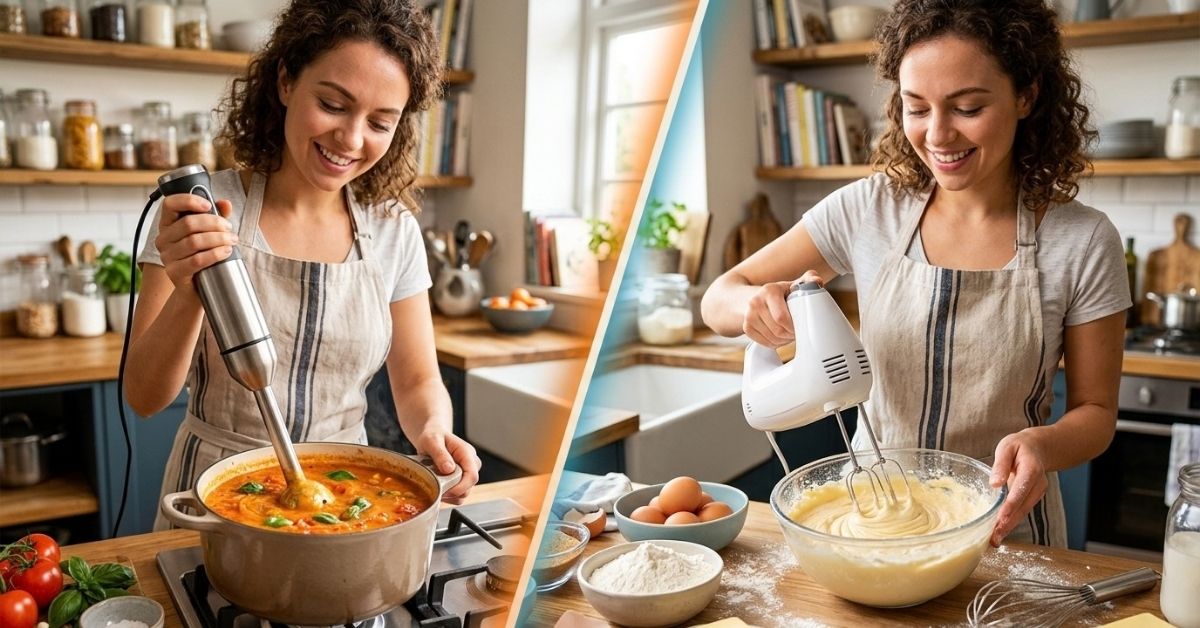
When I first looked into Is an Immersion Blender the Same as a Hand Blender?, I thought there might be a real difference between the two. The names made them sound like separate kitchen tools. But after digging into how these blenders are made and used, I found the answer is much simpler.
An immersion blender and a hand blender are usually the same type of kitchen appliance. Both have a motor handle with a blending blade at the end. You place the blade into the food instead of moving the food into a blender jar. The small differences usually come from the model, attachments, power, and design.
Is an Immersion Blender the Same as a Hand Blender?
Yes. In most cases, an immersion blender is the same as a hand blender.
“Immersion blender” describes how the tool works. You immerse the blade into food, soup, sauce, or another mixture. “Hand blender” describes the way you hold and use it.
You may also see names such as stick blender, stick mixer, or wand blender. In everyday kitchen use, these terms often point to the same basic appliance.
| Name | Usually means | Main idea |
| Immersion blender | Stick-style blender | Blade goes into food |
| Hand blender | Handheld blender | Held in your hand while blending |
| Stick blender | Same basic design | Long handle with blade |
| Wand blender | Another common name | Handheld blending tool |
The important thing is not the name on the box. I pay more attention to the motor power, speed control, blade design, shaft length, and included attachments.
Those details tell you much more about how useful the blender will be in your kitchen.
Why Do People Call It an Immersion Blender and a Hand Blender?
The different names can make shopping more confusing than it needs to be.
The term immersion blender comes from the way the appliance works. Instead of pouring soup into a countertop blender, you put the blending end directly into the pot or bowl.
The term hand blender comes from the way you hold it. You control the tool with your hand while the blade spins inside the food.
So, both names describe the same basic idea from different angles.
Are Stick Blender and Immersion Blender Also the Same?
In most cases, yes.
A stick blender is another common name for an immersion blender. Some companies may use slightly different names for marketing or product design, but the basic function stays the same.
| Term | Typical use |
| Stick blender | Common everyday name |
| Immersion blender | Common technical/product name |
| Hand blender | Focuses on handheld use |
One thing I learned while researching these appliances is that the name can be less useful than the specifications. Two products may both be called hand blenders, yet one may have much better speed control and attachments than the other.
How Does an Immersion or Hand Blender Work?
The basic design is quite simple.
A motor sits inside the handle. A long shaft connects the motor to a small blade assembly. When you press the control, the motor spins the blade.
You then move the blade through the food.
That simple design makes an immersion blender useful for foods that are awkward to transfer into a regular blender.
| Part | What it does |
| Motor handle | Powers the blade |
| Blending shaft | Carries power to the blade |
| Blade guard | Helps protect the spinning blade |
| Blades | Break down and mix food |
For example, if I make a pot of vegetable soup, I do not need to cool the soup, pour it into another container, blend it, and pour it back.
I can blend it right in the pot, provided the blender and cookware are suitable for that use.
That saves dishes and makes the process much less messy.
What Can You Make With an Immersion Blender?
This is where the handheld design becomes useful.
An immersion blender can handle many soft or liquid foods. It is especially handy when you want a smooth texture without using a large countertop blender.
Common uses include:
- Creamy soups
- Tomato sauce
- Gravies
- Purees
- Baby food
- Smooth sauces
- Salad dressings
- Mayonnaise
- Smoothies in a suitable container
- Milk-based drinks
| Food | How useful is it? | Why |
| Soup | Very useful | Blends directly in the pot |
| Sauce | Very useful | Easy to smooth small batches |
| Smoothie | Useful | Works best with soft ingredients |
| Ice | Usually poor choice | Many models are not made for it |
I would not assume that every immersion blender can crush ice or handle hard frozen foods. This is one of the easiest mistakes to make when comparing models.
The motor and blade design matter.
Immersion Blender vs Regular Blender: What Is the Real Difference?
An immersion blender and a countertop blender can both make food smooth, but they are designed for different jobs.
A regular blender has a container around the blades. An immersion blender brings the blades to the food instead.
That difference affects convenience, capacity, cleaning, and performance.
| Comparison | Immersion blender | Countertop blender |
| Storage | Compact | Takes more space |
| Blending location | Bowl or pot | Blender jar |
| Small batches | Very convenient | Can be less convenient |
| Large batches | Limited by container | Usually better |
| Cleanup | Often easier | More parts to wash |
For me, the biggest advantage of an immersion blender is not raw power. It is convenience.
If I only need to blend a small amount of soup or sauce, using a full-size blender can feel like too much work.
When Is a Hand Blender More Convenient?
There are certain kitchen jobs where a handheld blender makes a lot of sense.
Blending Soup in the Cooking Pot
This is probably the classic use.
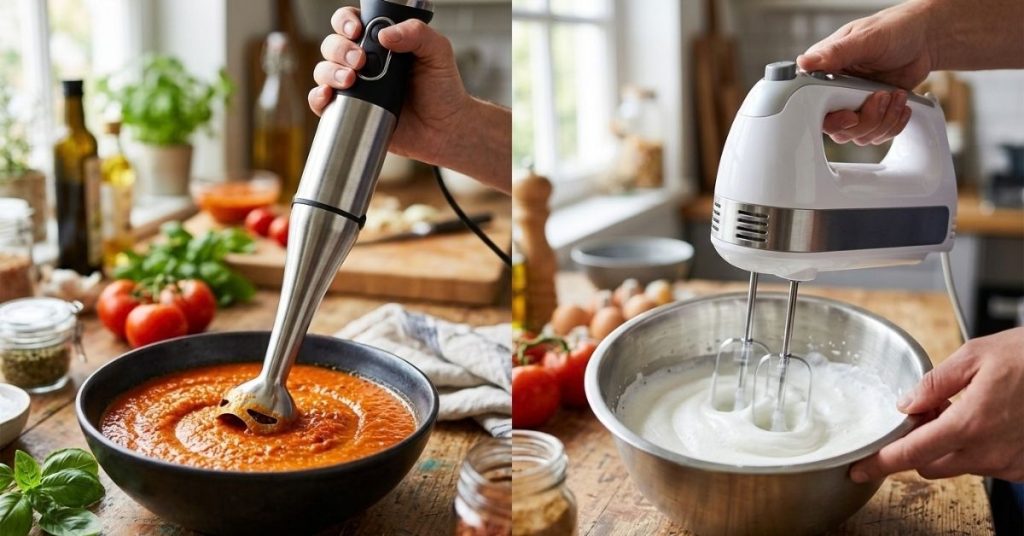
You can blend cooked vegetables and liquid directly in the pot. There is no need to transfer hot food to a separate blender jar.
Still, I would keep the blade submerged while running it. Splashing hot soup is a much bigger problem than a few extra seconds of blending.
Making Small Batches
A countertop blender can sometimes struggle with a tiny amount of food because the ingredients do not reach the blades well.
A hand blender does not have the same issue because you place the blade right where the food is.
Reducing Cleanup
This was one of the biggest practical lessons I found while comparing the two designs.
With an immersion blender, you may only need to clean the blending shaft and rinse the container you already used.
That can be much easier than washing a large blender jar, lid, blade assembly, and other parts.
What Are the Downsides of an Immersion Blender?
The compact size is useful, but it also creates some limits.
An immersion blender is not automatically a replacement for every blender in your kitchen.
| Limitation | What it means |
| Smaller blade area | May need more movement |
| Less capacity | Not ideal for huge batches |
| Splashing | Can happen if used poorly |
| Motor limits | Hard foods may be difficult |
Another issue is texture.
A good immersion blender can make soup very smooth, but it may not always create the same result as a powerful countertop blender.
If you want extremely silky smoothies or very fine blends, a full-size blender may still have an advantage.
Common Immersion Blender Mistakes I Would Avoid
Some problems have little to do with the blender itself. They come from how it is used.
Mistake 1: Running It Above the Food
This can pull air into the mixture and create splashes.
Keep the blade head properly positioned inside the food before switching it on.
Mistake 2: Assuming More Speed Always Means Better Results
High speed is not always the answer.
With thin liquids, high speed can create more splashing. With thicker mixtures, slower movement may give you better control.
Mistake 3: Ignoring the Container
A tall, narrow container can sometimes make blending easier than a wide, shallow bowl.
The right container keeps the food around the blade and reduces mess.
Mistake 4: Treating Every Model Like a Food Processor
An immersion blender is mainly a blending tool.
It is not automatically suitable for chopping hard vegetables, crushing ice, grinding nuts, or processing tough ingredients.
| Mistake | Better approach |
| Start above the food | Submerge the blade first |
| Always use maximum speed | Adjust speed to the food |
| Use a very shallow bowl | Try a suitable deep container |
| Blend hard foods blindly | Check the model’s instructions |
Do Immersion Blenders and Hand Blenders Have Different Attachments?
This is where two products with similar names can become very different.
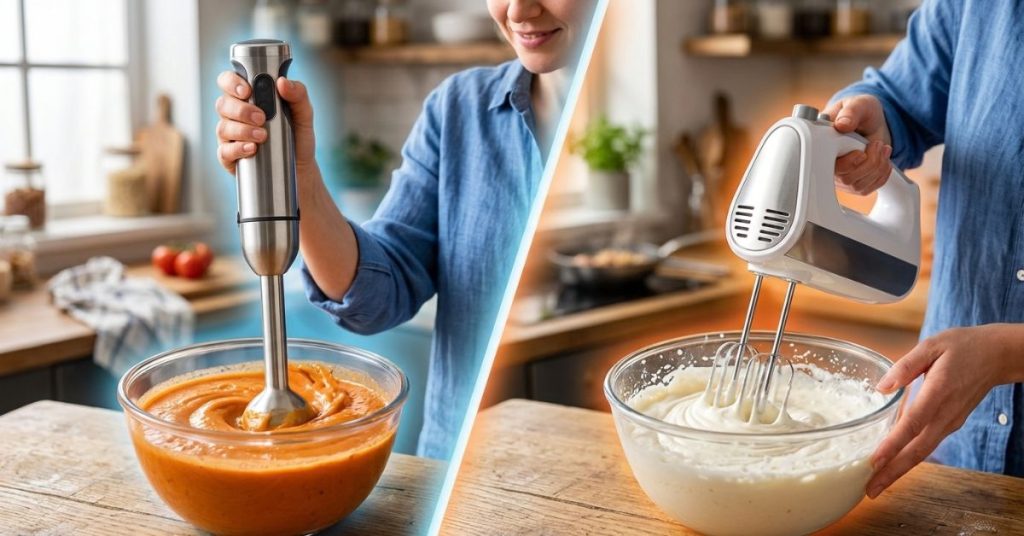
Some handheld blenders come with only a blending shaft. Others include a whisk, chopper bowl, measuring cup, or other accessories.
The attachments can make one model much more useful than another.
What Does a Whisk Attachment Do?
A whisk can help with tasks such as beating eggs, mixing light batters, or whipping certain ingredients.
It does not turn the hand blender into a stand mixer, though. The attachment has its own limits.
What Does a Chopper Attachment Do?
A small chopper bowl can handle jobs that are less suitable for the blending shaft.
Depending on the model, it may help chop herbs, onions, nuts, or other ingredients.
| Attachment | Useful for |
| Whisk | Eggs and light mixtures |
| Chopper | Small chopping jobs |
| Beaker/cup | Blending controlled portions |
| Blending shaft | Soups, sauces, purees |
This is why I would never compare two hand blenders based only on the words printed on the front of the package.
The accessory list can change what the appliance can actually do.
Does a More Powerful Hand Blender Blend Better?
Not always.
Motor power matters, but it is only one part of the picture.
Blade shape, speed control, shaft design, food texture, and how you move the blender all affect the result.
A very powerful motor may still be frustrating if the blade design does not work well with the food.
| Feature | Why it matters |
| Motor power | Helps with tougher mixtures |
| Speed control | Gives better control |
| Blade design | Affects blending action |
| Shaft length | Helps with deep pots |
| Grip design | Affects comfort |
I would look at the whole design rather than chasing the highest watt number.
For everyday soup and sauce work, control and comfort can matter more than having extreme power.
Can You Use an Immersion Blender in a Hot Pot?
Often, yes, but you should check the instructions for the specific model first.
This is one area where I would not make assumptions.
If the manufacturer allows hot-food blending, use care. Keep the blade submerged and move it slowly. Avoid lifting the running blade toward the surface.
Also think about the pot itself. A metal blending shaft can scratch some cookware if you drag it along the bottom.
A little care here can prevent a very annoying kitchen mistake.
Is an Immersion Blender Better Than a Hand Blender?
That question sounds reasonable, but it has a hidden problem.
An immersion blender and a hand blender are usually the same type of appliance.
So there is normally no “better” choice between those two names.
The useful comparison is between individual models.
If you are shopping for one, I would compare:
- Motor power
- Number of speed settings
- Variable speed control
- Blade design
- Shaft material
- Shaft length
- Dishwasher-safe parts
- Included attachments
- Comfort of the grip
- Corded or cordless design
This approach helped me avoid getting distracted by product names.
Which One Should You Choose for Your Kitchen?
If you see “immersion blender” on one box and “hand blender” on another, do not assume they are different appliances.
Look at what each model actually offers.
| Your main need | What to look for |
| Smooth soups | Strong blending shaft |
| Small sauces | Good speed control |
| Whisking | Whisk attachment |
| Chopping | Chopper attachment |
| Easy storage | Compact design |
For someone who mainly makes soup, sauces, purees, and small batches, a basic immersion or hand blender can be very practical.
If you regularly make large smoothies, crush hard ingredients, or want very fine textures, a countertop blender may make more sense.
Frequently Asked Questions About Immersion and Hand Blenders
Is an immersion blender the same as a hand blender?
Yes. In most cases, the terms describe the same handheld kitchen appliance. The exact features can vary from one model to another.
Why is it called an immersion blender?
It is called an immersion blender because you put the blending end directly into the food. This lets you blend soup, sauce, or puree without transferring it to a blender jar.
Is a stick blender the same as an immersion blender?
Usually, yes. “Stick blender” is another common name for the same basic style of handheld blender.
Can an immersion blender replace a regular blender?
Sometimes, but not for every job. It works well for soups, sauces, purees, and small batches, while a countertop blender can be better for large amounts and some hard ingredients.
Can I use a hand blender for soup?
Yes, if the specific model is designed for the task. Follow the manufacturer’s instructions for hot foods and keep the blade safely submerged while blending.
Are all hand blenders equally powerful?
No. Motor power, blade design, speed control, and construction can vary a lot between models.
Final Thoughts
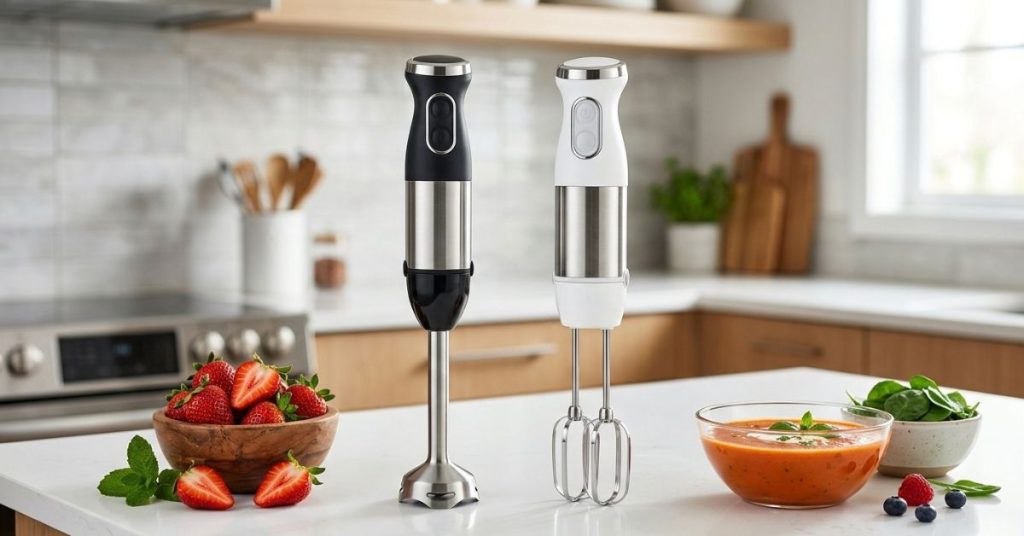
So, is an immersion blender the same as a hand blender? In everyday kitchen terms, yes. They are usually different names for the same basic handheld blending tool.
The bigger lesson is not to get stuck on the name. When I compare these appliances, I look at the motor, blade, speed control, attachments, comfort, and what foods the model is actually designed to handle.
If you mostly make soups, sauces, purees, and small batches, an immersion or hand blender can save space, dishes, and quite a bit of effort. Just choose the model based on the work you want it to do, not simply the label printed on the box.
To Get More About Home, Kitchen Accessories Product You Can Visit Our Site. If You Found our Posts Helpful Leave a Comment Below