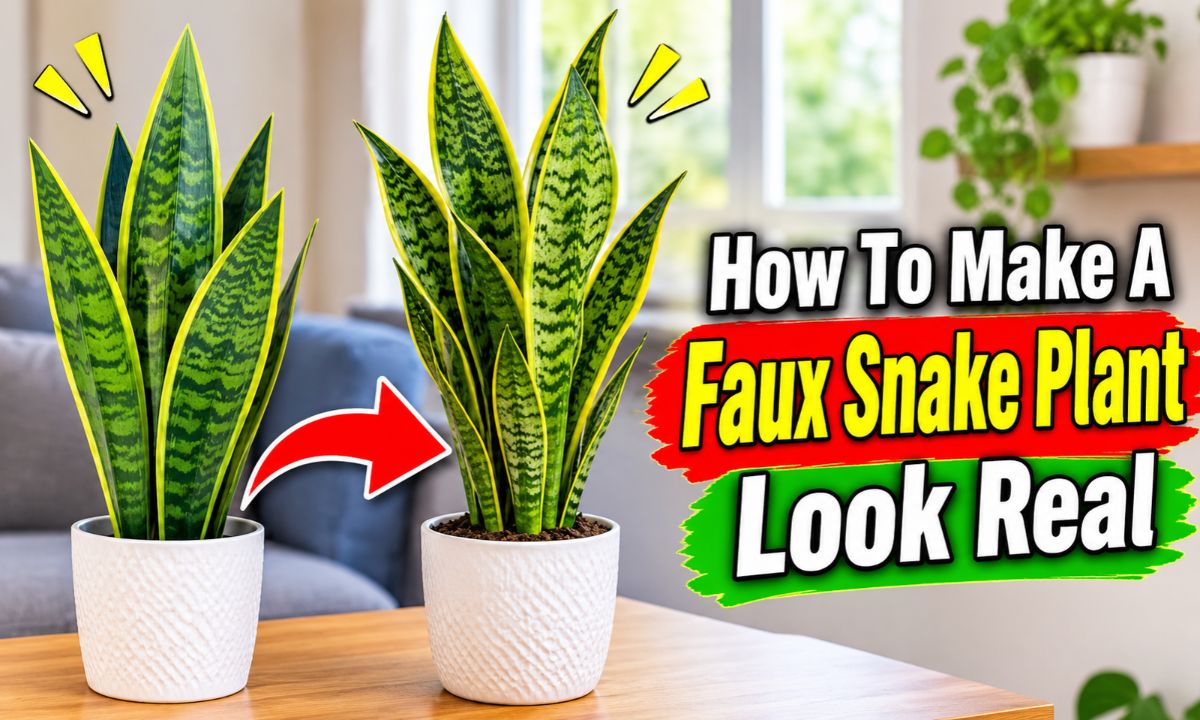
Make a faux snake plant look real by reshaping its leaves, hiding its plastic base, adding natural-looking soil or stones, and placing it in a well-sized decorative planter.
In American homes, snake plants are a popular way to add greenery to living rooms, bedrooms, entryways, and home offices. They have tall, upright leaves that fit well with modern, farmhouse, and minimalist decor. However, an artificial snake plant can sometimes look too shiny, stiff, or perfect to pass as a real houseplant.
The good news is that you do not need to buy another plant to improve its appearance. A few simple changes can make a big difference. Start by spreading the leaves, changing the planter, and covering the exposed plastic or foam at the base. Then give the plant a natural shape and place it where real greenery would look at home.
The goal is not to make every leaf look perfect. Real snake plants have small differences in leaf height, angle, color, and spacing. When you copy those details, your faux plant looks more natural and becomes a better part of your room’s decor. These steps work for small tabletop plants and larger floor-standing artificial snake plants.
A faux snake plant often looks artificial because its leaves are too uniform. Many inexpensive models have leaves that stand at almost identical angles. Their colors may also be the same shade of green from top to bottom.
Real snake plants have a more varied appearance. Some leaves stand close together, while others spread outward. Their leaves can have different widths, lengths, and patterns. Even plants of the same variety do not always have identical shapes.
The pot can also give away an artificial plant. A tall snake plant sitting in a tiny black plastic container may look unfinished. Exposed foam, plastic stems, and visible support wires make the problem even more noticeable.
Another common issue is excess shine. Some artificial leaves have a glossy coating that reflects indoor light. Real snake plant leaves may have a natural sheen, but they do not always look like polished plastic.
Understanding these problems helps you focus on the right changes. You do not have to hide the entire plant. Instead, improve its shape, surface, base, and surroundings.
Uniform leaves
Leaves that all face the same direction create a stiff, manufactured appearance.
Visible artificial base
Exposed foam, plastic, and support pieces make the plant look unfinished.
Wrong planter size
A tiny pot can make a tall plant look unstable or poorly styled.
Excessive shine
Strong reflections can reveal a plastic or rubber-like leaf surface.
Dusty surfaces
Dust settles on artificial foliage and makes the plant look neglected.
What Makes a Real Snake Plant Look Natural?
A real snake plant has firm, upright leaves that grow from its base. The leaves often have green shades, darker bands, or yellow edges, depending on the variety. Some types have broad leaves, while others have narrow, pointed foliage.
The leaves do not need to bend dramatically to look natural. Their slight differences in height, spacing, and direction create the relaxed appearance you want to copy. Use a real snake plant photo as a visual guide when arranging your artificial one.
Natural variation
Look for small differences in leaf height, width, and angle.
Balanced growth
The plant should look full without every leaf spreading equally.
Firm upright shape
Keep most leaves vertical because snake plants do not usually have a loose, trailing shape.
1. Reshape the Leaves to Create a Natural Appearance
Reshaping the leaves is one of the easiest ways to make a faux snake plant look real. Artificial plants often arrive tightly packed in boxes. Their leaves may be pressed together or forced into a narrow shape during shipping.
Before making changes, check the manufacturer’s instructions. Some faux plants have flexible wire inside their leaves, while others use molded plastic or rigid rubber-like materials. Only bend parts that are designed to move.
Place the plant on a flat surface where you can see it from all sides. Look for leaves that overlap too much or point in exactly the same direction. Make small adjustments rather than trying to change the entire shape at once.
Separate crowded leaves
Gently move flexible leaves apart to create small gaps and give each leaf more visual space.
Vary the angles
Let some leaves face slightly outward while others remain closer to the center.
Adjust the heights
Create a natural mix of taller and shorter leaves when the plant design allows it.
Check the back
Turn the plant around and make sure it looks balanced from more than one viewing angle.
Avoid Making Every Leaf Perfect
A common mistake is spreading every leaf into an evenly spaced circle. This can make the plant look like a decorative fan instead of a growing snake plant.
Leave some leaves close together and allow others to stand slightly apart. A few small differences in direction will give the plant a more relaxed appearance. Keep the overall upright form rather than bending all the leaves outward.
If a leaf feels stiff, do not force it. A cracked coating or broken wire can be difficult to repair, and the damage may make the plant look worse.
Use gentle movements
Make small adjustments instead of bending a leaf sharply at its base.
Preserve the natural outline
Keep the plant narrow and upright if that matches the snake plant variety.
How to Fix Leaves That Look Too Straight
If every leaf looks like a straight vertical line, change the direction of a few flexible leaves. A slight outward angle can add depth without changing the plant’s basic shape.
Do not try to create dramatic curves. Snake plant leaves are usually firm and upright. The best result comes from subtle differences, not exaggerated bends.
Move the outer leaves
Give a few outside leaves a slight outward angle.
Keep the center full
Avoid creating a large empty space in the middle of the plant.
2. Replace the Basic Plastic Pot With a Better Planter
A good planter can change the entire appearance of an artificial snake plant. Many faux plants come in small black or brown plastic pots that are designed to hold the plant in place rather than look attractive.
You can usually place the original pot inside a larger decorative container. This is called using a cachepot. It lets you improve the appearance without cutting the plant or rebuilding its base.
Choose a planter that matches the height and width of your plant. A container that is too small can make the plant look top-heavy. One that is too large may overpower the foliage and take up unnecessary floor space.
Think about the room before choosing a finish. A matte ceramic planter works well in many modern homes. Terracotta adds warmth, while a woven basket creates a softer and more casual look.
Ceramic planters
A matte ceramic pot gives the plant a clean, finished appearance and suits living rooms, bedrooms, and offices.
Terracotta pots
Warm earthy tones create a natural look that pairs well with wood furniture and neutral decor.
Concrete planters
A concrete-style container works well with modern, industrial, and minimalist interiors.
Woven baskets
A sturdy basket adds texture and softens the sharp upright lines of the plant.
Stone-look containers
A textured stone finish can make an artificial plant look like a more permanent part of the room.
How to Choose the Right Planter Size
Measure the original pot before buying a new planter. The inside of the decorative container needs enough room for the original base to fit without forcing it.
Check the height and width as well. The planter should support the visual weight of the leaves and leave enough space for a neat top dressing. For a tall faux snake plant, a stable, wide-bottomed pot is often more practical than a narrow decorative vase.
If you use a basket, make sure the original plastic pot is fully supported. A basket should not be the only thing keeping a top-heavy plant upright.
Measure the base
Check the original pot’s width and height before selecting a decorative planter.
Check stability
Choose a container with a firm base that will not tip easily.
Match the room
Select a color and finish that works with nearby furniture and flooring.
Should You Remove the Original Plastic Pot?
You usually do not need to remove the original pot. Sliding it into a larger container is often the easiest and safest option. It also makes future cleaning and moving simpler.
If you decide to remove the original pot, check how the leaves and support structure are attached. Some plants have a fixed molded base that cannot be removed without damaging the product.
For most decorative projects, keeping the original base hidden inside a larger pot provides a clean result with less work.
Keep it intact
Leave the original pot in place when it fits securely inside the new container.
Avoid unnecessary cutting
Do not cut stems or molded bases just to make the plant fit.
3. Cover the Artificial Base With Natural-Looking Materials
Covering the base is one of the most useful ways to improve a faux snake plant. Many artificial plants have visible foam, plastic strips, glue, or support pieces around the bottom of their leaves.
Real soil, decorative stones, bark, and suitable preserved moss can hide these parts. They also add texture, which helps the plant look more like a finished houseplant.
You do not need to fill the entire planter with decorative material. Use a stable filler below the original pot if there is a large gap, then add a shallow top layer to cover the visible area.
Decorative moss
Moss creates a soft green surface that blends well with artificial foliage.
Small pebbles
Natural-colored stones create a neat finish and work well with ceramic or concrete planters.
Bark chips
Bark adds an earthy texture that suits rustic and natural room designs.
Dry potting soil
A thin layer of clean, dry soil can imitate the surface of a real potted plant.
How to Add Decorative Moss
Start by checking whether the artificial plant is firmly attached to its original base. Add any support material before covering the top. You want the plant to stay upright when someone walks past or lightly brushes against it.
Spread a thin layer of preserved or artificial moss over the exposed surface. Work around the stems and make sure the plastic base is hidden. Avoid pressing moss so tightly that it changes the plant’s shape.
Choose a natural-looking green or muted brown shade. Bright, neon-colored moss may create a decorative look, but it can make the plant appear less realistic.
Use a thin layer
Cover the base without creating a thick mound around the leaves.
Hide the support
Make sure exposed foam and plastic are not visible from normal viewing angles.
Keep it dry
Use dry decorative materials and avoid adding water to the artificial plant’s base.
Can You Use Real Soil in a Faux Snake Plant?
Yes, you can use a small amount of real soil as a decorative top layer. It can create a convincing surface when the artificial leaves emerge from the planter. However, soil does not help the plant grow because the plant has no living roots.
Real soil may introduce insects, moisture, or dirt into the container. It can also become messy if the pot is moved often. For this reason, clean decorative stones, bark, or preserved moss may be easier to maintain.
If you choose real soil, keep it dry and avoid adding water or fertilizer. An artificial plant does not need either one.
Best for a natural finish
Use a small amount of dry soil to cover a visible base.
Best for easy care
Choose decorative pebbles or artificial moss if you want less mess.
4. Improve the Color and Texture of the Leaves
Leaf color plays a major role in how realistic a faux snake plant looks. Some artificial plants have a flat green color that makes the entire plant look like one molded piece of plastic.
Look at photographs of real snake plants and compare their patterns with your artificial plant. Many varieties have several shades of green, while some have yellow or cream-colored edges. The exact pattern depends on the variety being copied.
If your plant already has realistic colors, you may not need to change anything. Simply arranging the leaves so their different shades are visible can improve the result.
Look for natural color variation
Different shades of green can give artificial leaves more depth.
Avoid excessive shine
A matte or softly finished surface often looks more natural than a highly reflective one.
Keep the patterns visible
Turn some leaves slightly so their markings and edges can be seen.
Should You Paint a Faux Snake Plant?
Painting is usually not the first step to take. Many artificial leaves have a coating that may not accept ordinary craft paint. Applying the wrong paint can cause peeling, cracking, or an uneven finish.
If you want to change the color, check the manufacturer’s material and care instructions first. Only use a coating that is suitable for that material and test it on a hidden area if the manufacturer allows it.
For most people, choosing a plant with a more realistic color pattern is better than trying to repaint an artificial one.
Avoid random spray paint
Some formulas can damage plastic, rubber, or protective coatings.
Test carefully
Check product compatibility before applying any finish to visible leaves.
5. Place the Plant Where It Looks Naturally At Home
The right location can make an artificial snake plant look much more convincing. Place it where a real snake plant would make sense, such as beside a sofa, near an entryway, or in a bedroom corner.
A faux plant does not need sunlight to survive. However, placing it near natural light can help the leaves and their colors look more like real foliage. You should still protect ordinary artificial materials from strong direct sunlight because some can fade over time.
Think about the furniture around the plant. A tall snake plant can fill an empty corner beside a cabinet or chair. A small plant may look better on a desk, side table, or shelf.
Avoid placing it in the middle of an empty floor without a clear reason. The plant should look like part of the room rather than an object that was left there by mistake.
Living room
Place a medium or tall plant beside a sofa, console, or empty corner.
Bedroom
Use a smaller faux snake plant on a side table or a larger one near a dresser.
Entryway
A tall plant beside an entry console can create a welcoming first impression.
Home office
Place a compact plant near a desk or in an unused corner to add visual interest.
Bathroom
Use a faux plant in a spot where moisture and frequent splashes will not damage its materials.
Does a Faux Snake Plant Need Sunlight?
No. An artificial snake plant does not need sunlight, water, or plant food. You can use it in a room that does not receive enough natural light for a living houseplant.
However, direct sunlight can affect the materials used in some artificial plants. Prolonged exposure may cause fading or changes in color. Check whether your plant is labeled UV-resistant before placing it near a bright window.
If the plant is not UV-protected, choose a bright indoor location away from harsh direct sun. This helps preserve its appearance.
No growing light needed
Artificial leaves do not use sunlight for photosynthesis.
Watch for fading
Keep non-UV-resistant plants away from prolonged direct sunlight.
Choose a natural setting
Use a location that looks appropriate for an indoor decorative plant.
How High Should You Place a Faux Snake Plant?
The best height depends on the size of the plant and the furniture nearby. A small faux snake plant can sit on a table or shelf, while a taller version usually looks better on the floor.
Check the plant from the doorway and from the main seating area. Its height should look balanced with nearby furniture. Make sure it does not block a walkway, door, drawer, or window.
Small plants
Use desks, shelves, and side tables.
Medium plants
Try sideboards, bedside areas, and low floor spaces.
Tall plants
Use open corners and spaces beside larger furniture.
6. Keep the Leaves Clean and Free From Dust
Dust can make even a good-quality faux snake plant look cheap. It collects on flat leaf surfaces and around the edges. In a bright room, the dusty layer may become easy to see.
Cleaning the plant is simple, but the method depends on its material. For many artificial plants, a soft microfiber cloth or gentle brush is enough. Check the care instructions before using water or cleaning products.
Start at the top of each leaf and move toward the base. Support the leaf with your other hand if it is flexible. This helps prevent unnecessary pressure on the stem or internal wire.
Use a microfiber cloth
Wipe smooth leaves gently to remove loose dust.
Use a soft brush
A clean, soft brush can reach narrow areas and leaf edges.
Clean the planter
Remove dust from the pot, basket, and decorative stones as well.
Check before using water
Some artificial materials and glued parts may not be suitable for wet cleaning.
Can You Wash a Faux Snake Plant?
Some artificial snake plants can be wiped with a damp cloth, but not every model can safely be washed. Water may affect glued joints, fabric sections, metal wires, or decorative finishes.
If the manufacturer permits damp cleaning, use a lightly damp cloth and avoid soaking the leaves. Dry the plant fully before returning it to its planter.
Never assume that a faux plant is waterproof simply because its leaves are made from plastic. The base and internal parts may use different materials.
Check the care label
Follow the cleaning instructions supplied with the artificial plant.
Avoid harsh chemicals
Strong cleaners may damage colors, coatings, and glued parts.
Dry thoroughly
Do not leave moisture trapped around the base or inside the planter.
7. Add Small Natural Details Around the Plant
A faux snake plant can look more realistic when it sits among a few natural-looking materials. The right accessories help connect the plant to the rest of the room.
You can place a small wooden tray near the planter, add a natural woven basket, or use a stone-textured pot. These details create a balanced look without making the display feel crowded.
You can also place a real houseplant nearby. The difference in leaf texture and natural growth can make the artificial plant blend into the room more easily.
Do not add too many accessories. The snake plant should remain the main feature. A few simple materials are often enough.
Natural wood
Wooden furniture or a small wood accent adds warmth around the plant.
Woven materials
A basket or natural fiber accessory creates a relaxed home style.
Stone details
Decorative stones and textured surfaces complement the plant’s strong upright shape.
Live greenery
A nearby real plant can add natural texture and visual variety.
Should You Mix Real and Artificial Plants?
Yes. Mixing real and artificial plants is a practical way to decorate a room. You can place living plants near suitable light and use faux greenery in darker corners or places where regular plant care would be difficult.
Try to vary the plant shapes. A real plant with soft, rounded leaves can look good beside the firm, upright leaves of a faux snake plant. The contrast helps the arrangement look less repetitive.
Keep the plants in separate containers when possible. This makes watering and cleaning easier and prevents moisture from reaching artificial materials that may not tolerate it.
Vary the leaf shapes
Combine broad, rounded, or trailing foliage with the upright snake plant.
Use different heights
Place plants at different levels to create a more relaxed display.
Keep care separate
Water living plants without wetting nearby artificial foliage.
8. Fix Common Problems That Make a Faux Snake Plant Look Unnatural
If your artificial snake plant still looks fake after styling, look at the problem one part at a time. The leaves may be too crowded, the base may be visible, or the planter may not suit the plant’s size.
Avoid making several major changes at once. Fix the most obvious issue first, then step back and look at the plant from the normal viewing distance. Small adjustments often work better than a complete makeover.
Problem: Leaves look too crowded
Possible cause: The plant is still arranged in its shipping shape. Solution: Separate flexible leaves and give them a little room.
Problem: Leaves look too shiny
Possible cause: The surface material has a strong glossy finish. Solution: Use soft lighting and avoid applying unapproved coatings.
Problem: The plant looks too small
Possible cause: The planter or display area is too large for the plant. Solution: Use a better-sized container or place it on a suitable stand.
Problem: The base looks fake
Possible cause: Foam, plastic, or support pieces remain exposed. Solution: Cover them with a suitable dry decorative material.
Problem: The plant looks dusty
Possible cause: Dust has collected on the leaf surfaces. Solution: Clean the plant using a material-safe method.
Problem: The plant keeps tipping
Possible cause: The planter is too light or the plant is top-heavy. Solution: Use a stable container and add suitable weight near the bottom.
What If the Leaves Cannot Be Bent?
Some faux snake plants have rigid molded leaves. These cannot be reshaped like artificial stems with internal wire. Do not use heat or excessive force to make them move.
Instead, improve the parts you can control. Change the planter, cover the base, clean the leaves, and choose a good display location. You can also rotate the plant to show its most natural-looking side.
If the plant has a poor shape from every angle, replacing it may be more practical than trying to alter the material.
Do not force rigid leaves
Pressure can cause cracks or permanent damage.
Improve the display
Use a better pot and natural-looking decorative materials.
What If the Plant Looks Too Perfect?
A perfectly round arrangement can make artificial foliage look manufactured. Rotate a few adjustable leaves and create small differences in their angles.
Do not make the plant look messy. The goal is a balanced shape with subtle variation, not a collection of bent or damaged leaves.
Break up symmetry
Make a few small changes to leaf direction.
Keep the main shape
Preserve the upright form that makes a snake plant recognizable.
9. Materials You Need for a Faux Snake Plant Makeover
You do not need a large collection of supplies to improve an artificial snake plant. Most of the work can be done with items you may already have at home.
The most useful items are a decorative planter, a soft cleaning cloth, and something to cover the artificial base. Other materials depend on the size of the plant and the condition of its original pot.
Choose materials that suit your particular plant. A small tabletop version may only need a new ceramic pot and a little decorative moss. A large floor plant may need a more stable container and extra support.
Decorative planter
Choose a stable pot that fits the original base.
Microfiber cloth
Use it to remove dust from the leaves and planter.
Preserved or artificial moss
Use it to hide exposed foam and plastic.
Decorative stones
Use them as a clean and simple top dressing.
Dry filler
Use suitable packing material or stable filler to reduce empty space inside a larger pot.
Measuring tape
Measure the original pot and the available display space.
A Simple Makeover Plan for Beginners
If this is your first faux plant makeover, keep the process simple. Start by cleaning the leaves and checking whether they can be adjusted. Then place the original pot inside a decorative planter.
Add dry filler if needed, cover the exposed top with moss or stones, and make small changes to the leaf arrangement. Finish by placing the plant near furniture that suits its height.
This approach avoids unnecessary cutting, painting, or gluing. It also makes it easier to change the display later.
First
Clean the plant and inspect its structure.
Next
Select a stable decorative planter.
Then
Hide the base and adjust the leaves.
Finally
Choose a natural-looking position in your room.
10. How to Tell If Your Faux Snake Plant Looks Real
After finishing the makeover, take a few steps back and look at the plant from the doorway. This is a useful way to judge its overall shape because most people see indoor plants from a normal room distance rather than close up.
Check whether the leaves have enough space, the planter looks balanced, and the base is hidden. The plant should fit the room instead of looking like a separate decoration that does not belong there.
Also inspect the plant from the side and back. Some artificial plants look convincing from the front but reveal their plastic support structure from other angles. Turn the plant or make small adjustments if needed.
Remember that a faux plant does not need to fool everyone at close range. The practical goal is to create a clean, natural-looking display that suits your home.
Natural leaf arrangement
The leaves have slight differences in direction and spacing.
Balanced proportions
The pot and plant look like they belong together.
Hidden artificial parts
Foam, support pieces, and plastic bases are not visible.
Clean surfaces
The leaves and planter are free from obvious dust.
Good room placement
The plant fits naturally beside the furniture and does not block movement.
A Quick Final Styling Check
Before calling the project finished, look at the plant in the room’s normal lighting. Check it in the morning and evening if the room gets changing natural light.
If one part still looks artificial, fix that specific detail. A small adjustment to the pot, leaf spacing, or base may be all you need.
Check the front
Make sure the plant has a balanced outline.
Check the sides
Look for exposed plastic or unnatural leaf angles.
Check the bottom
Make sure the decorative top dressing covers the artificial base.
Check the room
Make sure the planter and plant size suit the surrounding furniture.
Common Mistakes to Avoid When Styling a Faux Snake Plant
Even simple styling changes can go wrong if you try to do too much. The best artificial plant displays usually have a few thoughtful details rather than many decorations.
Keep the natural shape of the snake plant in mind. It has strong upright leaves, so adding too many loose accessories or bending every leaf can make it look like a different plant.
Also remember that artificial materials have limits. Some can fade, crack, or lose their finish if exposed to harsh sunlight, strong cleaners, or excessive heat.
Bending every leaf
This can destroy the firm upright shape that gives a snake plant its identity.
Using an oversized planter
A container that is much larger than the plant can make the arrangement look unbalanced.
Leaving the base uncovered
Visible foam and plastic can spoil an otherwise attractive display.
Adding too many decorations
Excessive accessories distract from the plant and make the display look staged.
Using strong cleaners
Harsh chemicals may damage the leaf coating or change its color.
Ignoring stability
A top-heavy plant in a light container may tip over when bumped.
Using unapproved heat
A hair dryer or heat gun may damage plastic, coatings, and internal materials.
Do Not Add Water to Make the Plant Look Real
A faux snake plant does not need water. Adding water to its planter will not improve its appearance and may create problems if the base contains foam, metal, or glued parts.
Use dry soil, decorative stones, bark, or moss instead. These materials create a natural surface without introducing unnecessary moisture.
If you use a decorative container that could collect water, keep the artificial plant’s base dry and clean.
Keep the base dry
Do not water an artificial plant as if it were a living houseplant.
Use dry decoration
Choose suitable materials that create a realistic soil surface.
Research Notes and Useful Follow-Up Questions
This guide focuses on the practical styling task rather than making claims about artificial plant materials that have not been verified for a particular model. The reviewed styling guidance from HGTV, House Beautiful, Afloral, Koch & Co, and Leaf covers several recurring methods: reshaping foliage, choosing a better container, hiding the base, cleaning the leaves, and placing plants thoughtfully.
A useful improvement is to explain how those general methods apply to snake plants. Unlike trailing vines or loose artificial flowers, snake plants need to retain their firm upright form. Heavy bending, dramatic drooping, and excessive spreading can make them look less realistic rather than more realistic.
The exact cleaning method, flexibility of the leaves, and compatibility of decorative coatings depend on the artificial plant’s construction. Manufacturer instructions should guide those decisions.
Before styling
Determine whether the leaves are flexible, molded, or wired so you do not damage them.
During styling
Focus on leaf spacing, planter proportions, and hiding the artificial base.
After styling
Check the plant’s balance, clean the surfaces, and choose a suitable location.
Next-Question Gap Map
The following questions are useful extensions of the main task. They are identified as inferred next needs rather than verified search-demand findings. They address practical decisions that can arise before, during, and after a faux snake plant makeover.
Can you use real soil in an artificial plant?
Reader stage: During styling. Basis: The need to hide exposed foam and plastic. Coverage: Answered in this guide. Benefit: Helps readers choose between soil and dry decorative materials.
How do you clean artificial snake plant leaves?
Reader stage: After styling. Basis: Artificial leaves collect dust over time. Coverage: Answered in this guide. Benefit: Helps readers maintain a natural-looking finish.
Can you bend artificial snake plant leaves?
Reader stage: During styling. Basis: Different products use different leaf materials. Coverage: Answered with material limitations. Benefit: Helps prevent damage.
How do you stop a tall faux snake plant from tipping?
Reader stage: During setup. Basis: Tall foliage can create an unstable arrangement. Coverage: Answered briefly. Benefit: Encourages a stable container and suitable support.
Can artificial snake plants fade in sunlight?
Reader stage: After placement. Basis: Artificial materials may react to prolonged UV exposure. Coverage: Answered with UV-resistance limitations. Benefit: Helps preserve the plant’s color.
Frequently Asked Questions
Q
How do you make a cheap faux snake plant look expensive?
Start by replacing its basic plastic pot with a ceramic, terracotta, or concrete planter. Cover the exposed base with decorative moss, bark, or natural-colored stones. Then spread the leaves gently and remove any dust.
You do not need expensive accessories. A well-sized planter and a clean, natural leaf arrangement can make an inexpensive artificial plant look much more polished.
Q
Can I use real moss on an artificial snake plant?
Yes, you can use suitable preserved moss as a decorative covering. It helps hide the plastic base and adds natural-looking texture around the leaves.
Keep the moss dry and follow its care instructions. Avoid using fresh living moss unless you are prepared to provide the moisture and conditions it needs.
Q
How often should I clean a faux snake plant?
Clean it whenever you notice dust collecting on the leaves. The frequency depends on the room, airflow, and amount of dust in your home.
A soft microfiber cloth or brush is often enough for routine cleaning. Use a damp cloth only if the manufacturer allows it.
Q
Can I put a faux snake plant outside?
You can place an artificial snake plant outdoors if its materials are designed for exterior use. Look for a product specifically labeled for outdoor use or UV resistance.
Ordinary indoor faux plants may fade or deteriorate when exposed to strong sunlight, rain, and changing temperatures. Use a stable planter and follow the manufacturer’s outdoor-use instructions.
Q
Should a faux snake plant have real soil or fake soil?
Both can work as decorative top layers. Dry real soil creates a natural appearance, while artificial soil, moss, bark, and decorative stones can be cleaner and easier to maintain.
The best choice depends on your preference. For a low-mess indoor display, decorative stones or preserved moss are practical options.
Q
How do I make a faux snake plant look fuller?
Gently separate the flexible leaves and spread them around the center. Check the plant from all sides so the foliage does not look crowded in one direction and empty in another.
If the plant has a fixed shape, use a better display angle or a slightly wider planter. Do not force rigid leaves or add unrelated foliage that changes the snake plant’s natural form.
Q
Can I use a hair dryer to reshape artificial snake plant leaves?
Do not use a hair dryer unless the manufacturer specifically approves heat-based reshaping. Heat can soften, warp, discolor, or damage artificial leaves and their coatings.
For flexible wired leaves, gentle hand adjustments are usually the better option. Leave rigid molded leaves in their original shape.
Q
Where should I put a faux snake plant in my living room?
A faux snake plant often looks good beside a sofa, near a console table, or in an empty corner. Choose a position that suits its height and does not block doors or walkways.
A spot with natural indoor light can help the plant look more convincing, but avoid prolonged direct sunlight if the plant is not UV-resistant.
✦ Wrapping Up
Conclusion
Making a faux snake plant look real does not require complicated DIY work. The biggest improvements come from reshaping flexible leaves, choosing a suitable planter, covering the artificial base, and keeping the foliage clean.
Pay attention to small details. A few leaves facing different directions can make the plant look more natural. A ceramic or terracotta pot can give it a finished appearance, while moss, bark, or stones can hide the plastic parts at the base.
Most importantly, keep the upright shape that makes a snake plant recognizable. Avoid excessive bending, unnecessary painting, and decorations that make the plant look too busy. With a little care, your artificial snake plant can become a natural-looking part of your home decor.
💡 Key Takeaway
Start with your existing faux snake plant. Clean its leaves, gently adjust any flexible foliage, place its original pot inside a well-sized decorative planter, and cover the exposed base with dry moss or decorative stones. Finish by choosing a balanced spot beside your furniture.