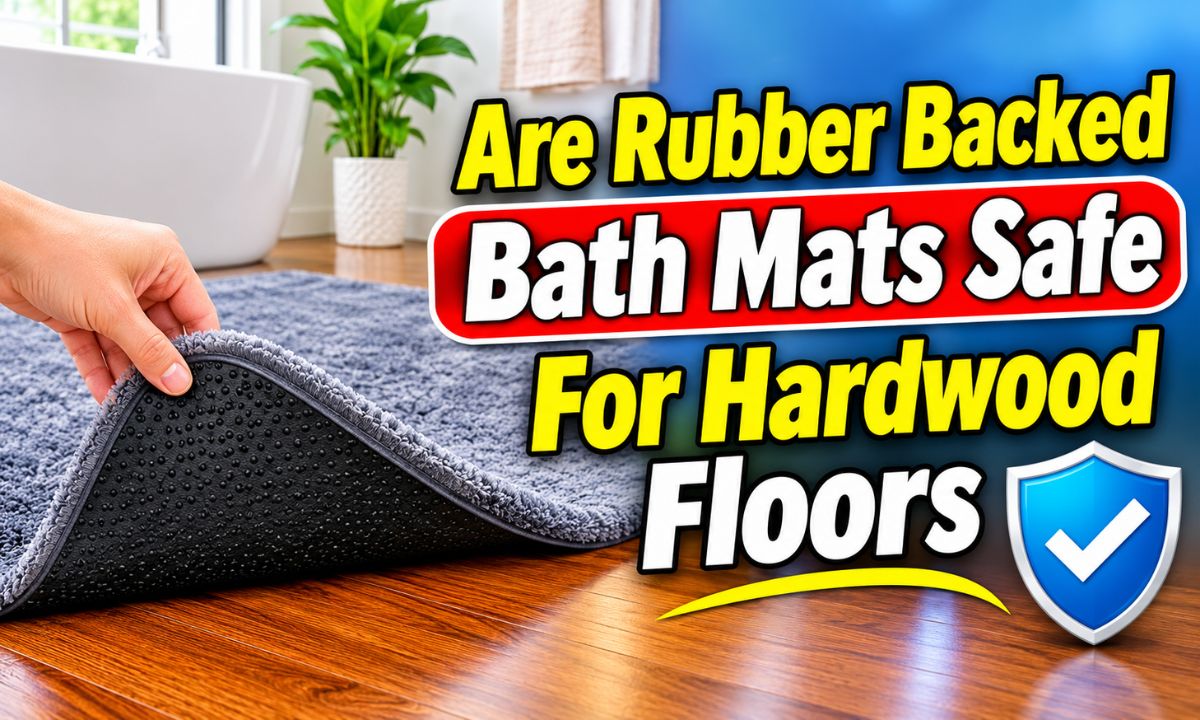
No, rubber backed bath mats are generally not the safest choice for hardwood floors because they can trap moisture, discolor the finish, and leave marks.
Hardwood floors add warmth and beauty to homes across the United States. Many American homeowners use bath mats near tubs, showers, and bathroom sinks to catch drips and keep wet feet from slipping. However, choosing the wrong mat can create a problem that is easy to miss until the floor starts to look different.
Rubber backed bath mats can cause trouble on hardwood. Their backing may hold moisture against the floor and limit airflow. Some rubber and synthetic materials may also react with certain floor finishes. The result can include dark marks, cloudy patches, sticky residue, or damage to the protective coating. The National Wood Flooring Association advises using breathable rugs and taking care with nonskid pads because some can leave impressions on wood floors.
This does not mean every rubber mat will damage every floor right away. The risk depends on the backing material, floor finish, moisture level, and how long the mat stays in one place. Still, a breathable bath mat with a backing approved for your exact flooring is a more cautious choice. This guide explains what can go wrong, how to choose a safer mat, and what to do if you already have a rubber backed one.
Why Rubber Backed Bath Mats Can Damage Hardwood Floors
Rubber backed bath mats can damage hardwood because the backing may hold moisture against the floor. This is a concern in bathrooms, where water often drips from showers, tubs, and wet feet. A mat may look dry on top while its underside remains damp.
Wood reacts to moisture. When water stays near a wood floor, it can affect the finish and, in some cases, the wood beneath it. A rubber backing can make the problem worse by slowing evaporation.
There is another concern. Certain rubber, latex, and synthetic backing materials may interact with floor coatings. This can lead to stains, marks, or changes in the finish. The National Wood Flooring Association also warns that some nonskid pads can leave surface impressions on wood flooring.
Trapped moisture
A solid backing can reduce airflow and keep water between the mat and floor. Long periods of damp contact raise the risk of finish damage and moisture-related problems.
Finish discoloration
Some backing materials can react with a floor’s protective coating. The result may be a dark, yellow, cloudy, or uneven patch.
Sticky residue
Some synthetic backings may leave a tacky film or residue after prolonged contact with a floor finish.
Surface impressions
Certain nonslip pads can leave a pattern or texture on the finish. The mark may remain even after the mat is removed.
How Moisture Gets Trapped Under a Bath Mat
Think of a rubber backed mat as a lid placed over a damp surface. Water from your feet can pass through the fabric and collect near the backing. If the backing is solid, air may not move freely beneath it.
The moisture then takes longer to dry. This is especially important in a bathroom with poor ventilation or frequent shower use. A damp mat left in the same spot can keep the floor wet for much longer than expected.
A breathable mat allows better airflow. It does not make the floor waterproof, but it can reduce the chance of moisture staying trapped underneath.
After a shower
Water can pass through the top fabric and reach the backing.
During storage
A mat left flat on a damp floor may prevent the surface below it from drying.
In humid rooms
Poor ventilation can slow the drying of both the mat and the floor.
How Rubber or Latex Can Affect a Floor Finish
Not all rubber materials have the same chemical makeup. Some synthetic backings contain additives that may interact with certain floor coatings. This is one reason that a mat labeled nonslip should not automatically be treated as hardwood safe.
A floor finish acts as a protective layer. If a backing is incompatible with that finish, it may leave a mark or change the surface appearance. The exact result depends on the materials and contact conditions.
Johnson Hardwood specifically advises against continuous solid rubber backings because they can trap moisture and contribute to finish damage. Its guidance also warns against gel mats for its flooring products.
Important distinction
Rubber is a broad material category. A breathable rubber grid pad and a solid rubber sheet do not have the same structure or moisture behavior.
Do not rely on appearance
A soft, clean-looking backing is not proof that it is compatible with hardwood.
Are All Rubber Backed Bath Mats Unsafe for Hardwood?
No, the risk is not identical for every rubber backed mat. The backing type, floor coating, moisture exposure, and product instructions all matter. However, solid rubber and latex backed mats are a poor default choice when you want to protect hardwood.
Some flooring makers allow certain breathable, non-staining synthetic pads. Others give stricter instructions and advise against rubber or latex altogether. For this reason, the flooring manufacturer’s care guide should take priority over a general label on a bath mat.
A product described as safe for tile, laminate, or vinyl is not automatically safe for hardwood. Different surfaces have different finishes and care needs. Always look for clear approval for finished hardwood floors.
Solid rubber backing
Generally avoid it on hardwood because it can block airflow and hold moisture against the floor.
Latex backing
Avoid it unless your flooring manufacturer clearly approves the exact material and product.
Open-grid backing
It may allow more airflow than a solid sheet, but it still needs to be confirmed as non-staining and suitable for your floor.
Breathable fabric backing
Often a better starting point, provided the manufacturer confirms that the backing will not transfer color or damage the finish.
What About Rubber Mats With Holes?
Some nonslip mats have a grid or honeycomb design instead of a solid rubber layer. The openings can allow more air to move beneath the mat. This may reduce moisture entrapment compared with a continuous rubber sheet.
However, holes do not guarantee hardwood safety. The rubber itself may still be incompatible with the floor finish. A grid pattern may also hold dirt or water if the mat is not cleaned and dried.
Check the product information and ask the flooring manufacturer before using one. Do not assume that an open pattern makes every rubber mat suitable.
Check the material
Find out whether the backing is natural rubber, synthetic rubber, latex, PVC, or another material.
Check the floor approval
Look for specific approval for finished hardwood rather than a general hard-floor claim.
Does a Waterproof Mat Protect Hardwood?
A waterproof mat can keep water from passing through its surface, but that does not make it a safe choice for hardwood. If water reaches the edges or gets beneath the mat, the waterproof layer may slow drying.
A waterproof surface can be useful near a shower, but the mat should be used only on flooring that can safely handle its backing. For hardwood, a breathable and compatible design is usually the better choice.
Waterproof does not mean breathable
A mat can block water while also limiting airflow beneath it.
Check the underside
The backing material matters just as much as the top surface.
What Type of Bath Mat Is Safer for Hardwood Floors?
The safest starting point is a breathable bath mat with a non-staining backing that the hardwood flooring manufacturer approves. It should absorb water from wet feet without holding moisture against the floor for long periods.
Cotton and other washable fabrics can be useful because they are easy to clean and can dry when hung up. However, the backing still matters. A cotton mat with an incompatible rubber layer may create the same concern as another rubber backed product.
You should also think about the mat’s grip. A mat that moves around can create a fall risk, especially on a smooth bathroom floor. Choose a product designed for your exact flooring type rather than adding an unapproved sticky pad underneath.
Cotton bath mats
Cotton can absorb water and is often easy to wash. Choose a design with a hardwood-compatible backing or no incompatible backing.
Breathable fabric mats
These can allow more airflow than solid-backed mats. Confirm that the materials will not stain the floor.
Non-staining rug pads
A pad made specifically for finished hardwood may help reduce movement while protecting the finish. Follow the flooring maker’s approval list.
Washable bath rugs
A washable rug can be practical if you remove it regularly, clean it as directed, and dry it fully before returning it to the floor.
How to Choose a Hardwood-Safe Bath Mat
Start with the floor care instructions. If you know the flooring brand and model, check its official maintenance guide. If you do not know the brand, ask the flooring retailer or a qualified wood floor professional to help identify the finish and suitable materials.
Next, read the bath mat label. Look for the exact backing material and any statement about use on finished hardwood. A vague claim such as safe for hard floors is not enough.
Finally, consider how you will care for the mat. A good bath mat should be easy to lift, wash, and dry. It should not stay wet on the floor throughout the day.
Step 1: Identify your flooring
Find out whether you have solid hardwood, engineered hardwood, or a wood-look product. Check the manufacturer’s care instructions.
Step 2: Read the backing label
Look for material details and clear hardwood compatibility information.
Step 3: Check the nonslip feature
Make sure the grip system is approved for your floor and does not rely on a sticky or damaging coating.
Step 4: Plan regular drying
Choose a mat that you can easily lift and hang after use.
Are Cotton Bath Mats a Good Option?
Cotton bath mats can be a practical option because the fabric absorbs water and is usually easy to wash. They also tend to be simple to lift and hang over a towel bar or drying rack.
The main issue is the underside. Some cotton bath mats have a rubber or latex coating for grip. Those versions still need to be checked before they touch hardwood.
A cotton mat without a harmful backing may be more suitable, but it can move on a smooth floor. Use only a separate nonslip pad that your flooring manufacturer approves.
Main benefit
Absorbent fabric can collect water from wet feet and can be washed.
Main limitation
Cotton alone does not provide reliable grip, and the wrong backing can still harm the finish.
How to Use a Bath Mat Without Damaging Hardwood
Even a suitable bath mat needs proper care. Moisture, dirt, and grit can collect under any floor covering. Regular cleaning and drying help reduce the chance of damage.
The goal is to keep the floor dry, allow air to circulate, and stop small particles from rubbing against the finish. The National Wood Flooring Association recommends that rugs be cleaned, shaken out, and thoroughly dried before being placed on wood floors.
Use the following routine if your flooring maker approves the mat and its backing.
Lift the mat after use
Do not leave a wet bath mat flat on the floor for long periods.
Dry both surfaces
Make sure the mat and the floor beneath it are completely dry before putting it back.
Clean the floor
Remove dirt and grit from the area under the mat with a floor-safe cleaning method.
Wash the mat
Follow the care label so the fabric stays clean and does not develop a musty smell.
A Simple Daily Bath Mat Care Routine
After a shower, pick up the bath mat and hang it over a towel bar or drying rack. Avoid folding it while it is wet because this can slow drying.
Check the floor for water drops. Wipe them with a soft, dry cloth. Do not leave standing water around the mat or along the edges of nearby floorboards.
Before placing the mat back, check that the underside and the hardwood are dry. If the bathroom stays humid, keep the mat off the floor until the room has dried.
Morning
Lift and hang the mat after the last shower or bath.
During the day
Allow the floor to dry and keep the bathroom well ventilated.
Before reuse
Check the backing and floor for dampness, dirt, or residue.
How Often Should You Check Under a Bath Mat?
Check beneath the mat every time you lift it to dry it. Also inspect the floor more closely during routine bathroom cleaning. Look for color changes, moisture, residue, and marks.
If the mat stays in a high-use area, check it more often. A bathroom used by several people may have more water exposure than a guest bathroom used only once in a while.
Do not wait for a visible stain. Regular checks can help you spot a problem while it is still small.
Check for moisture
Feel the floor and backing for dampness before returning the mat.
Check for grit
Remove sand, dust, and small particles that may scratch the finish.
Check for discoloration
Look for new cloudy, dark, or yellow areas.
What Happens If You Already Have a Rubber Backed Bath Mat?
If you already use a rubber backed bath mat, do not panic. A short period of use does not mean your hardwood floor has been damaged. However, it is wise to stop using the mat until you confirm that its backing is suitable.
Lift the mat and inspect the area. Look for dampness, sticky residue, unusual color changes, cloudy patches, or a pattern that matches the backing. Compare the covered area with nearby exposed flooring.
If the floor looks normal, clean and dry the area using the flooring manufacturer’s approved method. Replace the mat with a compatible option rather than continuing to take a risk.
If the floor is damp
Remove the mat and allow the area to dry. Wipe up standing water at once.
If the floor looks cloudy
Do not scrub the finish or apply household chemicals. Ask the flooring manufacturer or a wood floor professional for advice.
If the backing feels sticky
Stop using the mat. Avoid scraping or using solvents that may damage the finish.
If the boards look swollen
Arrange an inspection by a qualified flooring professional because moisture may have affected the wood itself.
How to Remove a Rubber Backed Mat Safely
Lift the mat gently instead of dragging it across the floor. Dragging can move trapped grit under the backing and scratch the finish.
If the mat sticks to the floor, do not pull hard or use a sharp tool. A stuck backing may be bonded to or interacting with the finish. Get advice before trying to remove it.
Once the mat is removed, inspect the surface in good light. Take photographs of any marks before cleaning. This can help a flooring professional assess whether the issue is a surface residue or finish damage.
Lift gently
Avoid dragging the backing over the floor.
Avoid harsh cleaners
Do not use bleach, ammonia, acetone, or strong solvents unless the floor manufacturer specifically approves the product for the problem.
Document the damage
Photograph unusual marks and keep the mat’s product label or material details.
Can You Repair Discoloration Caused by a Rubber Mat?
The repair depends on what caused the discoloration. A surface mark may be removable with a product approved for the floor finish. A chemical reaction or damaged coating may need professional repair.
Do not assume that a dark patch is dirt. Scrubbing harder can make a damaged finish worse. Likewise, sanding or refinishing without identifying the floor type can cause additional problems.
Contact the flooring manufacturer or a qualified hardwood floor contractor if the mark does not disappear with the approved cleaning method. Some damage may require a touch-up, recoating, or board repair.
Surface residue
A flooring professional may be able to recommend a suitable cleaning method.
Finish damage
A repair or new finish coat may be needed, depending on the affected area.
Wood damage
Swelling, cupping, or board separation needs a professional assessment.
Special Care for Newly Finished Hardwood Floors
Newly finished hardwood needs more care than an established floor. A finish may look dry before it has fully cured. Placing a rug or mat on it too soon can affect the finish or leave an impression.
The National Wood Flooring Association advises that, unless the finish manufacturer gives different instructions, area rugs should not be placed on a newly finished wood floor for at least seven days after the final coat. Some finishes may need longer, so the product instructions are the deciding guide.
Do not use a rubber backed bath mat to test a new floor. Wait until the required curing period has passed and confirm which rug materials the manufacturer permits.
Follow the finish instructions
The actual waiting period depends on the finish product and its curing requirements.
Avoid early covering
Do not cover the floor with rugs, mats, or other materials before the approved time.
Ask before using nonslip pads
Some pads can leave impressions or affect the finish even after the initial curing period.
Why Does Floor Curing Matter?
Drying and curing are not always the same thing. A finish may feel dry to the touch while it is still completing the process needed to reach its intended performance.
Covering it too early can limit normal exposure to air or create contact with a material that is not compatible with the coating. This may cause impressions, discoloration, or changes in appearance.
The safest approach is to ask the installer for the finish name and written care instructions. Keep those instructions for future mat and rug purchases.
Ask for the product name
Find out which finish was applied to the floor.
Confirm the waiting period
Use the manufacturer’s full curing instructions, not just the time needed before walking on the floor.
Solid Hardwood vs. Engineered Hardwood: Does the Advice Change?
Both solid and engineered hardwood need protection from excess moisture and unsuitable rug backings. Engineered flooring has layers of wood bonded together, while solid hardwood is made from a single piece of wood. The construction differs, but neither type should be treated as waterproof.
Engineered flooring can also suffer when moisture affects its surface finish or internal layers. Johnson Hardwood warns that moisture trapped beneath solid rubber backings can affect the finish and the plies that form the core of engineered products.
The same basic rule applies to both types: use a breathable, non-staining mat that the flooring manufacturer approves. Do not assume engineered hardwood can tolerate a solid rubber mat just because its construction is different.
Solid hardwood
Excess moisture can affect the finish and may cause the boards to swell, cup, or change shape.
Engineered hardwood
Moisture can affect the surface and, in some cases, the bonded layers or core.
Both flooring types
Require suitable cleaning, moisture control, and compatible rug materials.
What If You Have a Wood-Look Floor?
Some floors that look like hardwood are actually laminate, vinyl plank, or another manufactured material. Their care instructions may differ from those for real wood.
Do not identify the flooring by appearance alone. Check your installation paperwork or ask the retailer. A mat that is suitable for one floor type may not be suitable for another.
Follow the instructions for the exact flooring product, including its rules for rubber, latex, PVC, and other backing materials.
Identify the floor
Check whether it is solid wood, engineered wood, laminate, or luxury vinyl.
Read the correct care guide
Use the instructions for the actual product rather than a general hardwood guide.
Common Mistakes to Avoid When Using Bath Mats on Hardwood
A good bath mat can help keep water off the floor, but poor habits can cancel out that benefit. The most common mistake is leaving a damp mat in one place all day.
Another mistake is choosing a mat based only on how well it grips the floor. A strong grip does not prove that the backing is safe for the finish. Some sticky and solid materials can create problems even when they prevent slipping.
Avoid these habits to help protect both the floor and the people using the bathroom.
Leaving a wet mat on the floor
This can keep moisture trapped and delay drying.
Ignoring the backing material
A soft fabric top does not make an unsuitable backing safe.
Using an unapproved grip pad
Some nonslip pads can stain or leave marks on finished wood.
Dragging the mat
Trapped grit can scratch the floor as the mat moves.
Using strong cleaning chemicals
Harsh products may damage the protective finish or make an existing mark worse.
Ignoring small warning signs
Dampness, residue, or cloudy patches deserve attention before the damage spreads.
Do Not Trade Floor Protection for Slip Protection
A bath mat must help prevent slips, but it should not damage the surface beneath it. These two goals need to work together.
If a mat slides easily, do not solve the problem by placing any random rubber pad underneath it. Check whether the floor manufacturer approves a specific nonslip pad or mat system.
If you cannot find a suitable product, keep the wet area on a bathroom floor surface designed for regular water exposure. Do not rely on an unapproved mat to make hardwood safe for a wet shower exit.
Choose an approved grip system
Confirm both floor compatibility and nonslip performance.
Keep the walking path dry
Wipe up splashes and drips instead of relying on a mat alone.
Quick Comparison: Bath Mat Backings for Hardwood Floors
The following comparison can help you narrow down your choices. It is a general guide, not a guarantee that every product in a material category will be safe. The exact product and your flooring manufacturer’s instructions still matter.
Solid rubber
Generally avoid. It can trap moisture and may affect some floor finishes.
Latex
Generally avoid unless the flooring maker approves the specific product.
PVC or vinyl backing
Check carefully. Some formulations and additives may affect certain finishes.
Breathable polypropylene
May be acceptable when non-staining and specifically approved for the floor.
Cotton fabric
Can be a useful absorbent option, but check the underside and nonslip system.
Natural fiber
May provide a breathable option, but texture and abrasion should also be considered.
Which Option Should You Choose?
For most homeowners, a washable fabric mat with a compatible, breathable backing is a sensible starting point. It should absorb drips, dry easily, and avoid direct contact between an unsuitable backing and the finish.
If the flooring manufacturer recommends a particular rug pad, follow that advice. A product designed for hardwood is a better choice than a generic mat that only claims to work on all hard surfaces.
Best starting choice
A breathable, washable mat with documented hardwood compatibility.
Avoid
A continuous solid rubber or latex backing without clear approval from the flooring manufacturer.
Research Notes and Reader Question Gap Map
Research date: November 11, 2026. Market: United States. Primary intent: help homeowners decide whether a rubber backed bath mat can be placed on finished hardwood and identify safer alternatives.
The research reviewed guidance from the National Wood Flooring Association, the World Floor Covering Association, Robbins and Hartco flooring support, and Johnson Hardwood. These sources were selected because they address wood floor maintenance, rug materials, moisture, or nonslip backing compatibility.
The strongest useful finding is that a mat’s nonslip feature does not establish that it is safe for hardwood. The type of backing, ability to breathe, moisture exposure, and flooring manufacturer’s instructions all matter.
The reviewed guidance also shows why a simple yes-or-no answer needs a practical follow-up. Homeowners need to know what to replace the mat with, how to dry the floor, and what to do when a mark appears.
DOCUMENTED: National Wood Flooring Association
Its 2025 Wood Flooring Installation Guidelines recommend breathable rugs, regular cleaning and drying, and caution with nonskid pads that may leave impressions.
DOCUMENTED: World Floor Covering Association
Its hardwood care guidance warns that rubber backed or non-ventilated mats can damage wood flooring.
DOCUMENTED: Robbins and Hartco
Their flooring FAQs recommend breathable, non-staining materials and warn against solid, rubber, or latex backed rugs for their products.
DOCUMENTED: Johnson Hardwood
Its care guidance explains that continuous solid rubber backing can trap moisture and contribute to damage to the finish or engineered flooring layers.
Competitor Coverage and Useful Gaps
The reviewed flooring pages explain the main risks of rubber backing, but their coverage is often written for general area rugs rather than bathroom mats. This guide adds practical details about wet feet, daily drying, mat removal, and the signs that call for professional help.
The following questions are inferred next needs based on the main task. They are not claims about verified search volume or observed search demand.
Question: Can I leave a rubber bath mat down all day?
Basis: Inferred next need. Reviewed guidance warns against non-breathable coverings and trapped moisture. Priority: High. Placement: Moisture and daily care sections.
Question: What should I use instead of rubber backing?
Basis: Inferred next need. Reviewed manufacturer guidance supports breathable, non-staining alternatives. Priority: High. Placement: Safer bath mat section.
Question: What if a rubber mat has already left a mark?
Basis: Inferred next need. Reviewed pages address finish damage but do not provide a complete bathroom mat removal routine. Priority: High. Placement: Existing mat and repair sections.
Question: Are engineered hardwood floors different?
Basis: Inferred next need. Johnson Hardwood specifically discusses moisture effects on engineered flooring layers. Priority: Medium. Placement: Flooring type section.
Question: Can I use a nonslip pad on new hardwood?
Basis: Inferred next need. NWFA guidance warns about impressions and recommends waiting after the final finish coat. Priority: Medium. Placement: Newly finished floor section.
Evidence Limits
This article is based on published flooring guidance and manufacturer care instructions. No bath mats were physically tested, and no laboratory comparison of rubber, latex, PVC, cotton, or polypropylene backings was performed.
The research does not establish that every rubber backed mat will damage every hardwood floor. It supports a cautious recommendation against using continuous solid rubber or unapproved backings on finished wood.
The supplied image list contained temple photographs rather than relevant bath mat or flooring photographs. No unrelated images were added.
Not established
A universal time period after which every rubber backed mat will cause damage.
Not established
A universal chemical reaction between every type of rubber and every hardwood finish.
Manufacturer-dependent
Which specific backing materials and pads are approved for each flooring product.
Frequently Asked Questions
Q
Can rubber backed bath mats ruin hardwood floors?
Yes, rubber backed bath mats can damage hardwood floors. Some can trap moisture, leave residue, or discolor the protective finish. The risk depends on the backing material, floor coating, and how the mat is used.
Solid rubber and latex backed mats are generally best avoided unless your flooring manufacturer specifically approves the product.
Q
Can I put a rubber bath mat on hardwood for a few minutes?
Brief contact does not automatically mean damage will occur. However, it is not wise to use an unapproved rubber mat just because you plan to remove it quickly.
Water can collect beneath a mat even during short use. A compatible, breathable bath mat is a better option.
Q
What is the safest bath mat backing for hardwood floors?
A breathable, non-staining backing approved by your flooring manufacturer is the safest starting point. Some manufacturers accept certain breathable polypropylene materials, while others have different requirements.
Check the exact product label and floor care guide before use. Avoid assuming that every fabric or synthetic backing is suitable.
Q
Can a rubber backed rug leave permanent marks on hardwood?
Yes, some rubber or synthetic backings can leave discoloration, residue, or impressions on a hardwood finish. Whether a mark can be removed depends on its cause and how deeply the finish has been affected.
Do not scrub aggressively or apply solvents. Use only a cleaning method approved by the flooring manufacturer and seek professional advice if the mark remains.
Q
Is a cotton bath mat safe for hardwood floors?
A cotton bath mat can be a suitable option because it absorbs water and is generally easy to wash and dry. However, the backing still matters.
Choose a cotton mat without an incompatible rubber or latex layer. If it needs a nonslip pad, use one specifically approved for your hardwood flooring.
Q
Can I use a bath mat on engineered hardwood?
Yes, if the mat and its backing are approved for the specific engineered flooring product. Engineered hardwood still contains wood and can be affected by excess moisture.
Avoid solid rubber backings that can trap moisture. Follow the flooring manufacturer’s instructions and dry the area regularly.
Q
How often should I wash and dry a bath mat on hardwood?
Wash the mat according to its care label and how often it gets wet or dirty. More important, lift and dry it after use rather than leaving a damp mat flat on hardwood.
Before putting it back, make sure both the backing and the floor are fully dry. This helps limit moisture buildup and unpleasant odors.
Q
What should I do if my hardwood floor turns dark under a bath mat?
Remove the mat and check the area. A dark patch may be related to moisture, residue, or damage to the finish. Allow the area to dry and avoid placing the mat back.
Do not sand, bleach, or use strong cleaning chemicals on the spot. Contact the flooring manufacturer or a qualified wood floor professional if the mark remains or the boards appear swollen.
✦ Wrapping Up
Conclusion
Rubber backed bath mats are generally not a safe first choice for hardwood floors. Solid rubber and latex backings can trap moisture, and some synthetic materials may leave stains or marks on certain finishes. These problems can affect both the floor’s appearance and its protective coating.
A breathable, washable bath mat with a non-staining backing approved for hardwood is a better choice. Check the floor manufacturer’s instructions before buying a mat, especially if your floor is newly finished or has a special coating.
Good care matters just as much as the mat itself. Lift it after use, let it dry, wipe up water, and check the floor beneath it. These small habits can help protect your hardwood while keeping your bathroom more comfortable.
💡 Key Takeaway
Before using your next bath mat, check its backing material and confirm that the flooring manufacturer approves it. Avoid solid rubber and latex backings unless specifically approved, and always dry both the mat and hardwood floor after use.