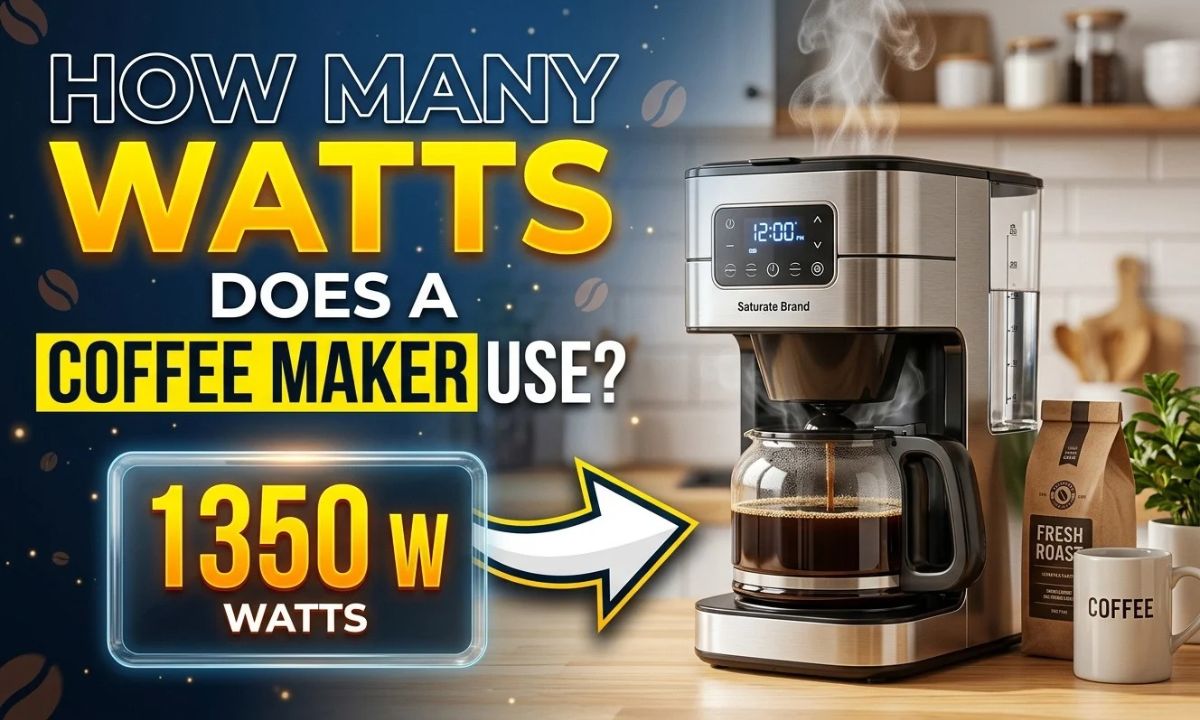
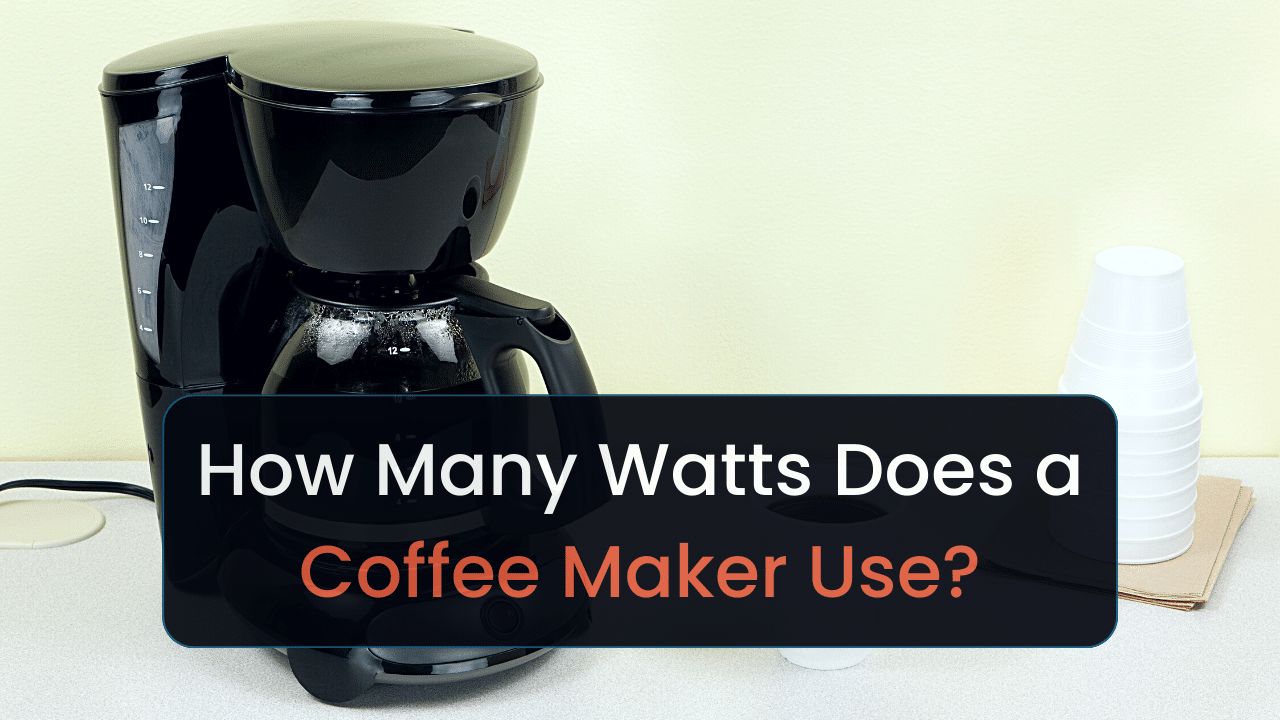
Most home coffee makers in the U.S. use about 550 to 1,500 watts while actively brewing, with many full-size drip models falling around 750 to 1,200 watts.
If you use a coffee maker in a U.S. home, the wattage tells you how much electrical power the machine can draw while it is operating. A typical 10- to 12-cup drip coffee maker may use around 750 to 1,200 watts during brewing, while many single-serve machines can use about 900 to 1,500 watts.
The watt number alone does not tell you what the machine costs to run. A coffee maker may draw close to 1,000 watts while heating water but run for only several minutes. To estimate actual electricity use, you need to consider both wattage and operating time. Your exact model’s rating label or owner’s manual is the best source for its rated power.
Most household electric coffee makers use between about 550 and 1,500 watts during active brewing. The exact figure depends on the type of coffee maker, its capacity, its heating system, and the way it is designed to heat water.
For a common U.S. kitchen, a full-size automatic drip coffee maker is often in the 750- to 1,200-watt range. Smaller drip machines can use less, while single-serve pod machines and many home espresso machines can reach 1,500 watts.
These are useful planning ranges rather than a substitute for the rating on your particular machine. Two coffee makers that look similar can have different electrical ratings.
Source: um.travellerandtourist.co.uk
Small drip coffee maker
Many small 4- or 5-cup automatic drip machines fall around 550 to 900 watts.
Full-size drip coffee maker
Many 10- or 12-cup models use about 750 to 1,200 watts while actively brewing.
Single-serve coffee maker
Pod and capsule machines commonly use about 900 to 1,500 watts because they heat water quickly.
Home espresso machine
Many electric espresso machines use roughly 1,000 to 1,500 watts, although the rating varies considerably by design.
Why Coffee Makers Need So Many Watts
The heating element is the main reason a coffee maker can have a relatively high wattage. Heating water requires a substantial amount of energy, and coffee makers are designed to bring water to brewing temperature in a short period.
The pump, controls, display, and other electronics generally use much less power than the heating system. This means the machine can have a high rated wattage even though it does not operate at that level for the entire morning.
Heating water
The heating element does most of the high-power work during brewing.
Water volume
A larger brew can require more energy because more water must be heated.
Brewing speed
Machines designed to heat water quickly may use more power during their short heating cycle.
Coffee Maker Wattage by Type
Coffee maker wattage changes significantly by machine type. A small drip brewer does not have the same power requirements as a fast single-serve machine or a pump-driven espresso machine.
The ranges below are useful for estimating power needs when you do not yet know the exact rating of a machine. For a precise figure, use the appliance’s nameplate or manual.
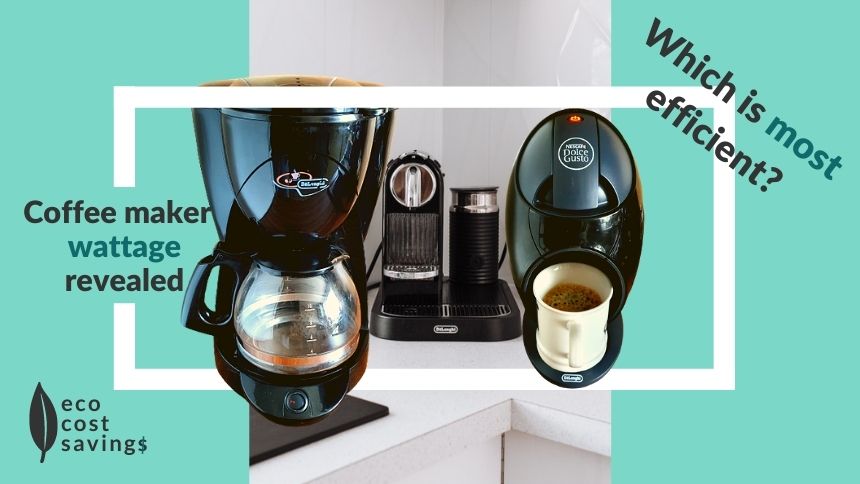
Source: ecocostsavings.com
Small automatic drip
Approximately 550 to 900 watts. These machines are designed for smaller batches and generally have lower-capacity heating systems.
Full-size automatic drip
Approximately 750 to 1,200 watts. This is a common range for household machines that brew a larger carafe.
Single-serve pod or capsule
Approximately 900 to 1,500 watts. The higher draw helps heat water quickly for individual servings.
Pump or fully automatic espresso
Approximately 1,000 to 1,500 watts for many household models, with some specialized machines outside this range.
Manual coffee brewing
A French press or pour-over brewer itself uses 0 watts because it has no electric heating element. An electric kettle or other water-heating appliance used with it still consumes electricity.
Is a 1,000-Watt Coffee Maker Considered High Power?
A 1,000-watt coffee maker has a fairly substantial instantaneous power draw for a small kitchen appliance, but that does not mean it uses a large amount of electricity every day. The operating time matters just as much.
For example, a 1,000-watt machine running for 10 minutes uses about 0.167 kilowatt-hours. That is very different from running a 1,000-watt appliance continuously for several hours.
Power
1,000 watts describes the rate at which the machine uses electrical power while operating.
Energy
Kilowatt-hours describe how much electricity is consumed over a period of time.
Watts vs. Kilowatt-Hours: What Is the Difference?
Watts and kilowatt-hours answer different questions. Watts tell you how much power an appliance draws at a given moment. Kilowatt-hours tell you how much electrical energy it consumes over time.
This distinction matters when estimating your electric bill. A 1,200-watt coffee maker may draw more power than a 700-watt model, but if the 1,200-watt model runs for less time, its total energy consumption may be similar.
Source: measuringstuff.com
Watts
Watts measure electrical power. A higher watt rating generally means the appliance can draw power at a faster rate while operating.
Kilowatts
One kilowatt equals 1,000 watts. A 1,000-watt coffee maker is a 1-kilowatt appliance for calculation purposes.
Kilowatt-hours
A kilowatt-hour measures energy consumed. Utility companies commonly use kilowatt-hours when billing for electricity.
How to Calculate Coffee Maker Electricity Use
Use this simple calculation: watts divided by 1,000, multiplied by the number of hours the appliance operates. The result is the approximate kilowatt-hours used.
For a hypothetical 1,000-watt coffee maker that runs for 10 minutes, first convert 10 minutes to one-sixth of an hour. Then calculate 1,000 divided by 1,000, multiplied by one-sixth. The result is about 0.167 kilowatt-hours.
To estimate the cost, multiply the kilowatt-hours by your electricity rate. For example, if your rate were 20 cents per kilowatt-hour, 0.167 kilowatt-hours would cost about 3.3 cents for that brewing period. Your actual rate may be different.
Formula
Energy in kWh = watts ÷ 1,000 × operating hours.
Cost formula
Electricity cost = kilowatt-hours used × your electricity price per kilowatt-hour.
Example
A 1,000-watt coffee maker running for 10 minutes uses about 0.167 kWh before accounting for any additional warming or standby use.
How Much Electricity Does a Coffee Maker Use Per Pot?
A typical brewing cycle uses much less energy than its wattage number might suggest because the heating element usually operates for only part of an hour. The exact amount depends on the machine’s wattage, brew time, amount of water, starting water temperature, and whether a warming plate stays on afterward.
For a simple example, a 900-watt coffee maker running for 10 minutes uses 0.15 kilowatt-hours. A 1,200-watt machine running for the same 10 minutes uses 0.20 kilowatt-hours.
These calculations describe the brewing period only. If the coffee maker keeps a carafe warm, the warming element can add more electricity use after brewing has finished.
Source: mtnlyoncafe.com
900 watts for 10 minutes
Approximately 0.15 kWh during that 10-minute period.
1,000 watts for 10 minutes
Approximately 0.167 kWh during that 10-minute period.
1,200 watts for 10 minutes
Approximately 0.20 kWh during that 10-minute period.
1,500 watts for 5 minutes
Approximately 0.125 kWh during that 5-minute period.
Does the Warming Plate Use Electricity?
Yes. On a traditional drip coffee maker, the warming plate can continue drawing electricity after the coffee has finished brewing. The amount varies by model, so the most accurate figure comes from the manufacturer’s specifications or a power meter.
This is why leaving a coffee maker switched on for a long time can consume more electricity than the brewing cycle alone. Using an automatic shutoff feature, when provided, can limit unnecessary warming time.
During brewing
The heating system usually creates the largest power draw.
After brewing
A warming plate may continue using power to keep the carafe hot.
Best check
Look at the manual or measure the machine directly if you need its actual post-brew power draw.
How to Find the Exact Wattage of Your Coffee Maker
The easiest way to find the exact rated wattage is to check the coffee maker itself. Manufacturers commonly place electrical information on a label on the bottom, back, or near the power cord. The owner’s manual and manufacturer’s product specifications can also list the rating.
Look for a number followed by W, such as 900 W, 1,000 W, or 1,200 W. You may also see voltage and amperage information. In the U.S., household coffee makers commonly operate from a 120-volt household supply.
Source: kitchenrank.com
Check the appliance label
Look underneath or behind the machine for its electrical rating.
Check the owner’s manual
The technical specifications often provide the rated wattage and voltage.
Search the exact model
Use the model number from the appliance when checking the manufacturer’s specifications.
Use a plug-in power meter
A suitable watt meter can show actual electrical draw during brewing and other operating modes.
Can You Calculate Watts From Volts and Amps?
For a simple electrical load, watts can be estimated by multiplying volts by amps. For example, a device drawing 8 amps from a 120-volt supply would have an apparent power of about 960 watts under a simple calculation.
For the most reliable coffee maker specification, however, use the manufacturer’s stated wattage or the appliance nameplate. Electrical behavior can vary during different operating stages.
Basic formula
Watts ≈ volts × amps for a simple resistive load.
Example
120 volts × 8 amps gives approximately 960 watts.
How Many Amps Does a Coffee Maker Use?
For U.S. household planning, amperage can be estimated from wattage and voltage. At a nominal 120 volts, a 900-watt coffee maker would draw about 7.5 amps under a simple watts-divided-by-volts calculation, while a 1,200-watt model would be about 10 amps.
Actual current can vary during operation, and the appliance nameplate is the better reference for electrical planning. If you are concerned about a circuit, consider the total load of all appliances operating on that circuit rather than looking at the coffee maker alone.
Source: storage.googleapis.com
900 watts at 120 volts
About 7.5 amps using the basic calculation.
1,000 watts at 120 volts
About 8.3 amps using the basic calculation.
1,200 watts at 120 volts
About 10 amps using the basic calculation.
1,500 watts at 120 volts
About 12.5 amps using the basic calculation.
Can a Coffee Maker Overload a Kitchen Circuit?
A coffee maker can contribute a substantial load to a household circuit, especially when another high-power appliance is operating at the same time. The risk depends on the circuit rating, wiring, other connected loads, and the actual appliance current.
Do not assume that a power strip, extension cord, or outlet is suitable simply because the plug fits. Follow the coffee maker manufacturer’s instructions and applicable electrical safety guidance. If a breaker repeatedly trips, an outlet becomes hot, or you notice burning smells, stop using the appliance and have the electrical issue checked by a qualified professional.
Consider the combined electrical load of appliances sharing the same circuit.
Watch for warning signs
Repeated breaker trips, hot outlets, damaged cords, or burning odors require attention.
Follow manufacturer instructions
Use the power connection and operating setup specified for your coffee maker.
How to Reduce Coffee Maker Electricity Use
You do not necessarily need a lower-wattage coffee maker to reduce electricity use. The most useful changes are often related to how long the machine operates and how much water you heat.
Brewing only the amount of coffee you need can reduce the amount of water that must be heated. Turning off the machine after brewing can also reduce energy used by a warming plate, provided your model does not require a specific operating procedure.
Source: timscoffee.com
Use the right amount of water
Avoid heating substantially more water than you need for the coffee you plan to make.
Use automatic shutoff
If your coffee maker has an automatic shutoff feature, use it to limit unnecessary warming time.
Turn off the machine when appropriate
Follow the manufacturer’s instructions and switch off the coffee maker when its active heating or warming function is no longer needed.
Choose a machine that fits your routine
A small brewer can make more sense for one or two cups than repeatedly heating a large full-size carafe.
Measure actual consumption when necessary
A compatible plug-in energy meter can help identify how much electricity your specific machine uses during brewing and standby.
Does a Lower-Watt Coffee Maker Always Use Less Electricity?
No. A lower-watt machine may run for a longer period, while a higher-watt machine may complete the heating cycle faster. Total energy consumption depends on both power and time.
For example, a hypothetical 700-watt coffee maker running for 15 minutes uses about 0.175 kWh. A 1,000-watt coffee maker running for 10 minutes uses about 0.167 kWh. The higher-watt machine uses slightly less energy in this example because it runs for less time.
Compare wattage
Use wattage to understand the machine’s power demand.
Compare operating time
Consider how long the machine takes to complete the same task.
Compare total energy
Use kilowatt-hours when comparing actual electricity consumption.
What Wattage Do You Need for a Coffee Maker on a Generator or Power Station?
If you plan to operate a coffee maker from a portable power station, inverter, generator, or battery system, the coffee maker’s rated wattage becomes especially important. A machine rated at 1,200 watts needs a power source capable of supplying that load, with appropriate margin for the equipment and any startup behavior specified by the manufacturer.
Do not size a power system from an average wattage guess when the exact appliance rating is available. Check the coffee maker’s label first, then check the continuous output and any surge or peak limits of the generator, inverter, or power station.
Source: mtnlyoncafe.com
Check continuous output
The power source should be rated to handle the coffee maker’s operating load.
Check peak capacity
Some electrical equipment has separate continuous and peak output ratings, so review both when required.
Allow for other loads
If other appliances share the same power source, add their expected loads rather than sizing only for the coffee maker.
Consider energy capacity
Battery systems also need enough watt-hours to run the coffee maker for the required number of brewing cycles.
A Simple Portable Power Example
Suppose a coffee maker is rated at 1,000 watts and you want to brew for 10 minutes. The brewing energy is about 167 watt-hours, or 0.167 kilowatt-hours, before accounting for conversion losses or additional operating time.
A portable power system should not be selected solely because its battery capacity exceeds that number. Its inverter also needs to support the coffee maker’s power demand, and real-world efficiency means usable energy is lower than the battery’s headline capacity.
Power requirement
The coffee maker needs a power source capable of handling its rated wattage.
Energy requirement
The battery needs enough usable watt-hours for the intended brewing time and number of cycles.
Frequently Asked Questions
Q
How many watts does a 12-cup coffee maker use?
Many 10- to 12-cup drip coffee makers use roughly 750 to 1,200 watts while brewing. Some models fall outside that range, so check the rating label for the exact wattage.
Q
How many watts does a single-serve coffee maker use?
Many single-serve or capsule coffee makers use about 900 to 1,500 watts during active heating. The exact requirement varies by model and heating system.
Q
Does a coffee maker use a lot of electricity?
The power draw can be high while brewing, but brewing usually takes only a short time. Total electricity use depends on wattage, brewing time, warming time, and how often you use the machine.
Q
How much does it cost to run a 1,000-watt coffee maker?
A 1,000-watt coffee maker running for 10 minutes uses about 0.167 kWh. Multiply that amount by your electricity rate to estimate the brewing cost.
Q
Can I run a coffee maker from a portable power station?
Yes, if the power station’s inverter can safely supply the coffee maker’s required wattage and its battery has enough usable capacity. Check both ratings before connecting the appliance.
✦ Wrapping Up
Conclusion
So, how many watts does a coffee maker use? For most household electric models, a useful planning range is about 550 to 1,500 watts while actively brewing. Full-size drip coffee makers commonly fall around 750 to 1,200 watts, while single-serve and espresso machines can reach about 1,500 watts.
The key point is that wattage is only part of the picture. To understand actual electricity consumption, combine the coffee maker’s wattage with its operating time. A high-wattage machine used for only a few minutes may consume less energy than a lower-wattage appliance that stays on for much longer.
For an exact answer, check the rating label or owner’s manual for your coffee maker. If you are planning to use the machine with a generator, inverter, or portable power station, use that exact rating and account for the other electrical loads connected to the system.
💡 Key Takeaway
Check your coffee maker’s wattage label, convert its expected running time into hours, and use watts ÷ 1,000 × hours to estimate kilowatt-hours. Then multiply by your local electricity rate to estimate the cost.