
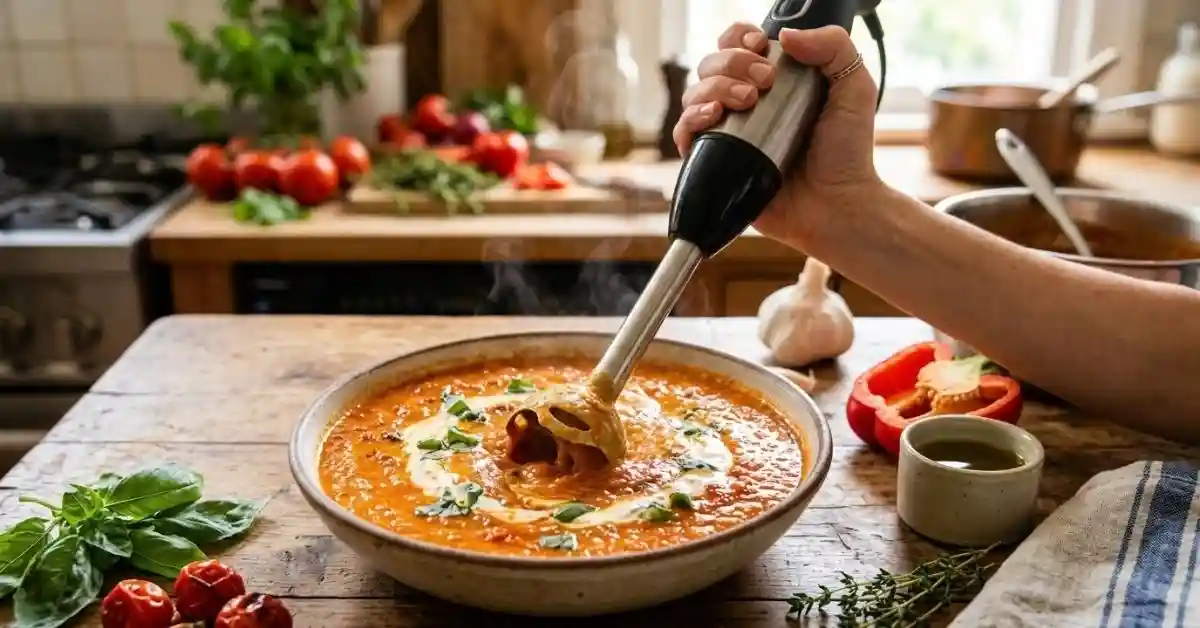
An immersion blender is mainly used to blend, puree, and mix food right in the pot, bowl, or cup. I find it most useful for soups, sauces, smoothies, baby food, and other soft foods where moving everything to a full-size blender feels like extra work.
The big draw is simple: you put the blending end into the food and turn it on. There is less mess, less moving around, and usually less cleanup. But an immersion blender is not a small version of every kitchen blender. It has limits, too. Here is where it works best, where it can struggle, and the small mistakes that can make blending harder than it needs to be.
What Is an Immersion Blender Used for?
An immersion blender is used to blend soft foods and liquids directly in their cooking or serving container. It is also called a hand blender or stick blender.
The first thing I would remember is this: an immersion blender is great when you want to blend food without transferring it.
| Food or task | How well it works | Useful tip |
| Soup | Excellent | Blend right in the pot |
| Sauce | Excellent | Use short pulses |
| Smoothie | Good | Use enough liquid |
| Baby food | Excellent | Blend in small batches |
| Ice crushing | Usually poor | Use a suitable blender instead |
This makes it especially handy for foods that would be annoying to pour into a regular blender. Hot soup is a good example. Instead of lifting a heavy pot, pouring soup into a blender, blending it, and washing the blender jar, you can often blend it right where it was cooked.
That small difference saves more time than I first expected.
How Does an Immersion Blender Work?
An immersion blender has a small motor in the handle and a blade at the bottom. When you place the blade into food and turn it on, the spinning blade pulls food toward it and breaks it into smaller pieces.
You control the blender by moving it through the food. That movement matters more than many beginners expect.
Why the Blade Needs to Stay Under the Food
One common mistake is turning the blender on before the blade is fully covered. This can make a mess fast.
Keep the blade head below the surface when blending liquids. Move it slowly up and down or around the container as needed.
| What you notice | Likely cause | What to do |
| Food splashes | Blade is too close to the surface | Lower the blade |
| Large pieces remain | Blender is not reaching them | Move it around slowly |
| Blend feels uneven | Food is too thick | Add a little liquid |
| Motor slows down | Mixture is too thick | Stop and loosen the mixture |
I learned to think of the blender as a tool that needs some movement. Holding it in one spot does not always give an even result.
What Foods Can You Make With an Immersion Blender?
This is where an immersion blender earns its place in a kitchen. It can handle many soft foods with very little setup.
Soups Are One of Its Best Uses
Creamy soups are probably the classic use for an immersion blender.
You can cook vegetables such as potatoes, carrots, pumpkin, or squash in a pot. Once they are soft, place the immersion blender into the pot and blend until the soup reaches the texture you want.
There is no need to transfer the hot soup to another container.
| Soup type | Immersion blender result |
| Tomato soup | Smooth and easy |
| Potato soup | Creamy and thick |
| Pumpkin soup | Very smooth |
| Vegetable soup | Smooth or partly chunky |
I also like the control it gives you. You do not have to make every soup perfectly smooth. A few short pulses can leave some small pieces behind.
Sauces and Gravies
An immersion blender can also smooth sauces and gravies.
It is useful when a tomato sauce has large pieces of onion or tomato that you want to break down. It can also help smooth some homemade gravies and pan sauces.
The main trick is not to over-blend. A sauce can go from nicely textured to completely smooth very quickly.
Smoothies and Protein Drinks
An immersion blender can make a quick smoothie, especially in a tall cup.
Soft fruits such as bananas, berries, and ripe peaches are easy to blend. Yogurt and milk also help create a smooth mixture.
Hard frozen fruit can be more demanding. The result depends on the blender’s motor, blade design, and how much liquid you use.
| Smoothie ingredient | How to handle it |
| Banana | Blend easily |
| Soft berries | Usually easy |
| Yogurt | Blend with enough liquid |
| Frozen fruit | Use smaller pieces |
| Ice | Check the model first |
I would not assume that every hand blender can crush ice. That is one of those small details that can turn into a frustrating cleanup job.
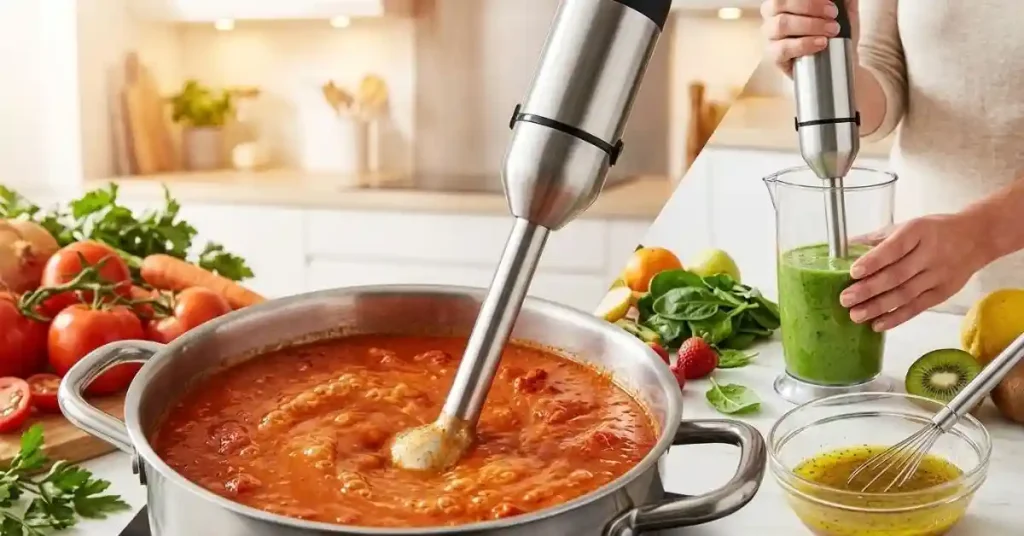
Can You Use an Immersion Blender for Hot Soup?
Yes, many immersion blenders are designed for blending hot foods, which is one of their most useful jobs. However, you should always check the instructions for your specific model.
The main safety issue is splashing. Hot liquid can burn skin quickly.
A Safer Way to Blend Soup
Let the blade head go fully into the soup before turning it on. Start at a low speed if your model allows it.
Then move the blender slowly around the pot.
| Better habit | Why it helps |
| Keep blade submerged | Reduces splashing |
| Start slowly | Gives you more control |
| Blend in short bursts | Helps avoid over-blending |
| Use a deep pot | Keeps liquid contained |
Do not lift a running immersion blender out of the soup. Turn it off first, then move it.
That sounds obvious, but it is an easy mistake to make when you are trying to check the texture.
Immersion Blender vs Regular Blender: Which One Makes More Sense?
The two tools overlap, but they are not really built for the same style of cooking.
A regular countertop blender is usually better when you need very smooth results, large batches, or harder ingredients. An immersion blender is better when convenience and quick cleanup matter most.
| Comparison | Immersion blender | Regular blender |
| Directly in pot | Yes | No |
| Large batches | Limited | Better |
| Cleanup | Easy | More parts |
| Very smooth blends | Good | Often better |
| Storage | Compact | Takes more space |
For me, the biggest difference is not raw blending power. It is where you can use the tool.
If I already have soup in a pot, using a stick blender means I do not need another container. That can make a simple dinner much easier.
What Should You Not Use an Immersion Blender For?
An immersion blender is useful, but it is not a universal kitchen machine.
Very hard foods can put a lot of stress on the motor and blade. Some models may handle certain hard ingredients, but you should follow the manufacturer’s instructions.
Foods That May Cause Problems
Be careful with large ice cubes, hard nuts, coffee beans, raw hard vegetables, and very thick mixtures unless your model specifically supports them.
| Food | Main concern |
| Large ice cubes | Can strain the motor |
| Coffee beans | Wrong tool for the job |
| Hard nuts | May need a stronger blender |
| Very thick dough | Can overload the motor |
| Large raw vegetables | Hard to blend evenly |
This is one area where more power does not solve every problem. Blade design and the intended use of the appliance matter too.
If you often make nut butter, grind dry ingredients, or crush ice, a full-size blender or food processor may be a better fit.
Can an Immersion Blender Make Mashed Potatoes?
It can, but this is one job where I would use some caution.
Potatoes contain a lot of starch. Aggressive blending can turn cooked potatoes from fluffy to sticky and gluey.
If you want to use an immersion blender, blend very briefly and gently. Better yet, use a potato masher or ricer if fluffy mashed potatoes are the goal.
My Biggest Lesson With Thick Foods
The thicker the food, the more important your technique becomes.
If the blade cannot move freely, do not keep forcing it. Stop, loosen the mixture with a little suitable liquid, and continue only if the recipe and appliance allow it.
This simple habit can help protect the motor and improve the final texture.
How Do You Get a Smoother Blend?
Getting smooth food is not only about buying a powerful immersion blender. The way you prepare and blend the food matters a lot.
Cut large ingredients into smaller pieces before cooking or blending. Make sure vegetables are soft enough. Then move the blender slowly through the mixture.
| Problem | Better approach |
| Chunky soup | Cook vegetables until soft |
| Uneven sauce | Move the blade around |
| Thick smoothie | Add some liquid |
| Foamy mixture | Use slower movement |
| Bits left at the bottom | Tilt and reposition the blender |
I also prefer short blending sessions instead of running the motor nonstop. It gives me more control over the texture and lets me check the food as I go.
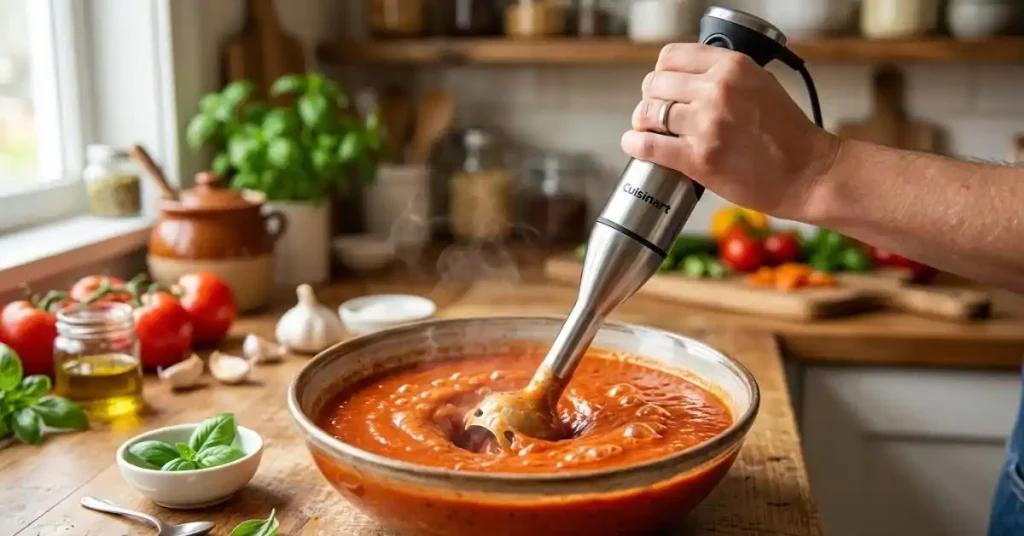
What Are the Most Common Immersion Blender Mistakes?
Most problems are not caused by the basic idea of the tool. They come from using it in the wrong way.
Mistake 1: Blending at the Surface
This is one of the easiest ways to create splashes.
Keep the blade below the surface. If the food level is too low, use a narrower and deeper container when appropriate.
Mistake 2: Using Too Little Liquid
A thick mixture may not move around the blade well.
If the recipe allows it, add a small amount of liquid. Do not add too much at once. You can always add more.
Mistake 3: Leaving the Blender in One Spot
The blade can only reach so much food from one position.
Move it slowly around the container. For chunky soup, this helps the blade reach different pieces.
Mistake 4: Blending for Too Long
More blending is not always better.
Some foods become gummy, foamy, or overly smooth when you keep going.
| Common mistake | What I would do instead |
| Lift while running | Turn it off first |
| Force thick food | Add suitable liquid or stop |
| Blend hard foods blindly | Check the manual |
| Run it too long | Blend in short bursts |
| Ignore splashing | Keep the blade submerged |
These are small habits, but they make an immersion blender much easier to live with.
Is an Immersion Blender Worth Having in a Small Kitchen?
For a small kitchen, an immersion blender can make a lot of sense.
It takes up far less space than many countertop blenders. It can often sit in a drawer, and some models have detachable blending shafts that make cleaning easier.
It is also useful when you cook for one or two people. You do not always need a large blender jar for a small batch of soup or sauce.
When It Fits a Small Kitchen Best
I would consider one especially useful if you often make:
- Small batches of soup
- Sauces and gravies
- Smoothies
- Baby food
- Purees
- Salad dressings
- Simple dips
It does not replace every appliance. But it can cover several small jobs without taking up much room.
Immersion Blender Attachments: Are They Useful?
Some immersion blender sets include extra attachments. These can include a whisk, blending cup, or food processor-style accessory.
They can be handy, but I would not buy a model based only on the number of accessories in the box.
The main question is whether you will use them.
| Attachment | Useful for |
| Whisk | Eggs and light mixtures |
| Blending cup | Smoothies and small blends |
| Chopper | Small food prep |
| Standard blending shaft | Soups, sauces, purees |
For me, the blending shaft is the part that matters most. The extras are useful only when they fit your normal cooking habits.
Can an Immersion Blender Replace a Regular Blender?
Sometimes, but not completely.
If most of your blending involves soups, sauces, soft foods, and small smoothies, an immersion blender may cover a large part of your needs.
If you make large smoothies, frozen drinks, nut butter, or very smooth blends on a regular basis, a countertop blender may still be the better tool.
Think about what you actually make instead of what the appliance can theoretically do.
A Simple Way to Choose
| Your main need | Better fit |
| Soup in a cooking pot | Immersion blender |
| Small sauce batches | Immersion blender |
| Large smoothies | Regular blender |
| Ice-heavy drinks | Regular blender |
| Compact storage | Immersion blender |
| Large food batches | Regular blender |
That is the distinction I would keep in mind before buying either one.
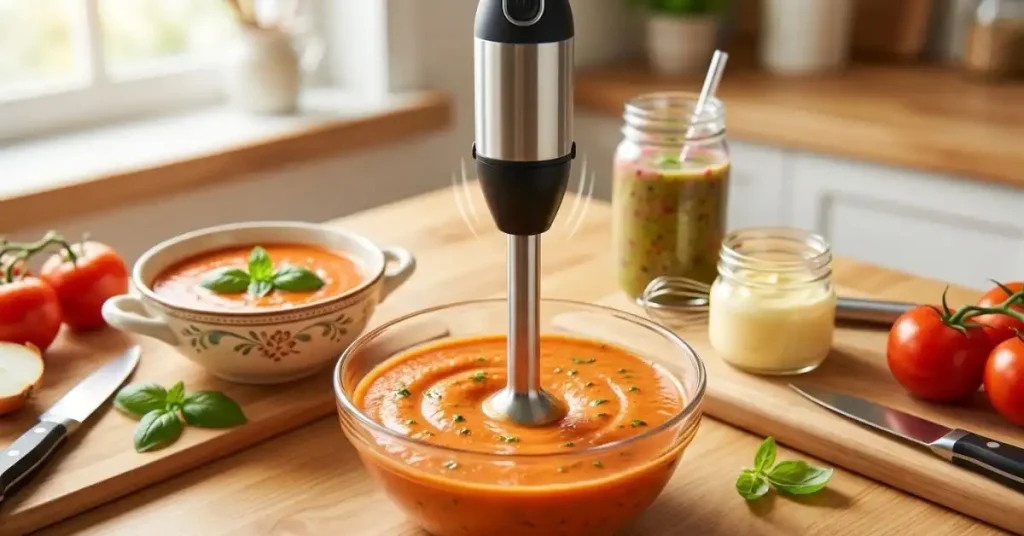
Final Thoughts on What Is an Immersion Blender Used for?
So, what is an immersion blender used for? It is mainly a quick tool for blending and pureeing soft foods and liquids without moving them into another container. Soup, sauce, smoothies, purees, and small batches are where it makes the most sense.
The biggest lesson is that convenience is its real strength. It will not replace a powerful countertop blender for every task, and it should not be pushed through foods it was not designed to handle. But for quick kitchen jobs, easy cleanup, and direct blending in a pot, an immersion blender can be surprisingly useful.
To Get More About Home, Kitchen Accessories Product You Can Visit Our Site. If You Found our Posts Helpful Leave a Comment Below