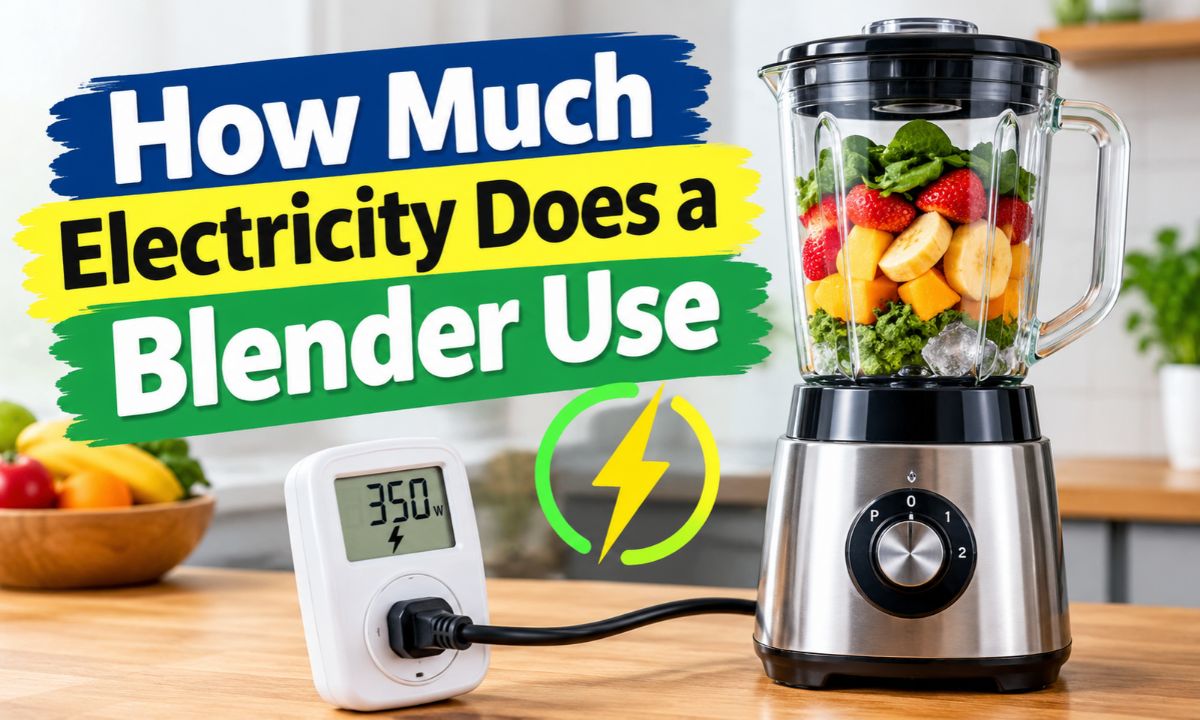
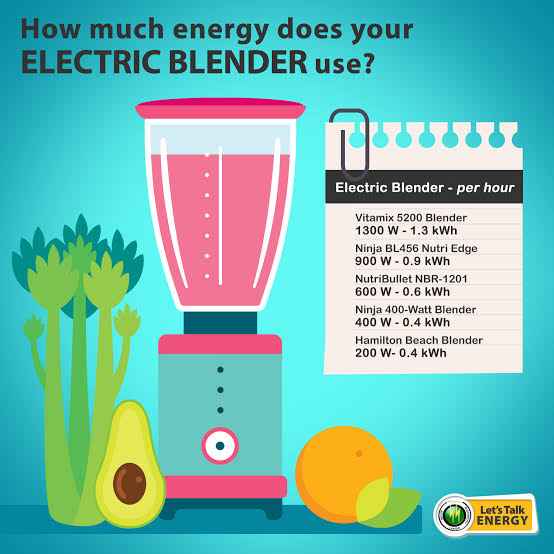
Most household blenders use about 300 to 1,500 watts while running, but a short blending session usually consumes only a small amount of electricity.
In American homes, blenders help make smoothies, soups, sauces, dips, and frozen drinks. These small kitchen appliances can have powerful motors, yet they usually run for only a few seconds or minutes at a time. That short run time matters more to your electric bill than the wattage number alone.
To estimate your blender’s electricity use, check its rated wattage, work out how many minutes you use it, and convert the result to kilowatt-hours. Your local electricity rate then tells you the cost. A 1,000-watt blender running for five minutes uses about 0.083 kilowatt-hours at its rated power, which costs about 1.25 cents at a hypothetical rate of 15 cents per kilowatt-hour.
Actual power use can vary with the blender model, selected speed, ingredients, load, and motor design. The calculations in this guide use clear examples rather than claiming that every blender draws its full rated power at all times. You can use the same method for a compact smoothie blender, a standard countertop model, or a high-powered blender.
A typical household blender may be rated at 300 to 1,500 watts. Compact models often sit toward the lower end, while many full-size and high-powered models use higher ratings. The exact number depends on the product, so check the label or manual instead of assuming that all blenders use the same amount of power.
Watts measure the rate at which an appliance uses energy. Kilowatt-hours measure the energy used over time. Since an electric bill usually charges for kilowatt-hours, the wattage rating alone cannot tell you the full cost of blending.
For example, a 600-watt blender running for one minute at its rated power uses 10 watt-hours, or 0.01 kWh. A 1,200-watt blender running for the same minute uses 20 watt-hours, or 0.02 kWh. Both figures are small because the appliances run for such a short time.
These are calculated estimates based on rated power. A blender may draw less than its rating during some tasks or draw different amounts as the motor works against thick ingredients. The exact result depends on the model and the conditions.
Source: cornwallsolarcompany.com
Compact personal blender
A small smoothie blender may have a relatively low wattage rating and a small blending cup. Its electricity use depends on its motor rating and how long each batch takes.
Standard countertop blender
A conventional kitchen blender may offer several speeds and a larger jar. Short daily use generally keeps its total energy consumption modest.
High-powered blender
A powerful model may have a higher rated wattage for demanding tasks such as crushing ice or blending thick mixtures. Its actual energy use still depends on the time and load.
Does a blender use electricity when it is off?
A basic blender with a mechanical switch may draw no meaningful power when switched off, especially if it is unplugged. Models with electronic controls, displays, or standby features may use some electricity while connected to an outlet. The amount depends on the design.
If your blender has electronic features and you want to check standby use, a suitable plug-in energy meter may help. Follow the meter’s instructions and use a properly rated device. Unplugging the blender after use is a simple way to avoid any standby consumption.
Simple manual controls
These designs often have little or no standby demand, but the exact behavior depends on the internal circuit.
Electronic controls
A display or touch panel may need a small amount of power while waiting for use.
How to Calculate Blender Electricity Consumption
You can estimate a blender’s energy use with a simple formula. First, find its wattage rating. Next, divide the watts by 1,000 to convert them to kilowatts. Then multiply that number by the number of hours the blender runs.
The formula is: Electricity used in kWh = watts ÷ 1,000 × operating hours. If you know the electricity price per kWh, multiply the energy result by that rate to estimate the cost.
For example, suppose a blender is rated at 800 watts and runs for three minutes. Three minutes is 0.05 hours. The calculation is 800 ÷ 1,000 × 0.05, which equals 0.04 kWh. At $0.15 per kWh, the estimated cost is $0.006, or six-tenths of one cent.
This estimate assumes the blender draws its full rated power throughout the session. A real blender may use less or more than a simple calculation suggests at different points in its cycle, within the limits of its design. The formula is best treated as a clear starting point, not a direct measurement.
Source: cornwallsolarcompany.com
Step 1: Find the wattage
Look at the product label, owner’s manual, or manufacturer’s specifications. Do not confuse watts with volts or motor speed.
Step 2: Record the run time
Add the minutes spent blending during the period you want to measure. Include repeated pulses if you want to estimate a complete recipe.
Step 3: Convert minutes to hours
Divide the total minutes by 60 before multiplying by the kilowatt rating.
Step 4: Apply your electricity rate
Use the energy price on your electric bill, expressed in dollars per kWh, to estimate the cost.
A simple calculation for daily use
Suppose you use a 1,000-watt blender for two minutes each morning. Two minutes equals one-thirtieth of an hour. At full rated power, the blender uses about 0.033 kWh per session.
Over 30 days, that adds up to about 1 kWh. At $0.15 per kWh, the estimated monthly cost is about 15 cents. This example shows why short blending sessions often have little effect on a household electricity bill.
Daily energy
1,000 W ÷ 1,000 × 2 ÷ 60 = approximately 0.033 kWh.
Monthly energy
Approximately 0.033 kWh × 30 sessions = 1 kWh.
Monthly cost
1 kWh × $0.15 per kWh = $0.15, using the example rate.
How Much Does It Cost to Run a Blender?
For many households, the cost of running a blender is measured in cents over many uses rather than dollars for each smoothie. The cost is low because blending sessions are usually brief. Still, a cost estimate can help if you use the appliance many times a day or run it for longer food preparation tasks.
Electricity prices vary across the United States and may differ by utility, plan, season, and time of day. Your actual bill may also include fixed charges, taxes, and other fees that do not change with one blending session. For a fair estimate of the blender’s direct energy cost, use the per-kWh rate that applies to your household.
The table below uses a hypothetical rate of $0.15 per kWh. It assumes each blender runs at its full rated wattage for the listed time. These numbers are calculations, not measured results from specific products.
Source: longroadhomeproject.com
One-minute session
A 500-watt blender uses 0.0083 kWh and costs about 0.13 cents at $0.15 per kWh.
Three-minute session
A 1,000-watt blender uses 0.05 kWh and costs about 0.75 cents at the example rate.
Five-minute session
A 1,500-watt blender uses 0.125 kWh and costs about 1.88 cents at the example rate.
Estimated cost by wattage and run time
Use the table to compare several common wattage ratings and run times. The amounts are rounded, so small differences may appear if you calculate with more decimal places.
At the same run time and electricity rate, the higher-wattage rating produces a higher estimated cost. But this comparison does not show which blender will finish a recipe faster, so it should not be the only factor when comparing appliances.
500 watts for 2 minutes
Approximately 0.0167 kWh, costing 0.25 cents at $0.15 per kWh.
750 watts for 3 minutes
Approximately 0.0375 kWh, costing 0.56 cents at $0.15 per kWh.
1,000 watts for 5 minutes
Approximately 0.0833 kWh, costing 1.25 cents at $0.15 per kWh.
1,500 watts for 10 minutes
Approximately 0.25 kWh, costing 3.75 cents at $0.15 per kWh.
How to estimate your monthly blender bill
To estimate a monthly cost, calculate the energy used in one session and multiply it by the number of sessions per month. Then multiply the monthly kWh figure by your electricity rate.
For example, a 1,000-watt blender running for five minutes per day uses about 0.0833 kWh per day at rated power. Over 30 days, that is 2.5 kWh. At $0.15 per kWh, the estimated monthly energy cost is $0.375, or about 38 cents.
Count every session
Include smoothies, sauces, meal prep, and other blending tasks if you want a complete estimate.
Use your own rate
Replace the example electricity price with the rate shown on your bill.
Does a Higher-Wattage Blender Use More Electricity?
A higher-wattage blender can use more electricity per minute when it draws more power, but it does not always use more energy for the same recipe. The total depends on the power draw and the time needed to complete the task.
Think of wattage as the rate of energy use and run time as the duration of that use. A 1,200-watt blender running for one minute at full rated power uses 0.02 kWh. A 600-watt blender running for two minutes uses the same amount: 0.02 kWh.
That comparison is mathematical, not proof that either blender will finish a particular recipe in the stated time. The jar shape, blade design, ingredients, batch size, and selected speed all affect performance. A powerful motor may handle some thick mixtures more quickly, while another task may show little practical difference.
For everyday use, choose a blender that handles your usual recipes without repeated long cycles or unnecessary strain. Buying the highest wattage available solely to save electricity is not a reliable strategy. Likewise, choosing the lowest wattage does not guarantee the lowest energy use for every task.
Source: blenderjunkie.com
Wattage
Shows the appliance’s rated power, but does not by itself tell you the energy used for a complete recipe.
Run time
Longer blending adds energy use, especially if the motor keeps running while ingredients remain stuck or poorly mixed.
Task difficulty
Frozen fruit, ice, nuts, and thick mixtures can change how hard the motor works and how long the task takes.
Blender design
Blade geometry, jar shape, speed settings, and motor controls affect how effectively the appliance processes ingredients.
Is a 1,500-watt blender expensive to run?
Not necessarily. If a 1,500-watt blender runs for only one minute, the full-rated-power estimate is 0.025 kWh. At $0.15 per kWh, that costs about 0.38 cents.
The same blender running for 20 minutes would use an estimated 0.5 kWh at rated power, costing 7.5 cents at the example rate. Longer use raises the cost, but even this example remains modest. Actual consumption can differ from the rated-power estimate.
Short sessions
Brief blending usually keeps total electricity use low even when the wattage rating is high.
Extended sessions
Repeated or prolonged blending increases energy use and may also increase heat buildup. Follow the manual’s duty-cycle limits.
What Factors Affect Blender Power Consumption?
The electricity used by a blender depends on more than its wattage label. The ingredients, portion size, speed setting, blending time, and motor design can all affect the amount of energy consumed during a session.
A thin fruit drink may blend quickly, while frozen fruit or a thick nut butter may need a different speed, several short pulses, or more time. A blender that struggles with the load may run longer, but you should not force it beyond the limits stated in the manual.
The best estimate uses your normal recipe and actual operating time. If the cost difference matters, measure several typical sessions with a compatible energy meter rather than assuming that the rated wattage remains constant.
Source: blenderjunkie.com
Ingredient texture
Soft fruit and liquids may blend quickly. Hard, frozen, or dense ingredients can require more work from the motor.
Batch size
A larger batch can take longer to blend. A batch that is too small for the jar may also fail to circulate well.
Speed and pulse settings
Different settings can change the motor’s operating conditions and the time required for a recipe.
Motor and control design
Different models manage speed and load differently, so two blenders with similar labels may not use identical energy for the same task.
Repeated blending
Several short cycles add up. Count all the active blending time when estimating daily or monthly use.
Why frozen ingredients can change the result
Frozen fruit and ice can place a greater load on the blades than soft ingredients. The blender may need a suitable speed, a pulsing pattern, or a recipe-specific amount of liquid to move the ingredients effectively.
Use the instructions for your model and avoid filling the jar beyond its marked limit. If the blades stop moving the mixture, switch the blender off before adjusting the contents. Never put a hand or utensil into a running blender.
Use suitable ingredients and portions
Follow the recipe and the manufacturer’s guidance for ice, frozen food, and thick mixtures.
Avoid unnecessary run time
Stop the motor if the mixture is not circulating, then check the load after the blades have fully stopped.
How to Measure a Blender’s Actual Electricity Use
A plug-in electricity meter can give you a more direct estimate of the energy your blender uses. It measures the power drawn through the outlet and may display accumulated energy in kWh. This can help when the appliance’s actual power draw differs from the rating on its label.
Choose a meter rated for the voltage, current, and plug type used by your appliance. Inspect the meter’s instructions and safety ratings before connecting it. Do not use an unsuitable adapter or meter, and do not open the blender or its electrical parts to measure consumption.
For a useful reading, measure a normal recipe rather than an empty blender. Record the starting energy value if the meter supports cumulative readings, run the blender as you normally would, and then note the energy used. Repeat the process for other common tasks if you want a more representative picture of household use.
Source: cornwallsolarcompany.com
Check compatibility
Confirm that the meter supports your household outlet and the blender’s electrical load.
Measure a normal session
Use the blender with a suitable recipe and follow its normal operating instructions.
Record kWh
Use the meter’s accumulated energy reading when available. A watt reading alone shows power at a point in time, not total energy.
Repeat if needed
Several typical sessions can help account for differences between smoothies, sauces, and other recipes.
What if the meter shows different power readings?
A changing reading is not automatically a problem. A blender’s motor may draw different amounts of power as it starts, changes speed, or processes ingredients. Some meters may also be less accurate at very low loads or during brief changes.
Focus on the accumulated kWh over a complete session when your meter supports that function. If a reading appears far outside the appliance’s documented electrical rating, stop using questionable equipment and check the manual or contact the manufacturer rather than opening the appliance.
Look at total energy
A cumulative kWh reading is more useful for calculating a session’s electricity cost than a momentary watt reading.
Check measurement limits
The meter’s accuracy and supported load range affect how much confidence you can place in the result.
Do Personal Blenders Use Less Electricity Than Full-Size Blenders?
Personal blenders often have smaller jars and may have lower wattage ratings than some full-size models. That can make them convenient for a single smoothie, but size alone does not prove that they always use less electricity for every recipe.
A personal blender may finish a small serving quickly. A full-size blender may be more suitable for several servings or a larger batch of soup. If the larger model processes a family-size batch in one cycle, it may avoid the need to run a small blender several times.
Compare energy for the same useful amount of food rather than comparing wattage alone. For a fair test, use a similar recipe and quantity, follow each blender’s minimum and maximum fill guidance, and measure the energy used for the complete task.
Source: thespruceeats.com
Personal blender
Often suited to single servings and small portions. Check the rating and cup capacity of the specific model.
Full-size countertop blender
Often suited to larger batches and more varied kitchen tasks. A larger motor may have a higher rated wattage.
High-powered blender
May handle some demanding recipes effectively, but its energy use depends on the task and run time.
Which blender is best for low electricity use?
The most practical choice is a blender that can handle your usual serving size and ingredients without unnecessary extra cycles. If you make one simple smoothie a day, a compact model may meet your needs. If you often blend large batches or thick mixtures, a suitable full-size model may be more useful.
Look at rated wattage, jar size, recommended uses, operating limits, and cleaning needs together. A low wattage rating can help reduce estimated energy per minute, but a poor match for your recipes may lead to longer blending or repeated batches.
For one daily smoothie
Consider a personal blender that fits your portion size and ingredients.
For family meals
Consider a jar that holds the batch you normally prepare, within its marked limits.
For dense recipes
Choose a model whose manual supports the ingredients and task instead of relying on wattage alone.
Practical Ways to Reduce Blender Electricity Use
The easiest way to reduce blender energy use is to avoid running it longer than the recipe requires. Because a typical session is short, the savings from small changes may also be small, but good habits can reduce waste and help the appliance work within its intended limits.
Start by using the right jar size and portion. Follow the recipe’s recommended order for adding liquids and solids, if provided, and select a suitable speed. If the ingredients stop circulating, turn the appliance off before checking the contents.
Do not shorten a cycle so much that the food remains unsafe or unsuitable for its intended use. Most blender recipes do not depend on the motor heating the food, and blending alone should not be treated as a reliable way to cook or sanitize ingredients.
Source: reviewmast.com
Prepare ingredients first
Cut ingredients to sizes allowed by the manual and measure the batch before switching on the blender.
Use the right amount of liquid
For recipes that need liquid to circulate, follow the recipe and appliance guidance instead of forcing the motor through a thick mixture.
Blend only as long as needed
Stop when the desired texture is reached, provided the recipe and appliance instructions allow it.
Avoid repeated failed cycles
If the mixture is stuck, switch off the appliance and inspect it only after the blades stop completely.
Unplug after use when appropriate
This can avoid standby power on models that use it and reduces the chance of accidental activation during cleaning.
Keep the blender in good condition
Follow the manual for cleaning, assembly, and maintenance. Stop using the appliance if the cord, plug, jar, or base is damaged.
Should you run a blender at a lower speed to save power?
A lower speed may reduce power draw in some blenders, but the result depends on the motor and control design. It may also take longer to finish the task, so the total energy used may not fall.
Use the speed that suits the recipe and the manufacturer’s instructions. If you want to know whether a lower setting saves energy on your model, compare measured kWh for the same recipe and amount at each suitable setting.
Compare complete tasks
Measure the energy used to finish the same recipe, not just the instantaneous watt reading.
Follow the recipe
Texture, ingredient movement, and safe operation matter more than forcing every recipe to use the lowest setting.
Common Mistakes When Estimating Blender Power Use
The most common mistake is treating watts and kilowatt-hours as the same thing. Watts describe power, while kilowatt-hours describe energy over time. Your electricity bill normally charges for energy, so both the power rating and the run time matter.
Another mistake is assuming the blender draws its maximum rated power every second. The label gives useful electrical information, but actual consumption can change as the motor starts, runs at different speeds, and processes different ingredients.
People may also compare two blenders by wattage alone and conclude that the lower-rated one will always be cheaper to operate. That overlooks differences in task time, batch size, and performance. A useful comparison measures the energy required to complete the same job.
Finally, avoid multiplying the blender’s wattage by all the hours it sits on the kitchen counter. Unless it is actively using that amount of power, the calculation will greatly overstate consumption. Standby use, where present, should be considered separately.
Source: thehomehacksdiy.com
Mistake: Forgetting to convert minutes
Convert the run time to hours before using the kWh formula. For instance, five minutes is 5 ÷ 60 hours.
Mistake: Using the wrong electricity rate
Use the applicable price per kWh on your bill rather than assuming every American household pays the same rate.
Mistake: Counting preparation time as run time
Only include time when the blender draws electricity, plus any separately measured standby use you wish to include.
Mistake: Ignoring task differences
A comparison between different recipes or batch sizes cannot reliably show which blender is more efficient.
Mistake: Ignoring electrical damage
Do not keep using a blender with a damaged cord, burning smell, unusual sparks, or signs of overheating. Disconnect it safely and seek qualified service or replacement.
When should you stop using a blender?
Stop the appliance if it produces smoke, a burning odor, unusual sparking, or a new harsh grinding sound. Turn it off and unplug it if you can do so safely. Do not touch damaged electrical parts or open the motor housing to investigate.
If the blender repeatedly stalls, overheats, or trips a circuit, check the manual for permitted batch sizes, duty cycles, and troubleshooting steps. If the problem continues, contact the manufacturer or a qualified repair professional. Do not bypass a safety feature or use an extension cord that is not rated for the load.
Smoke or burning smell
Stop using the blender and disconnect power if safe. Do not restart it until the cause has been addressed.
Repeated stalling
Check the recipe, load, and operating limits after the blades have stopped and the appliance is unplugged.
Damaged cord or plug
Do not use the appliance until it has been properly repaired or replaced.
How Blender Electricity Use Compares With Other Kitchen Appliances
A blender’s electricity use is usually low for a single task because it runs for a short time. Appliances such as refrigerators, freezers, and some countertop devices may use energy over much longer periods, while ovens, kettles, and microwaves may draw substantial power during active use.
A fair comparison must consider both watts and time. A 1,000-watt appliance running for one minute uses an estimated 0.0167 kWh at full rated power. An appliance rated at 100 watts running for one hour uses 0.1 kWh, which is six times as much energy.
This does not mean that all 1,000-watt appliances use the same energy for their intended tasks. Different devices operate in different ways, and their actual draw can change during use. The example only shows why operating time matters when comparing energy consumption.
Source: blenderjunkie.com
Blender
Often runs for seconds or a few minutes per recipe, so the total energy per session is usually modest.
Microwave
May draw substantial power during cooking, but the energy used depends on cooking time and its operating cycle.
Electric kettle
Often draws high power while heating water. The energy for a session depends on the amount of water and how long it takes to heat.
Refrigerator
Runs over the day with its compressor cycling as needed, so its daily energy use is better measured over a longer period.
Oven
May use substantial energy during preheating and cooking. Its total use depends on temperature, duration, and heating cycles.
Does a blender use more electricity than a microwave?
It depends on how long each appliance runs and how much power each draws. A microwave may have a higher input power rating than a small blender, but a short blender session can use less energy than several minutes of microwave operation.
To compare them, use each appliance’s input wattage and active time or measure the actual kWh. For a microwave, use its electrical input rating rather than the cooking output rating when estimating electricity use. The output rating describes energy delivered to food, not the full electrical input.
Use input power
Check the electrical input information in the appliance specifications or manual.
Compare complete tasks
Estimate or measure the energy for the actual blending and heating jobs you perform.
How to Choose a Blender Without Overpaying for Power
Choose a blender based on the tasks you perform most often, not on the highest wattage figure you can find. For simple drinks and soft fruit, a compact model may be enough. For thick mixtures, ice, nuts, or larger family batches, look for a model whose instructions support those tasks.
Consider the total cost of ownership, including the purchase price, jar capacity, replacement parts, cleaning effort, and warranty terms. Electricity is one part of that cost, but short blending sessions often make it a smaller factor than convenience and the ability to handle your recipes.
Read the product’s input power rating and operating instructions. If you are comparing models, check how each manufacturer defines its wattage figure and whether the specification refers to electrical input or another measure. Avoid assuming that a large motor rating guarantees better results for every ingredient.
Source: cornwallsolarcompany.com
For basic smoothies
Look for a practical jar size, simple controls, and instructions that cover your usual fruits and liquids.
Check that the model is designed for ice or frozen ingredients and follow its stated portion limits.
For sauces and soups
Consider the batch size, jar material, temperature limits, and whether the manual permits blending warm ingredients.
For thick mixtures
Check the manufacturer’s guidance for dense foods and any required accessories or minimum liquid levels.
For energy-conscious use
Compare estimated or measured kWh for a typical task instead of choosing solely by wattage.
Is a low-wattage blender always more energy efficient?
No. A low-wattage blender may use less energy per minute, but if it needs much more time to finish a recipe, the total energy may be similar or higher. The result also depends on whether the appliance can handle the ingredients safely and effectively.
For a meaningful comparison, use the same recipe, ingredient quantity, and target texture. Measure the total energy used by each model or calculate an estimate using its actual operating time. This provides a more useful answer than wattage alone.
Compare the same output
Use equivalent portions and a similar finished texture so that the tasks are comparable.
Include total run time
Count all blending cycles needed to complete the task.
A Practical Blender Electricity Calculator Example
You can estimate your own cost in less than a minute once you know the wattage, run time, number of sessions, and electricity rate. The example below uses a hypothetical 750-watt blender, three minutes per session, one session per day, and an electricity rate of $0.18 per kWh.
Convert 750 watts to 0.75 kilowatts. Convert three minutes to 0.05 hours. Multiply 0.75 by 0.05 to get 0.0375 kWh per session. Multiply that result by $0.18 to get $0.00675, or about 0.68 cents per session.
For 30 sessions, the estimated energy use is 1.125 kWh and the cost is $0.2025, or about 20 cents. These values assume the blender draws its rated power throughout each session. If actual power draw is lower or higher during operation, measured energy may differ.
Source: longroadhomeproject.com
Rated power
750 watts, equal to 0.75 kW.
Session length
Three minutes, equal to 0.05 hours.
Energy per session
0.75 kW × 0.05 hours = 0.0375 kWh.
Cost per session
0.0375 kWh × $0.18 per kWh = $0.00675.
Estimated monthly cost
Thirty sessions cost about $0.20 at the example rate.
How to make the estimate more accurate
Use the electricity rate that applies to your bill, and measure actual run time rather than counting the time spent preparing ingredients or washing the jar. If your blender has multiple speeds or automatic cycles, include the full sequence you normally use.
For the most direct estimate, use a compatible energy meter that records accumulated kWh. Take care to follow the meter’s load rating and the blender’s safety instructions. Repeat measurements if you want to account for differences between recipes.
Use your bill’s rate
Replace the example rate with your own electricity cost per kWh.
Record the full session
Include pulses and repeated cycles needed to finish the recipe.
Measure when precision matters
A compatible meter can show actual energy use more directly than the rated-wattage estimate.
Frequently Asked Questions
Q
How many watts does a normal blender use?
Many household countertop blenders have rated power between about 300 and 1,500 watts. Compact models may use less, and some specialized or high-powered models may have higher ratings. Check the product label or manual for the exact figure.
Remember that watts measure power, not the total electricity used during a recipe. A blender with a high rating can still use little energy if it runs for only a short time.
Q
Does a blender use a lot of electricity?
Usually, a blender does not use much electricity for a typical short session. For example, a 1,000-watt blender running for three minutes uses about 0.05 kWh at full rated power. At $0.15 per kWh, that is about 0.75 cents.
Frequent use and long blending sessions increase the total, but the cost for ordinary short tasks is often small. Your actual result depends on the blender’s power draw, run time, and electricity rate.
Q
How much does it cost to run a blender for one hour?
If a 1,000-watt blender drew its full rated power continuously for one hour, it would use 1 kWh. At an electricity rate of $0.15 per kWh, that would cost $0.15.
However, many blenders are not designed to run continuously for an hour. Check the manufacturer’s duty-cycle and cooling instructions before using a blender for an extended period. The calculation is an energy example, not a recommendation for continuous operation.
Q
Is a 500-watt blender cheaper to run than a 1,000-watt blender?
At the same run time and full rated power, a 500-watt blender uses half the estimated energy of a 1,000-watt blender. For example, over two minutes, the estimates are about 0.0167 kWh and 0.0333 kWh, respectively.
The total cost for a recipe may differ because the blenders may need different amounts of time to finish the same task. Compare the energy used for the same quantity and recipe when possible.
Q
Does using a blender every day increase the electric bill?
Yes, daily blending adds to household electricity use, but the increase is often small because sessions are brief. A 1,000-watt blender running for two minutes a day uses about 1 kWh over 30 days at full rated power.
At $0.15 per kWh, that example costs about 15 cents per month. If you blend for longer periods or use the appliance many times a day, calculate the total using your own operating time and electricity rate.
Q
Can a blender run on a portable power station?
Some blenders can run from a portable power station, but compatibility depends on the station’s continuous AC output, surge capacity, outlet type, battery capacity, and the blender’s electrical requirements. A motor can draw extra power when starting, so a station’s advertised battery capacity alone is not enough to confirm compatibility.
Check the specifications and instructions for both devices before connecting them. Do not exceed the power station’s output limits, and avoid improvised electrical connections. If the ratings are unclear, ask the manufacturers for guidance.
Q
Do blenders use electricity when plugged in but not running?
Some models with electronic controls or displays may use a small amount of standby power. A basic model with a mechanical switch may use little or none while idle, depending on its circuit design.
If you want to check standby consumption, use a compatible meter designed for the outlet and load. Unplugging the blender after use is a simple option when you do not need it connected.
Q
How can I find my blender’s exact electricity use?
Start with the wattage rating in the manual or on the appliance label. Use watts divided by 1,000, multiplied by operating hours, to estimate kWh. Then multiply the result by your electricity price per kWh.
For a more direct result, use a compatible plug-in energy meter that records accumulated kWh. Measure a typical recipe and follow all safety instructions for the meter and blender.
✦ Wrapping Up
Conclusion
A blender can have a powerful motor without using much electricity during a normal kitchen task. Many household models are rated at roughly 300 to 1,500 watts, but the energy used for a recipe depends on how long the motor runs and how much power it draws during that time.
The easiest way to estimate the cost is to convert the blender’s wattage to kilowatts, multiply by operating hours, and then multiply the kWh result by your electricity rate. For example, a 1,000-watt blender running for five minutes uses about 0.083 kWh at full rated power. At $0.15 per kWh, that is about 1.25 cents.
If you want a more accurate answer, measure a normal blending session with a compatible energy meter. Choose a blender that fits your recipes, follow the manufacturer’s operating limits, and avoid unnecessary run time. These steps help you estimate electricity use without treating wattage as the whole story.
💡 Key Takeaway
Check your blender’s rated wattage and your electricity rate, time one typical recipe, and calculate kWh = watts ÷ 1,000 × hours. Multiply that result by your rate to estimate the cost.